 Now, Yeogi
Jinju Food: Naengmyeon in Seafood Broth and Bibimbap with Raw Beef (2026)
Jinju's two dishes: a naengmyeon built on seafood broth, a bibimbap that is not vegetarian.
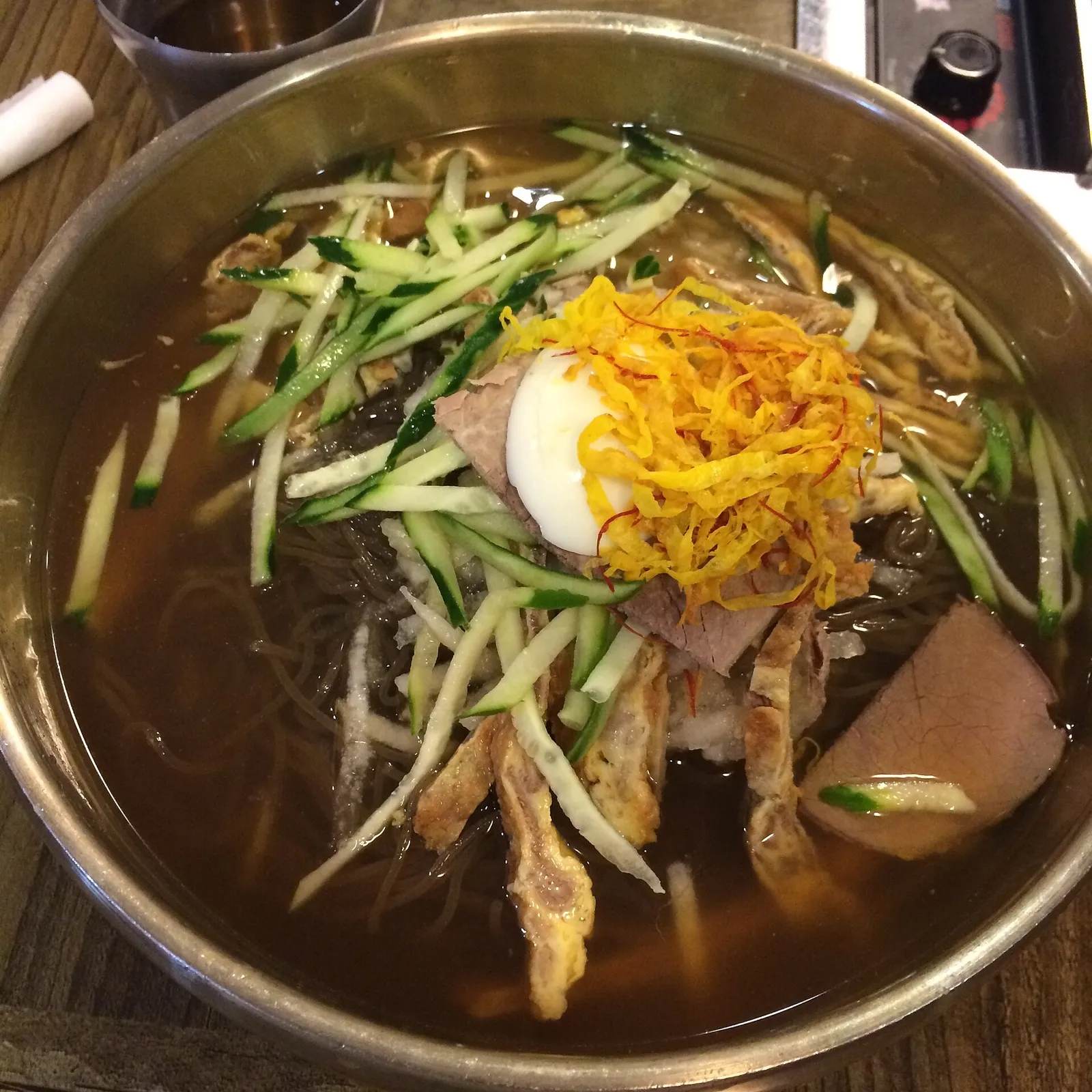
Jinju does not have a long list of local dishes. It has two very sharp ones, a cold noodle dish and a bibimbap, and both differ at the ingredient level from the versions sold elsewhere in Korea. This post summarises what Jinju City Hall and the Encyclopedia of Korean Culture publish; it contains no prices or opening hours, and the practical notes at the end explain why.
Jinju naengmyeon: the broth is seafood
In one sentence, Jinju naengmyeon is buckwheat noodles in a seafood broth, and that is the line separating it from the two famous northern versions.
Pyongyang naengmyeon is built on beef and beef-bone stock, cut with the brine of dongchimi radish water kimchi. Hamhung naengmyeon uses chewy potato-starch noodles and is tossed with raw skate in chilli sauce. Jinju naengmyeon is neither. Its stock is simmered from seafood: anchovy, clam, dried mussel and dried pollack.
The exact list varies by source. City Hall writes anchovy, manila clam, dried mussel and dried pollack plus shiitake; the Encyclopedia of Korean Culture lists dipori dried gizzard shad, anchovy, mussel, clam and hwangtae freeze-dried pollack; the Digital Jinju Cultural Encyclopedia adds sea cucumber, abalone and a beef stock alongside. What all three agree on is anchovy, shellfish and dried fish. Both encyclopaedias also record the same trick for killing the fishy smell: red-hot cast iron dropped into the boiling stock.
The topping most associated with the dish is yukjeon, thin slices of beef in egg batter, pan-fried. It needs a note: the Encyclopedia of Korean Culture describes yukjeon as a modern addition, not something that went on the bowl in the old days. The noodles are the same kind of story — City Hall says pure buckwheat, both encyclopaedias say sweet potato or mung bean starch is blended in today.
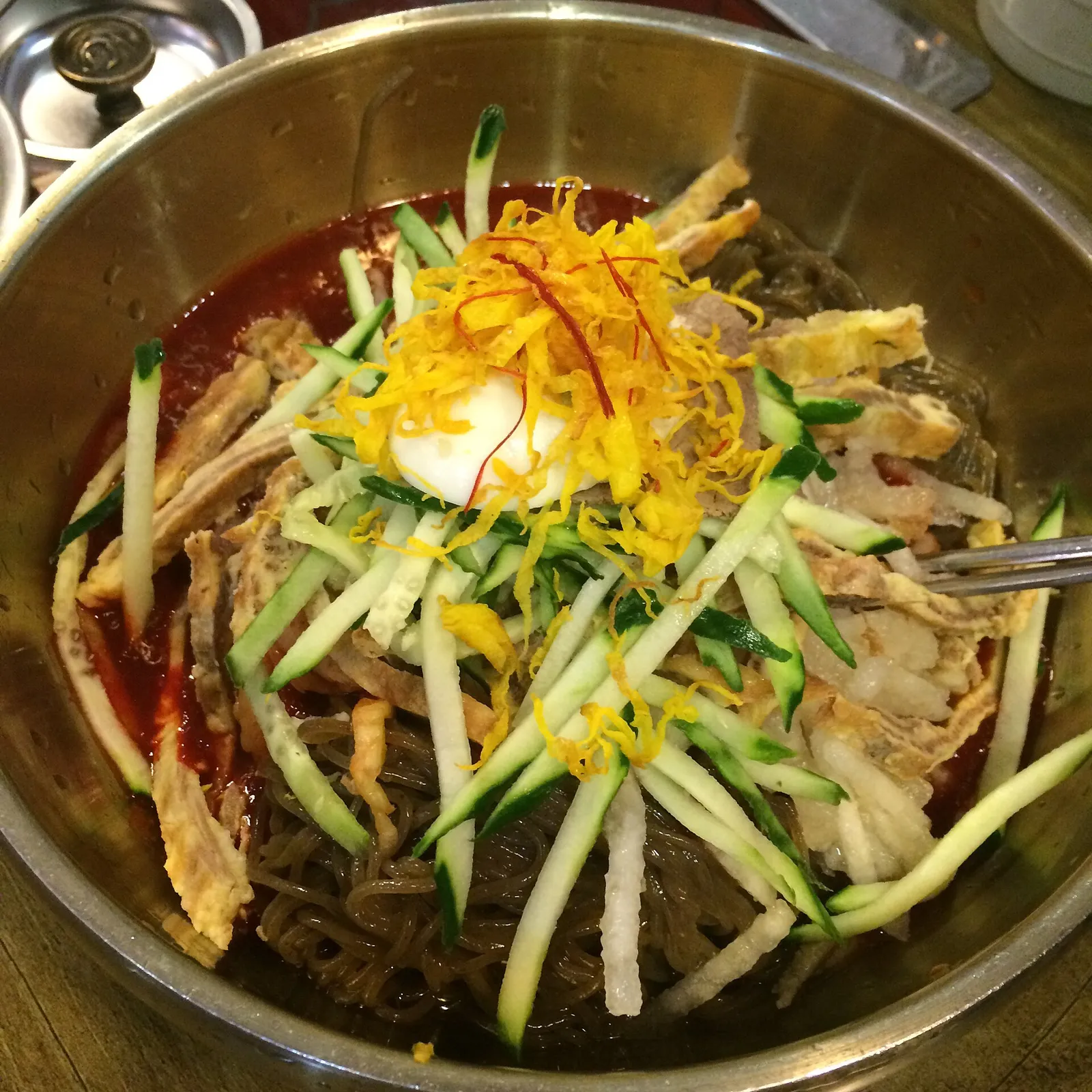
A dish that was broken, then brought back
This is the best-documented part of the story. Until the mid-1960s it was sold at places like Sujeong Sikdang, Pyeonghwa Sikdang and Eunha Sikdang, seven or eight of them around Okbong-dong. Then the line was broken by the Jungang Market fire of January 1966. The dish was recreated in 1999 and restored, the encyclopaedia says, on the back of the naengmyeon boom of the 2000s.
So what you eat in Jinju today is a dish revived about thirty years ago, not an unbroken tradition. Going looking for a hundred-year-old shop is the wrong frame for it.
One correction while we are here. The claim that the Dongguksesigi of 1849 records Jinju naengmyeon is false: what that text records is naengmyeon in general, not the Jinju version. The slogan “Pyongyang naengmyeon in the north, Jinju naengmyeon in the south” is likewise quoted without any source, by City Hall and the encyclopaedia alike.
Jinju bibimbap: raw beef on top, soup on the side
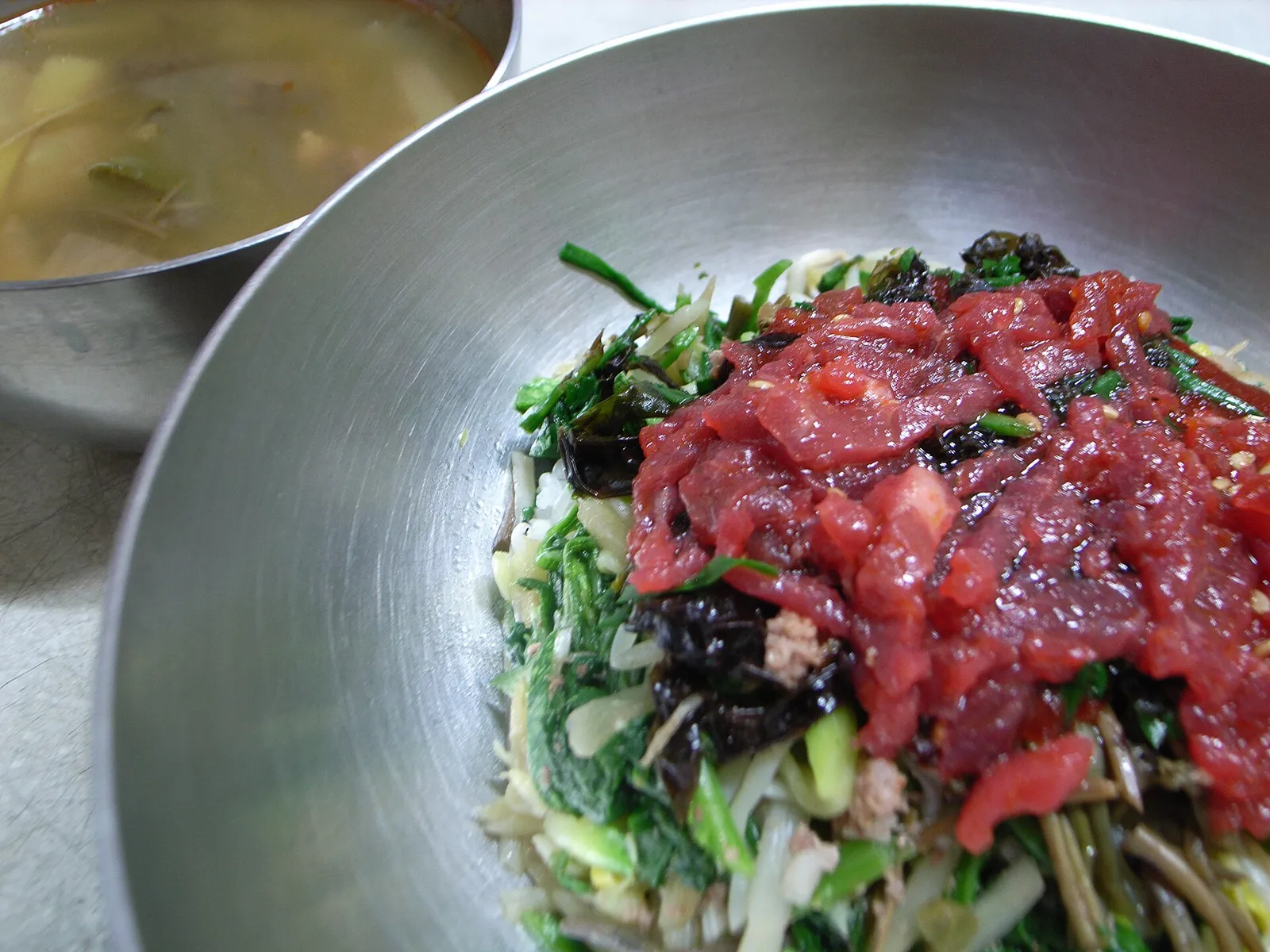
Its other name is chilbohwaban, flower rice, because seasonal vegetables arranged in a round brass bowl make the shape of a seven-coloured flower. Four things separate it from Jeonju bibimbap.
- Yukhoe is mandatory. Beef top round, finely cut and dressed with sesame salt, garlic and sesame oil. A component of the dish, not an option.
- The rice is cooked in beef broth, simmered from beef bone or brisket, in place of water.
- It uses yeot-gochujang, a separately made chilli paste locals call yeotkkojang.
- A soup comes on the side: seonjiguk, a broth long-simmered from lean beef, ox blood curd, liver, lung, omasum and offal with radish, bean sprouts and spring onion. That is the separate bowl on the left in the photo above.
Alongside comes botangguk, manila clams chopped fine, fried in sesame oil and simmered down with water. The vegetables are bean sprouts, mung bean sprouts, crown daisy, radish, bracken and a rock laver known locally as ssokdaegi, and one unusual instruction survives in the method: they are dressed by hand until a milky liquid runs out between the fingers.
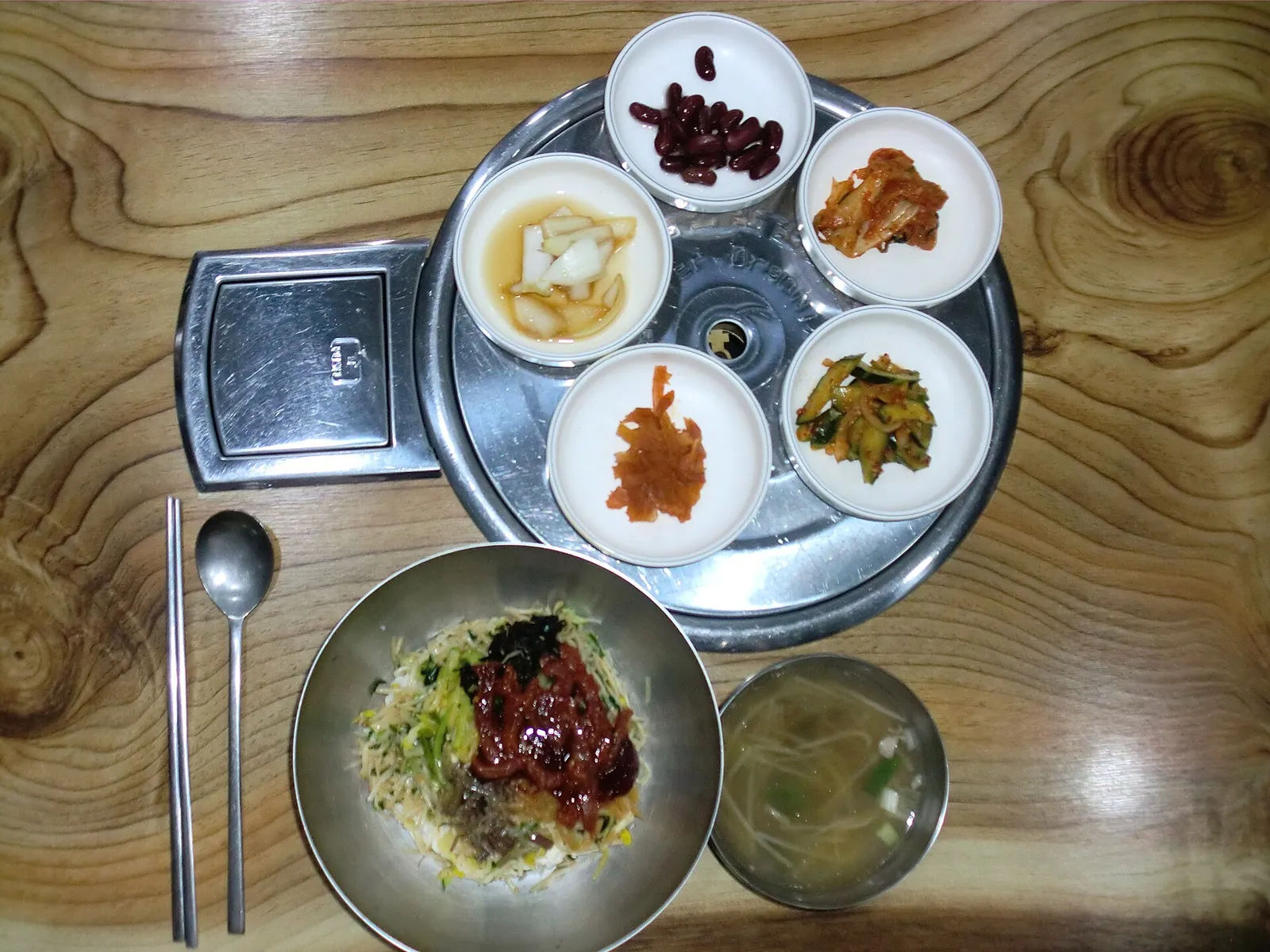
The origin is explained through eumbok, eating food from an ancestral rite: rice from the ritual table tipped into a big bowl, mixed with vegetables and shared out. City Hall adds that “there is a record” of ministers travelling a thousand li from Hanyang to Jinju to eat bibimbap in King Taejong’s reign — but it does not say which record, and the claim appears in neither encyclopaedia.
The other three
City Hall officially classifies five dishes as local specialities; three more join the two above.
Heot-jesabap is an ancestral-rite meal served when there is no rite: three jeok skewers, three tang soups, three-coloured namul, plus kimchi, yukjeon, croaker, rice and soup. City Hall tells of Joseon scholars who faked a rite to justify a late-night meal; the encyclopaedia, citing the Korean Folklore Comprehensive Survey Report, records it instead as a late-night dish sold by restaurants in modern Jinju — the version with documentary backing.
Jinju jangeo, eel, began about fifty years ago on platforms under the Namgang bridges. A dozen places clustered near the fortress entrance until they were cleared in 2016 for the Jinju Daecheop Square project. Two strands: South Sea conger and freshwater eel.
Jinju gyobang cuisine and hanjeongsik are banquet spreads from the city’s gyobang entertainment-house culture, using South Sea seafood and Jirisan mountain vegetables.
Where to eat
Jinju has no designated food street. What City Hall does instead is publish restaurant names and addresses directly, so working down that list is the surer approach — the four City Hall links in the sources above are those pages.
For markets, Jungang Market is the reference point: opened 1884, at 8-1 Jinyangho-ro 547beon-gil, with a food alley and live fish market in its zone 3. That description dates from 2006, so the current scale and hours may differ. Most shops were rebuilt after the 1966 fire. Across the road, on the site of the old Jinju Theatre, is the pedestrianised Rodeo Street.
Dietary notes, honestly
Jinju is not an easy city for restricted diets, and it is better to know that first.
- Jinju bibimbap cannot be made vegetarian. Leave off the yukhoe and the rice itself is still cooked in beef bone or brisket stock, and a blood soup comes with it.
- Jinju naengmyeon is not vegetarian either, but City Hall states explicitly that it uses no pork, which makes it a confirmed option for anyone avoiding pork specifically. Beef yukjeon and, by some sources, beef stock are still in the bowl.
- Jinju jangeo is fish-based, so it also works for anyone avoiding pork.
- No halal-certified or dedicated vegetarian restaurant appears anywhere in the city’s material.
Practical notes
- No prices are published. City Hall’s restaurant pages give the name, address, phone number, signature dish and seat count, and stop there; for hanjeongsik they simply say “varies by season and amount, please call”. That is why this post has no prices in it.
- Opening hours are the same story. The only one in official material was the Jungang underground arcade’s closing day, the last Sunday of each month. So call before you go — the numbers are on the City Hall pages.
- Naengmyeon is known as a summer dish, but some shops sell it year-round.
- The five-day markets, which trade only on dates ending in set digits: Munsan on the 4th and 9th, Geumgok and Daegok on the 1st and 6th, Ilbanseong on the 3rd and 8th.
Wrapping up
One meal in Jinju: the naengmyeon. Two: add the bibimbap. Both differ in their ingredients from the dishes sold under the same names elsewhere, which is a clear reason to eat them here.
Adjust one expectation, though. Jinju naengmyeon is not a case of seeking out a century-old restaurant. It is a dish that was broken and brought back, and knowing that changes how it tastes.
More in this series: the Jinju travel guide, where to stay and what to see.