 Now, Yeogi
Things to Do in Seochon: A Valley Dug Out From Under an Apartment Block (2026)
What there is to see in Seochon, set out from official sources: the valley that lay under an apartment block from 1971 until 2011 and the stone bridge found when it came down, a literature house built inside an abandoned water tank, and the fact that every venue here closes on a Monday.
Places in this post
- Address
- 179-1 Ogin-dong and neighbouring lots, Jongno-gu, Seoul
- Menu
- Official status Seoul Natural Heritage No. 6 (11 July 2024) · Admission Free
- Tip
- The Ogin Model Apartments covered the valley from 1971 until they were demolished in 2011 and the valley was recovered. Take the village bus from exit 3 of Gyeongbokgung Station.
- Address
- 119 Changuimun-ro, Jongno-gu, Seoul
- Hours
- 10:00-18:00 (last entry 17:30); closed Mondays, 1 January, and on Seollal and Chuseok day
- Menu
- Admission Free
- Tip
- It was made from an abandoned water pressure station and water tank. About 10 minutes by bus from exit 3 of Gyeongbokgung Station.
- Address
- 34 Ogin 1-gil, Jongno-gu, Seoul
- Hours
- Tuesday to Sunday 10:00-18:00 (entry until 17:30); closed Mondays
- Menu
- Admission Adult 3,000 won; youth 1,800 won; child 1,200 won
- Tip
- The house was built around 1937 and is Seoul Cultural Heritage Material No. 1. Wear hanbok and you get 50% off.
The things to see in Seochon have something in common. Many of them were built for something else and converted.
A water tank became a literature house, and an apartment block was pulled down to recover a valley.
Suseong-dong Valley
From 1971 to 2011 there was an apartment block on top of this valley. The Ogin Model Apartments.
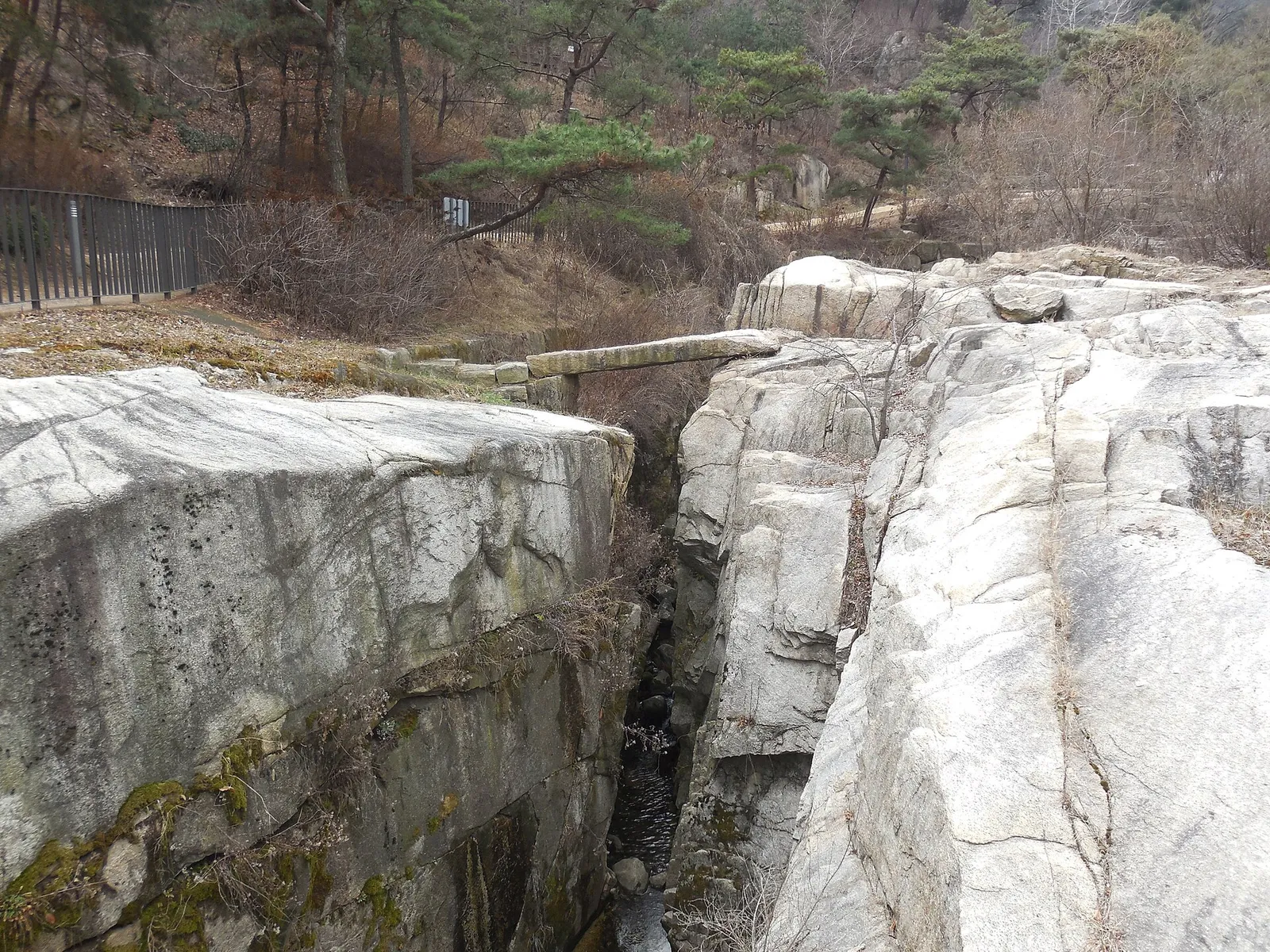
It was demolished in 2011 and the valley restored, and in the course of that work a stone bridge was found. Giringyo.
Here is the Korea Heritage Service’s stated reason for designation.
The area of the present Ogin Apartments was Suseong-dong in the Joseon period … it appears in the painting Suseong-dong by Jeong Seon, art name Gyeomjae, and since the scene of that time survives unchanged to this day it is worth preserving as a “traditional place of scenic beauty”. … The stone bridge spanning the lower part of the valley also appears in Gyeomjae Jeong Seon’s painting, and as the longest single-stone bridge preserved in its original position anywhere inside the old city walls it is of great value in the history of bridge building.
“The longest single-stone bridge preserved in its original position anywhere inside the old city walls.” That is the bridge in the photograph above.
Gyeomjae Jeong Seon painted this spot in the 18th century, and the bridge in that painting lay buried under an apartment block until it came back out 40 years later.
The designation changed in 2024
To put it exactly: it was Seoul Monument No. 31 (designated 21 October 2010), and on 11 July 2024 that designation was cancelled and it was re-designated the same day as Seoul Natural Heritage No. 6.
The system changed; it was not a demotion. Plenty of older articles still call it “Monument No. 31”, which is why it is worth noting.
It is free, and you get there on the Bus 9 Jongno 09 village bus from exit 3 of Gyeongbokgung Station. You can also walk up.
Yun Dong-ju Literature House
It was made from an abandoned water pressure station and water tank. Here is the Jongno Foundation for Arts and Culture’s description.
The Yun Dong-ju Literature House is the meaningful transformation of the Cheongun water pressure station and water tank, which had been left abandoned on the slopes of Inwangsan A pressure station is a facility that applies pressure to a slowing flow of water so that it runs strongly again
The names of the exhibition rooms are good.
- The Poet’s Room - photographs and facsimiles of manuscripts in his own hand
- The Open Well - the decommissioned water tank converted into a roofless courtyard
- The Closed Well - the circular water tank left as it was, used for film screenings
The reason it is here is that Yun Dong-ju, as a student at Yonhi College, lodged in Nusang-dong and climbed Inwangsan to work on his poems.
- Free
- 10:00-18:00 (last entry 17:30)
- Closed Mondays, 1 January, and on Seollal and Chuseok day
- Opened in 2012; a Seoul Architecture Award in 2014
This is not somewhere you walk to. It is about 10 minutes by bus from exit 3 of Gyeongbokgung Station. Get off at the Jahamun-gogae stop.
Park No-soo Art Museum
It is run by Jongno-gu, and the house was built around 1937. The painter Park No-soo lived in it from 1973.
It is Seoul Cultural Heritage Material No. 1, designated on 30 May 1991. “No. 1” catches the eye.
- Adult 3,000 won (about $2.25), youth 1,800 won, child 1,200 won
- Tuesday to Sunday 10:00-18:00 (entry until 17:30)
- Closed Mondays
- 50% off if you wear hanbok
It is one of the few places in Seochon you pay to enter.
Yi Sang’s House
It stands on the site of the house where the poet Yi Sang lived for nineteen years, from the age of three. It is now a cafe and exhibition space.
It is Seoul Future Heritage 2013-215. One point to get right, though. It was Registered Cultural Heritage No. 88 until that was cancelled on 23 June 2008. There is no cultural heritage designation now; only the Seoul Future Heritage listing stands.
Here is the Seoul Future Heritage description.
Yi Sang was adopted at the age of three by his uncle Kim Yeon-pil, and lived for 19 years in his uncle’s house here until he left it in 1932.
It opened in 2012 and was refurbished in 2018. It shows Yi Sang’s poems and fiction, his letters and his drawings.
The other places Jongno-gu runs
All of them close on Mondays.
- Sangchonjae - a traditional culture space converted from a hanok
- The Hwanghakjeong traditional archery exhibition hall - an archery ground and exhibits on Korean archery
- Cheongun Literature Library - a library in a hanok
- The Inwangsan forest rest area
Inwangsan and the Seoul City Wall
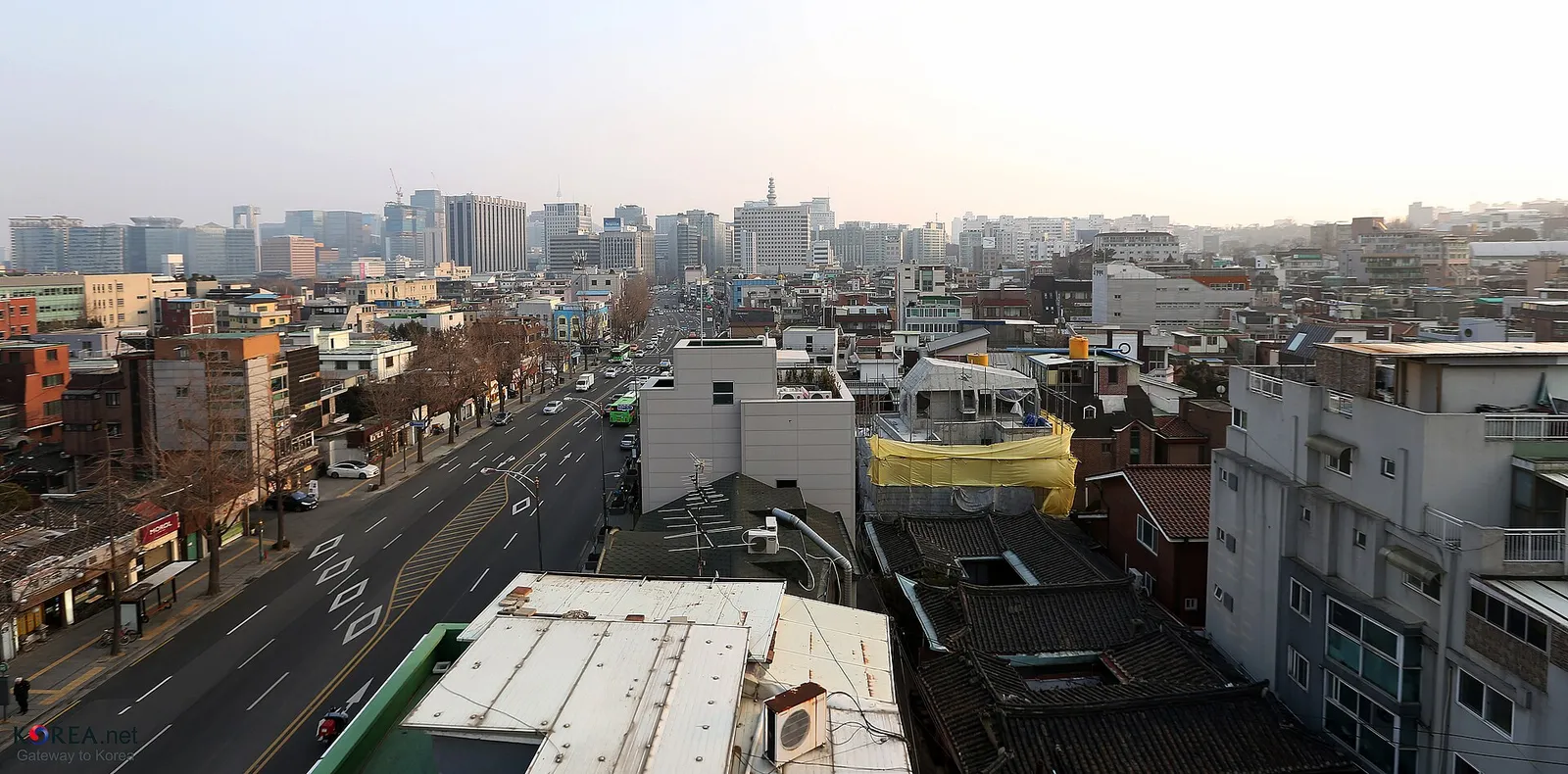
Inwangsan rises behind Seochon, and the Seoul City Wall runs along the ridge.
Here I should correct something I had wrong at first. Inwangsan opened fully in 2018, not 2022. It was partly opened in 1993, and in 2018 the military posts and perimeter installations were removed.
- The Inwangsan section is open 24 hours
- You do not need ID
That said, the Inwangsan Gokseong, the curved bastion section, is still a military facility and entry is prohibited.
Sajikdan Altar
At the southern end of Seochon. It is Historic Site No. 121, and its main gate is Treasure No. 177, both designated on 21 January 1963.
This is where Joseon held rites for the gods of earth and grain. If Gyeongbokgung was the king’s space, this was where the foundations of the state were prayed for.
It is open all year round and free, which makes it the Monday alternative.
Keep Monday and Tuesday straight
This is the most practical thing to know in Seochon.
| Closed | |
|---|---|
| Seochon venues (Yun Dong-ju Literature House, Park No-soo Art Museum, Sangchonjae, Hwanghakjeong, Cheongun Literature Library) | Mondays |
| The palaces (Gyeongbokgung, Changdeokgung, Changgyeonggung, Deoksugung) | Tuesdays |
| Sajikdan Altar | Always open |
| Suseong-dong Valley and Inwangsan | Always open |
Come to Seochon on a Monday and almost everything indoors is shut. The valley, Inwangsan and Sajikdan are open instead.
Gyeongbokgung closes on Tuesdays, so Seochon becomes the alternative that day. Use the difference when you are stringing the two together.
What could not be verified
No official basis could be found for the claim that Daeo Bookstore is “the oldest bookshop in Seoul”. All 499 Seoul Future Heritage entries were checked and it is not listed, nor does it hold any cultural heritage designation. Its opening hours and how it operates now could not be confirmed from official sources either, so they are not written here.
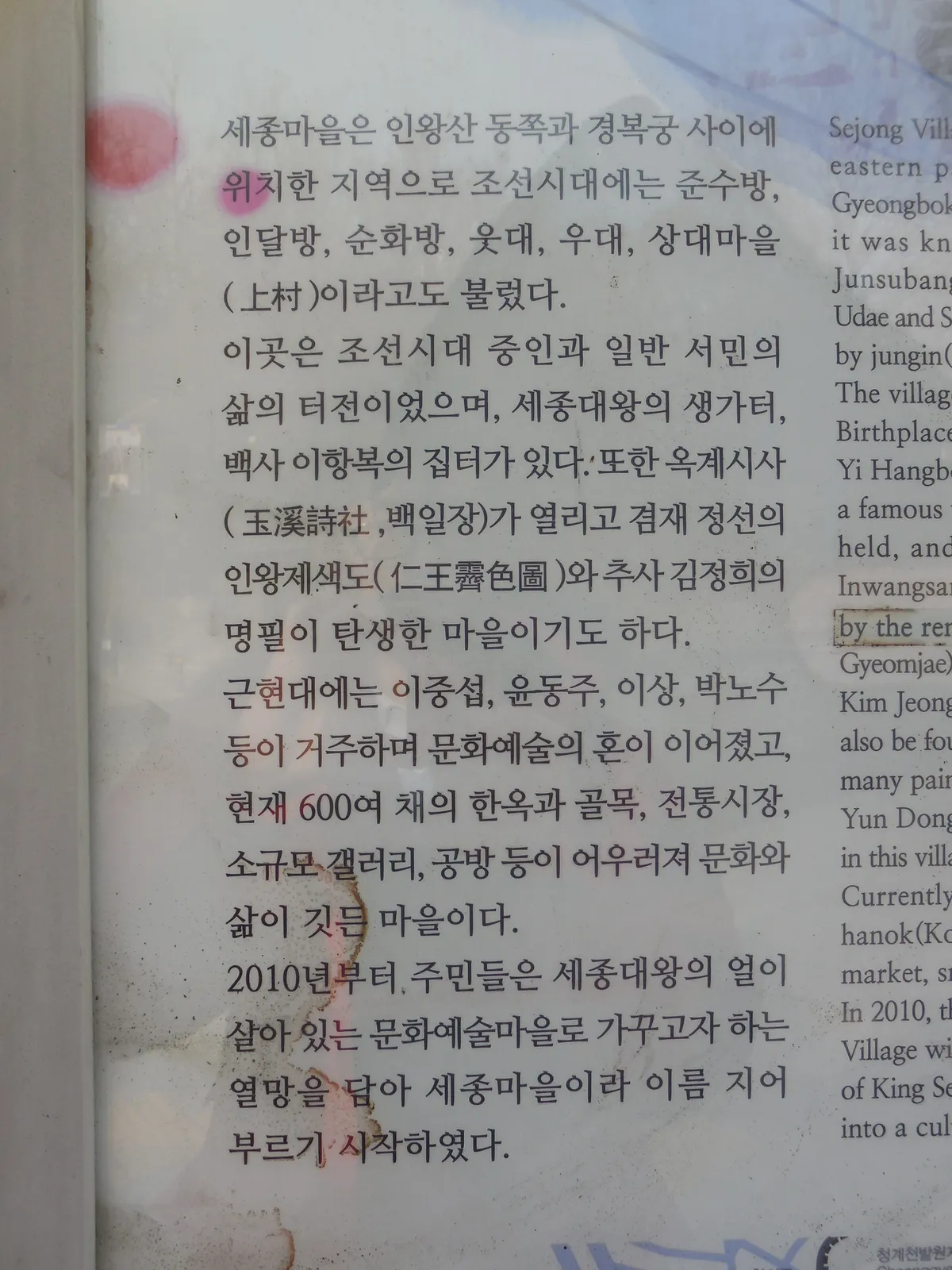
For the official number of hanok in Seochon, the information board on site says “some 600”, but that could not be confirmed against a city document.
Wrapping up
- Suseong-dong Valley lay under an apartment block from 1971 and was recovered in 2011. Giringyo is “the longest single-stone bridge preserved in its original position anywhere inside the old city walls”.
- On 11 July 2024 the designation changed to Seoul Natural Heritage No. 6.
- The Yun Dong-ju Literature House is a converted water tank, free, closed Mondays.
- The Park No-soo Art Museum is 3,000 won, half price in hanbok.
- Yi Sang’s House is Seoul Future Heritage; the registered cultural heritage designation was cancelled in 2008.
- Inwangsan opened fully in 2018, is open 24 hours and needs no ID.
- Seochon’s venues close on Mondays, the palaces on Tuesdays.
More in this series: the Seochon overview, Seochon food and where to stay in Seochon