 Now, Yeogi
Korea's Autumn Foliage in 2026: The Official Peak Forecast Is Out
On 22 September 2026 the Korea Forest Service published its 2026 foliage peak prediction map. Here are the official peak dates mountain by mountain, where the dates that were circulating before that came from, how to work out your own timing from the rule that foliage starts at Seoraksan and moves south 20–25 km a day, and which national park trails need a reservation in foliage season.
Places in this post
- Address
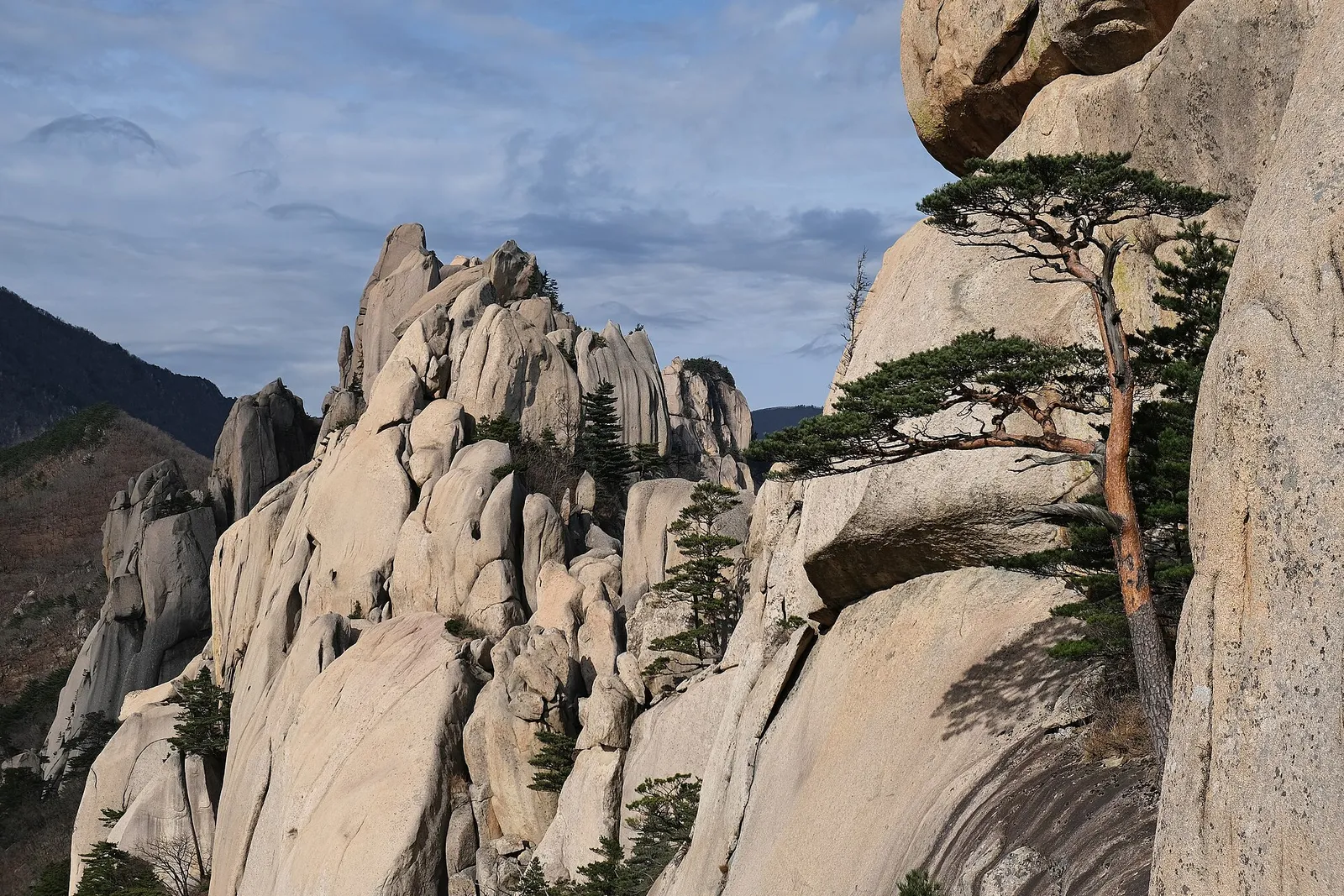
- 1091 Seoraksan-ro, Sokcho, Gangwon State (Sogongwon entrance)
- Hours
- Heullimgol trail reservation system 1 October – 30 November 2026 · 08:00–15:00 in October, 09:00–14:00 in November
- Menu
- Admission Free (abolished on 1 January 2007)
- Tip
- Heullimgol is a reservation-only section running a designated entry-time system with a cap of 5,000 people a day. Any places left over are issued on the spot at the Heullimgol visitor support centre.
- Address
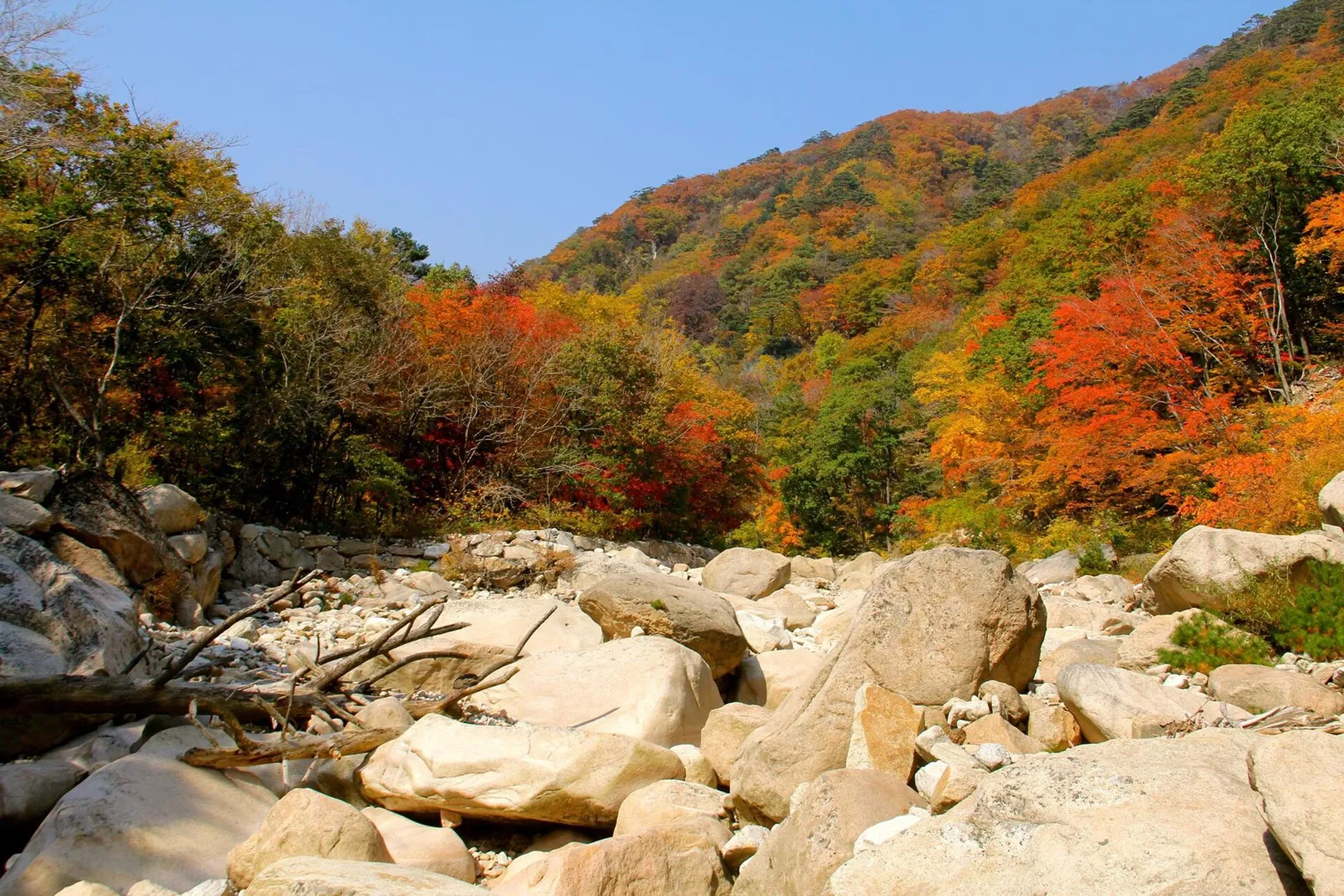
- 936 Naejangsan-ro, Jeongeup, Jeonbuk State
- Hours
- Seoraebong and Gatbawi trail reservation system 18 October – 16 November 2026
- Menu
- Admission Free · the Naejangsa temple fee was also abolished on 4 May 2023
- Tip
- The Korea Forest Service's 2025 prediction put peak foliage at Naejangsan on 6 November, almost two weeks later than Seoraksan.
If you are thinking of coming to Korea for the autumn foliage, there is something you need to know first.
On 22 September 2026 the Korea Forest Service published its 2026 Korean Peninsula Autumn Foliage Peak Prediction Map. Those are this year’s official government figures. The dates that had been going round online until then — Seoraksan on 30 September, or 3 October — were forecasts from private weather companies, and the companies did not even agree with each other.
This post sets out the official figures, and also how to judge the timing without leaning on a single date.
These are the only numbers that exist right now
Two private forecasters have published.
| Weatheri (published 4 September) | Kweather (published 11 September) | |
|---|---|---|
| Seoraksan first foliage | 3 October | around 30 September |
| Seoraksan peak | 25 October | 19 October |
| Central region peak | 31 October – 5 November | 19 October – 1 November |
| Southern region peak | 5–13 November | 1–11 November |
As you can see, for the same mountain they are three days apart on first foliage and six days apart on peak. Neither is a government figure.
Weatheri put it this way.
Daily average temperatures in September and October are expected to be above normal, so first foliage is expected to be later than usual
If you are booking flights to a specific day or two, do not lean on these numbers. Plan a range instead.
The official figures are out
The Korea Forest Service publishes a forest foliage prediction map every year, produced jointly by the Korea National Arboretum, the public arboretums around the country and the National Institute of Forest Science.
Here is when it has appeared.
- 2024 — 23 September
- 2025 — 1 October
- 2026 — 22 September, under the title “Red maples, yellow ginkgos: when does autumn peak on the Korean peninsula?”
The key sentences of the press release.
By species, the forecast is maples 31 October, oaks 31 October and ginkgos 30 October.
By mountain, the forecast is Seoraksan 20 October, Songnisan 28 October, Naejangsan 4 November, Hallasan 6 November and so on. Set against the peak foliage timing of the last five years, that works out about 0.8 days later.
Note the wording. It says 0.8 days later than the last five years, not later than normal. That is less than a single day. Some outlets rendered it as “later than usual”, but the original phrase is 최근 5년간 — the last five years.
The KMA works differently. It does not issue an advance forecast; it reports observations after the fact. Last year it put out a release headed “foliage begins at Seoraksan today, the 2nd” on the actual day it started. In other words, by the time the KMA announces something, it has already happened.
Use the rule, not a date
Korean foliage moves fairly predictably. Three things are enough.
One, it starts at Seoraksan. Seoraksan turns first every year, usually in late September.
Two, it moves south at 20 to 25 km a day. That is the speed given in Weatheri’s own release. It is why Seoraksan and the south of the country are close to a month apart.
Three, it takes two to three weeks to go from first foliage to peak. In the published figures for Seoraksan the gap has been 19 to 22 days.
On top of that, mountains turn from the top down. When the summit is at its peak, the entrance is often still green.
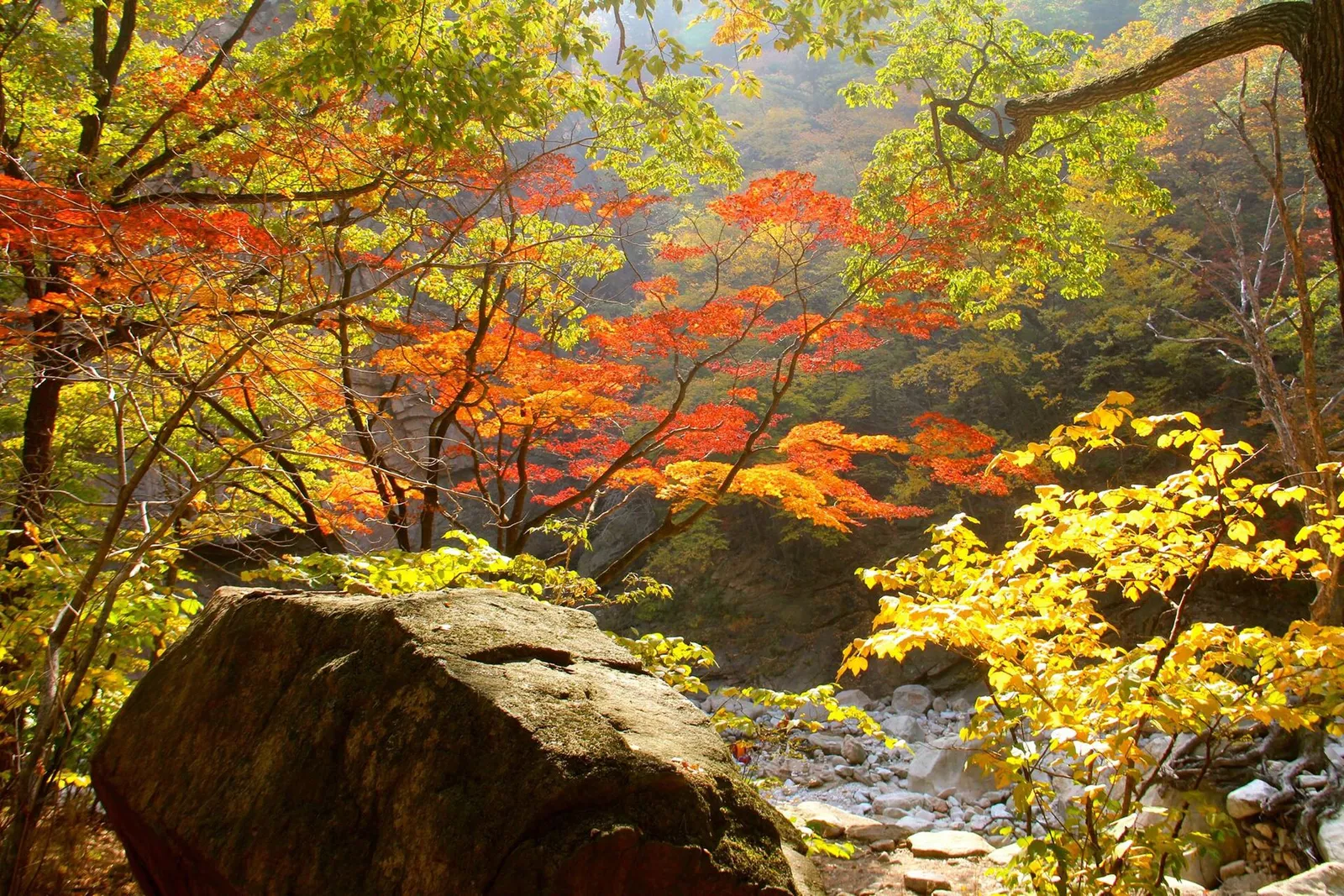
How far apart the mountains are
These are the per-mountain peak dates in the Korea Forest Service’s 2026 prediction map. The basis is the date on which each species reaches 50 percent turned.
| Mountain | Maples | Oaks | Ginkgo |
|---|---|---|---|
| Seoraksan | 20 October | 25 October | — |
| Hwaaksan | 20 October | 23 October | 21 October |
| Sobaeksan | 20 October | 16 October | — |
| Jeombongsan | 21 October | 21 October | — |
| Yongmunsan | 23 October | 24 October | 29 October |
| Juwangsan | 26 October | 6 November | 29 October |
| Jirisan | 27 October | 25 October | 26 October |
| Songnisan | 28 October | 30 October | 23 October |
| Palgongsan | 30 October | 1 November | — |
| Gyeryongsan | 1 November | 28 October | 25 October |
| Surisan | 2 November | 3 November | 4 November |
| Naejangsan | 4 November | 26 October | — |
| Byeonsanbando | 4 November | — | — |
| Hallasan (the 1100-ro station) | 6 November | 25 October | — |
| Wolchulsan | 9 November | 11 November | 28 October |
| Duryunsan | 11 November | — | — |
Seoraksan and Duryunsan are 22 days apart. There is no single block of time called the Korean foliage season; the colour moves south over more than three weeks.
The national averages are 31 October for maples, 31 October for oaks and 30 October for ginkgos. Those are separate numbers from the per-mountain ones.
A dash means that species’ map has no station at that mountain. Nothing has been invented. And Odaesan, Chiaksan, Bukhansan, Mudeungsan, Woraksan and Deogyusan are not observation points on this year’s map at all.
Why this year is expected to be late
These figures come from the KMA’s summer 2026 climate report, published on 3 September. This part is official.
- National average temperature 25.4°C, 1.7 degrees above normal — the third highest since 1973
- 21.5 days of heatwave (normal: 10.6)
- 18.2 tropical nights — the second highest on record
- Daily highs of 39°C or more on 42 occasions, the most since 2010
Leaves turn when temperatures drop, so a hot autumn delays the colour. One caveat, though. The KMA has never announced that this year’s foliage will be late. Every forecast of a delay comes from a private company.
The observed record shows the trend.
| Year | Seoraksan first foliage |
|---|---|
| 2021 | 28 September |
| 2022 | 28 September |
| 2024 | 4 October (six days later than normal) |
| 2025 | 2 October |
2023 is left out because its official record could not be confirmed. If 2024’s 4 October was “six days later than normal”, the normal date is around 28 September. The Korea Forest Service’s own material also notes that peak dates have shifted 4 to 5.2 days later than the average of the past decade.
It costs almost nothing
This part is good news.
National park admission fees were abolished on 1 January 2007. It is there in the park service’s own history page. There is nothing the park service charges you to walk in today.
The temple cultural heritage viewing fees, which lasted much longer, were abolished on 4 May 2023. The Naejangsan National Park Office is unambiguous.
As of 4 May 2023 the cultural heritage viewing fee has been abolished, and no admission fee is collected at Naejangsa temple
The same goes for Woljeongsa at Odaesan. From the Odaesan National Park Office.
The cultural heritage viewing fee was abolished as of 4 May 2023, and only parking fees are currently collected.
Not all of them, though
One exception is worth knowing about. Haeinsa, on Gayasan, still charges ₩3,000 (about $2.25) for adults. Both the temple’s own website and Hapcheon County’s official page, updated in 2025, say so, even though Haeinsa appears on the 2023 exemption list. What the charge is formally called could not be confirmed from an official source.
Two others sit in between. Hwaeomsa at Jirisan and Beopjusa at Songnisan are on the exemption list, but no statement from the temples themselves saying admission is free could be found. In policy terms it looks abolished; this post will not assert more than that.
So what is left is parking, plus a cable car fare if you take one. For anyone walking in, it is effectively free.
No cable-car discounts in foliage season
If Seoraksan’s Gwongeumseong cable car is part of your plan, three things to know.
It is ₩16,000 (about $12) return for adults and ₩12,000 (about $9) for children, sold same-day at the counter only — there is no online booking and no one-way ticket.
The operator’s notice also sets out a no-discount period.
19 September 2026 to 15 November 2026. Please note that discounts do not apply during this period.
That is the whole foliage season. Senior and Sokcho-resident discounts do not apply while you are likely to be there.
And there is no fixed timetable. The operator says hours change with the season and the weather, and that you should check the times posted fresh each day at the top of its homepage.
Some places need a reservation
Not everywhere — only certain sections. But they happen to be exactly the sections that open in foliage season.
Heullimgol at Seoraksan
Straight from the notice.
- Operating period 1 October to 30 November 2026
- Route: Heullimgol visitor support centre to Yongso Samgeori, 3.1 km one way, one-directional, 2 hours 30 minutes
- Capacity 5,000 people a day, on a designated entry-time system
- Hours 08:00–15:00 in October, 09:00–14:00 in November
- Bookings close at 14:00 the day before
Entering without a reservation is a fineable offence under the Natural Parks Act.
Seoraebong and Gatbawi at Naejangsan
Based on the notice of 7 September 2026.
- Operating period 18 October to 16 November 2026
- Seoraebong route 2.8 km, 520 people a day
- Gatbawi route 6.3 km and 3 hours, 790 people a day, with on-site sign-up closing at 13:00
Odaesan needs no reservation
Choose Odaesan in the reservation system and it returns “no trails registered”. Woljeongsa, Sangwonsa, the Seonjae Path and Birobong are all simply walk-in. If the booking is the part you want to avoid, Odaesan is the answer.
Foreign visitors: read this part
The national park reservation system has a separate English portal, and you can register without a Korean mobile number.
The English sign-up screen asks for this and nothing else.
First name / Last name / E-mail (ID) / Password / Birthday / Sex
No phone verification, no Korean resident registration number. The Korean-language sign-up, by contrast, runs to five steps, and step three is identity verification — which blocks you if you have no Korean phone.
Payment is covered in the English FAQ.
When making a reservation on our reservaion system, you don’t need to pay and you can pay by cash.
So you can book without a Korean card and pay cash when you arrive.
The English portal has one big limitation
Its menu has only two items, Shelters and Campsites. Trail reservations are not on the English menu at all. That means you cannot book Heullimgol or Naejangsan’s Gatbawi through the English site.
There is a way round it. These are the sections whose official pages state that on-site sign-up is available.
- Heullimgol — leftover places on site, at the Heullimgol visitor support centre
- Naejangsan Gatbawi — on-site sign-up until 13:00
- Naejangsan Seoraebong — on-site sign-up available
- Jirisan Nogodan — on-site sign-up available
- Seoraksan Gombaegol — on-site sign-up available, on the section from the Jeombongsan office up to Gombaeryeong
Only Jirisan’s Chilseon Valley is marked as online-booking-only.
If you want to sleep in a shelter
Since 2025 the mountain shelters have been entirely lottery-allocated. It is not first come, first served.
- October and November places open on 1 October, with the draw announced on 6 October
- Trail reservations are first come, first served, and November opens at 10:00 on 1 October
- 1 October to 15 November is the peak demand period, so the weekend rate of ₩30,000 (about $22.50) applies
Four shelters at Seoraksan can be booked: Socheong, Huiungak, Suryeomdong and Yangpok. Jungcheong shelter is not on the list, because it is being rebuilt. The park office’s reply says only that it aims to complete and open it within this year, without committing to a date. If you are crossing Daecheongbong, book Socheong or Huiungak.
If you are driving
Foliage season brings a few extra rules.
Parking has a peak-season rate. At Naejangsan a small or mid-size car pays ₩4,000 (about $3) on weekdays and ₩5,000 (about $3.75) at weekends and during the peak demand period. That period runs 1 October to 15 November, which is to say the whole foliage season.
The Seorakdong Sogongwon car park and the Gwongeumseong cable car are not park service operations. The park service fee table lists only a phone number for them, so you will have to check the amounts on site.
Free shuttle buses appear. Last year Seoraksan ran one 2.8 km from zones B and C to Sogongwon, and Naejangsan ran one over a 2.1 km stretch from car park 4, both free. The 2026 arrangements have not been announced yet, though. They usually go up between late September and mid-October, so check just before you travel.
Entry hours are fixed
Not knowing this will get you turned back at the gate. Under the designated entry-time system, each trail has set hours during which you may enter. It has been in force across the national parks since 2015.
These are the main Seoraksan trailheads. The rule changes from November, so read the table carefully.
| Route | Summer (April–October) | Winter (November–March) |
|---|---|---|
| Osaek → Daecheongbong | 03:00–12:00 | 04:00–11:00 |
| Biseondae → Madeungnyeong | 03:00–11:00 | 04:00–10:00 |
| Biseondae → Yangpok | 03:00–14:00 | 04:00–12:00 |
| Biseondae → Geumganggul | 03:00–14:00 | 04:00–14:00 |
Climbing Daecheongbong after lunch is not possible. The window shuts in the morning. The legal basis is the Natural Parks Act, and breaking it carries a fine.
In November, which is when the southern mountains peak, the winter rule applies: you can start an hour later and the cut-off comes earlier.
Pages to check before you set out
- Live access control notices — the park service page showing full and partial closures park by park
- Trail congestion — the park service runs a separate congestion page
For what it is worth, Naejangsan has been trialling AI crowd management since last year. It analyses density in real time at congestion points such as the cable car station and the “108 maple tunnel”, and offers translation in ten languages via QR codes on the signboards.
There are almost no foliage festivals
This part may surprise you.
The Naejangsan foliage festival does not appear on Jeongeup City’s official 2026 festival list. The festivals the city lists are the cherry blossom festival, the Donghak Peasant Revolution memorial event, the Jeongeupsa cultural festival, the gujeolcho flower festival, the lifelong learning festival, Citizens’ Day, the water light festival and various village festivals. Naejangsan appears only as a tourist attraction, the Naejangsan autumn foliage road. One was held in 2023, but no official page confirms an edition this year.
The Seoraksan and Daedunsan foliage festivals could not be confirmed either.
Exactly one autumn festival was confirmed from primary text on an official page.
The 19th Jeongeup Gujeolcho Flower Festival runs from Thursday 8 October to Sunday 18 October 2026, eleven days, at the Gujeolcho Regional Garden (571 Maejuk-ri, Sannae-myeon). Admission is ₩7,000 (about $5.25) for adults, ₩5,000 for students, service personnel and seniors, and ₩3,000 for children, with the ticket office open 08:30–17:30. It is a wildflower festival, not a foliage festival.
Which is to say that in Korea, autumn foliage is something you go to a mountain for, not a festival. You do not need to plan around an event calendar.
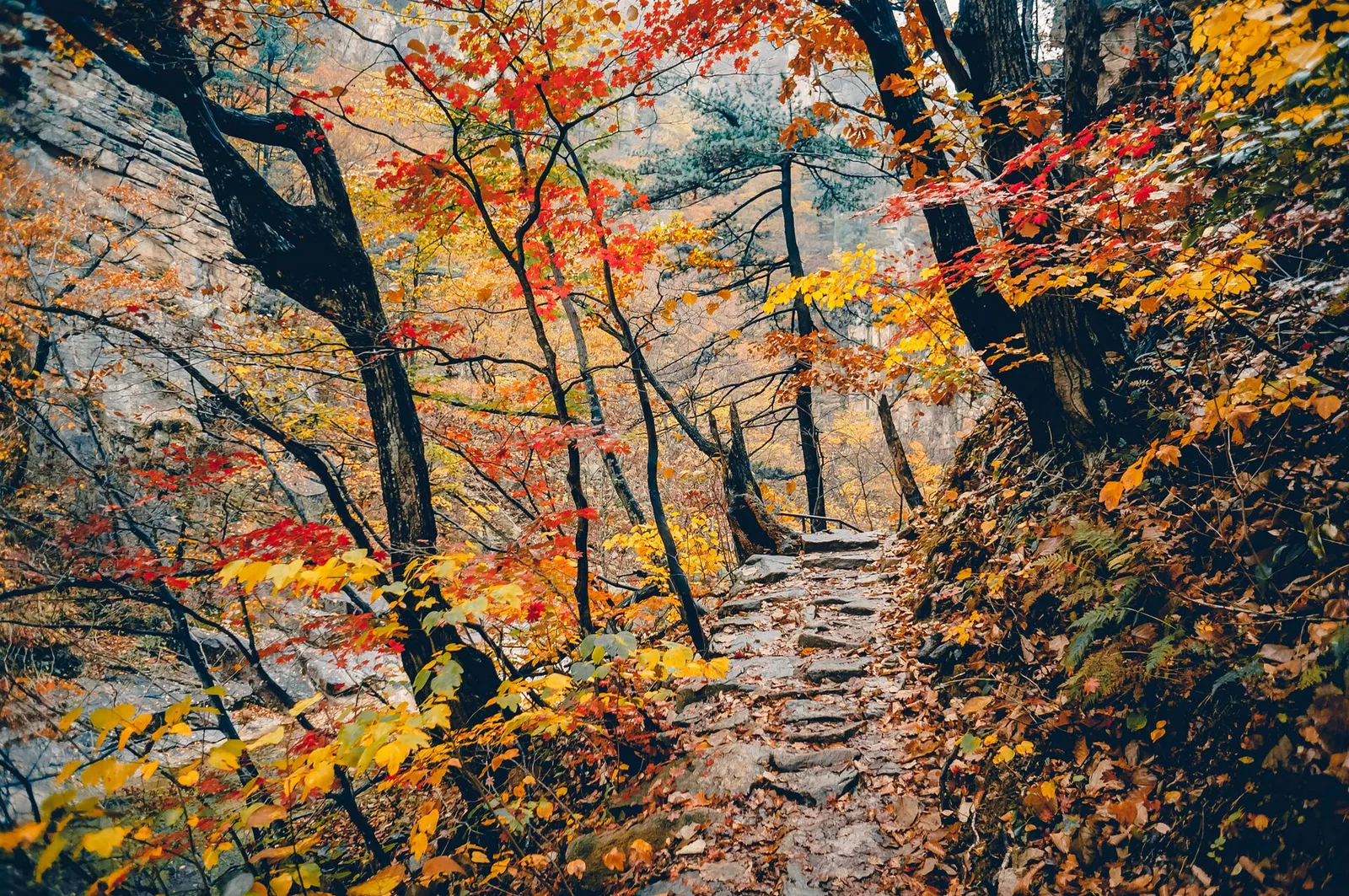
This is what mistiming looks like
The two photographs below are the same place: Uhwajeong Pavilion at Naejangsan.
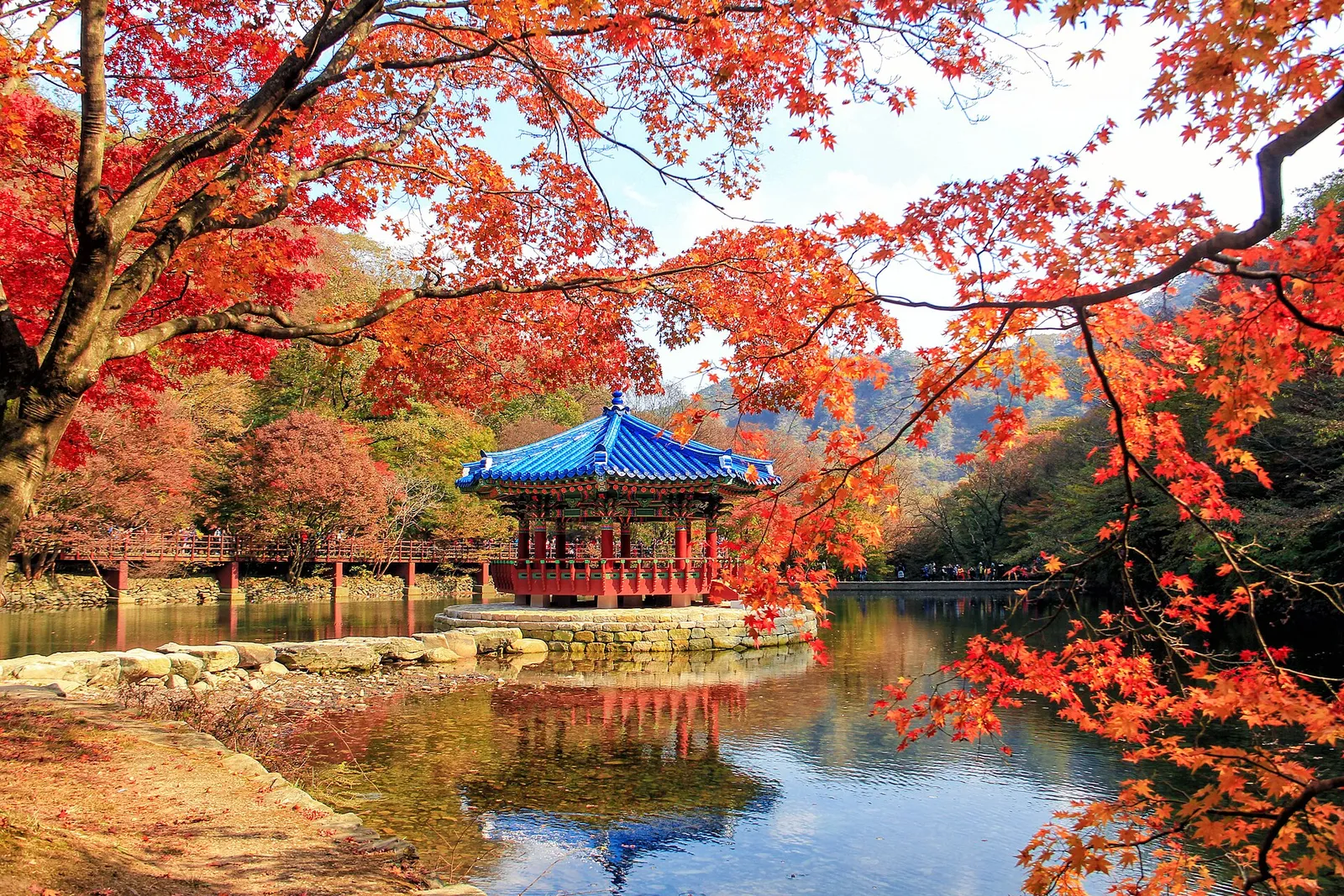
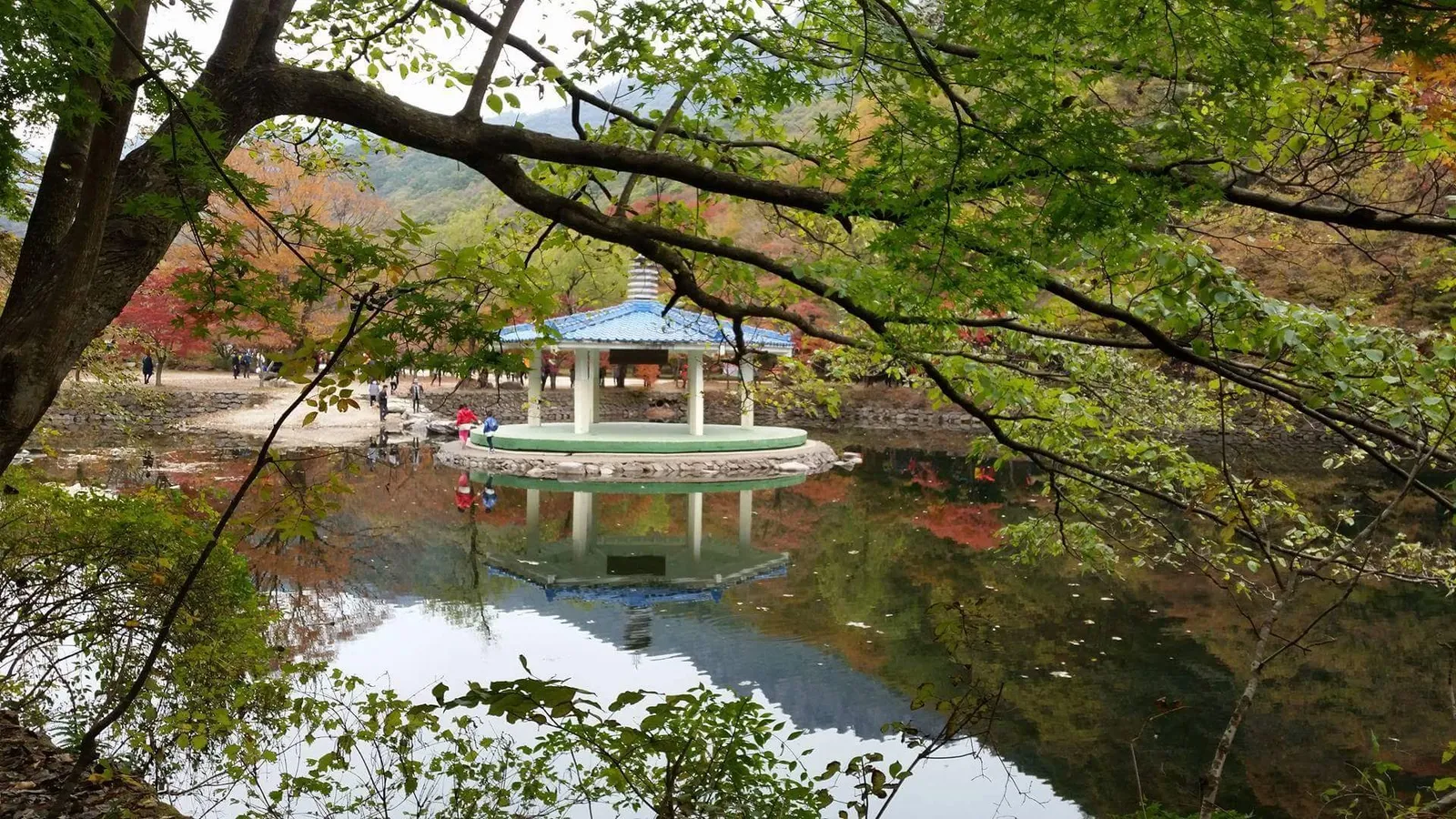
They are a few days to at most two weeks apart. Go in mid-October without knowing that Naejangsan peaks in early November and you get the second photograph. That is what happens when you plan a southern mountain on Seoraksan’s schedule.
What could not be verified
Stated plainly.
First foliage is commonly described as the point when about 20 percent of a mountain has turned, and peak as 80 percent. That definition could not be verified against the primary text of an official KMA page. The KMA’s foliage page is drawn by JavaScript, so the wording could not be extracted.
When the KMA stopped issuing foliage forecasts could not be established either. It is certainly true that it issued none in 2026, and the criteria are still in use. But no source document saying when and by what announcement the forecasts ended could be found.
Year-by-year official dates for Odaesan, Chiaksan, Bukhansan, Gyeryongsan, Jirisan, Mudeungsan and Hallasan could not be obtained. The full list in the Korea Forest Service prediction map sits inside an attachment that could not be accessed.
In short
- The official 2026 government forecast is out. The Korea Forest Service published it on 22 September: Seoraksan 20 October, Songnisan 28 October, Naejangsan 4 November, Hallasan 6 November.
- The dates that were circulating before that were all private forecasts, and the companies disagree.
- Seoraksan starts in late September, the colour moves south 20–25 km a day, peak comes two to three weeks after first foliage, and the south runs to early or mid-November.
- There is no park admission fee, and most temple fees are gone — but Haeinsa still charges ₩3,000.
- The Gwongeumseong cable car is ₩16,000 return, counter sales only, with no discounts in foliage season.
- Heullimgol (1 Oct – 30 Nov) and Naejangsan’s Seoraebong and Gatbawi (18 Oct – 16 Nov) are reservation-only. Odaesan needs no reservation.
- The English booking portal covers shelters and campsites only. For trails, aim for on-site sign-up.
- The designated entry-time system applies. From Osaek, entry to Daecheongbong closes at midday.
- There is essentially no foliage festival. Do not plan around one.
If you have to pick a single window, the central region in mid-October fails least often. Seoraksan will be just past its peak and Naejangsan will still be early, but somewhere in between will certainly have turned.
Read next: a full Sokcho guide and Seoraksan and what else to see in Sokcho.