 Now, Yeogi
What to Eat in Busan: Milmyeon, Dwaeji Gukbap and Jagalchi Market (2026)
Busan's food explained for visitors: pork soup and cold wheat noodles you cannot get properly elsewhere, how the Jagalchi fish market system works, seed-stuffed hotteok at BIFF Square, and what it all costs.
Places in this post
- Address
- 52 Jagalchihaean-ro, Jung-gu, Busan
- Hours
- 05:00–22:00. Closed the first and third Tuesday of each month.
- Menu
- Assorted raw fish platter Roughly ₩60,000 small to ₩120,000 extra large · Hoedeopbap, raw fish over rice About ₩15,000
- Tip
- Buy your fish downstairs, then carry it to a second-floor restaurant that slices and serves it. Agree the per-person table charge before you sit down.
- Address
- 36 Junggu-ro, Jung-gu, Busan
- Hours
- Varies by stall. Gukje Market closes the first and third Sunday of each month.
- Menu
- Ssiat hotteok About ₩2,000
- Tip
- BIFF Square is the 428 m street where seed-stuffed hotteok was invented. Eat standing at the stall; there is nowhere to sit.
- Address
- 42-16 Jungdong 1-ro, Haeundae-gu, Busan
- Hours
- 09:00–22:00, open year-round
- Tip
- Five minutes from Haeundae Station exit 3 and open late, which makes it the easiest market to reach if you are staying by the beach.
Busan has a food identity that does not overlap much with Seoul’s. It is a port city that took in a huge refugee population during the Korean War, and both of those facts show up on the menu. Prices below are typical ranges as of September 2026.
The two dishes to plan around
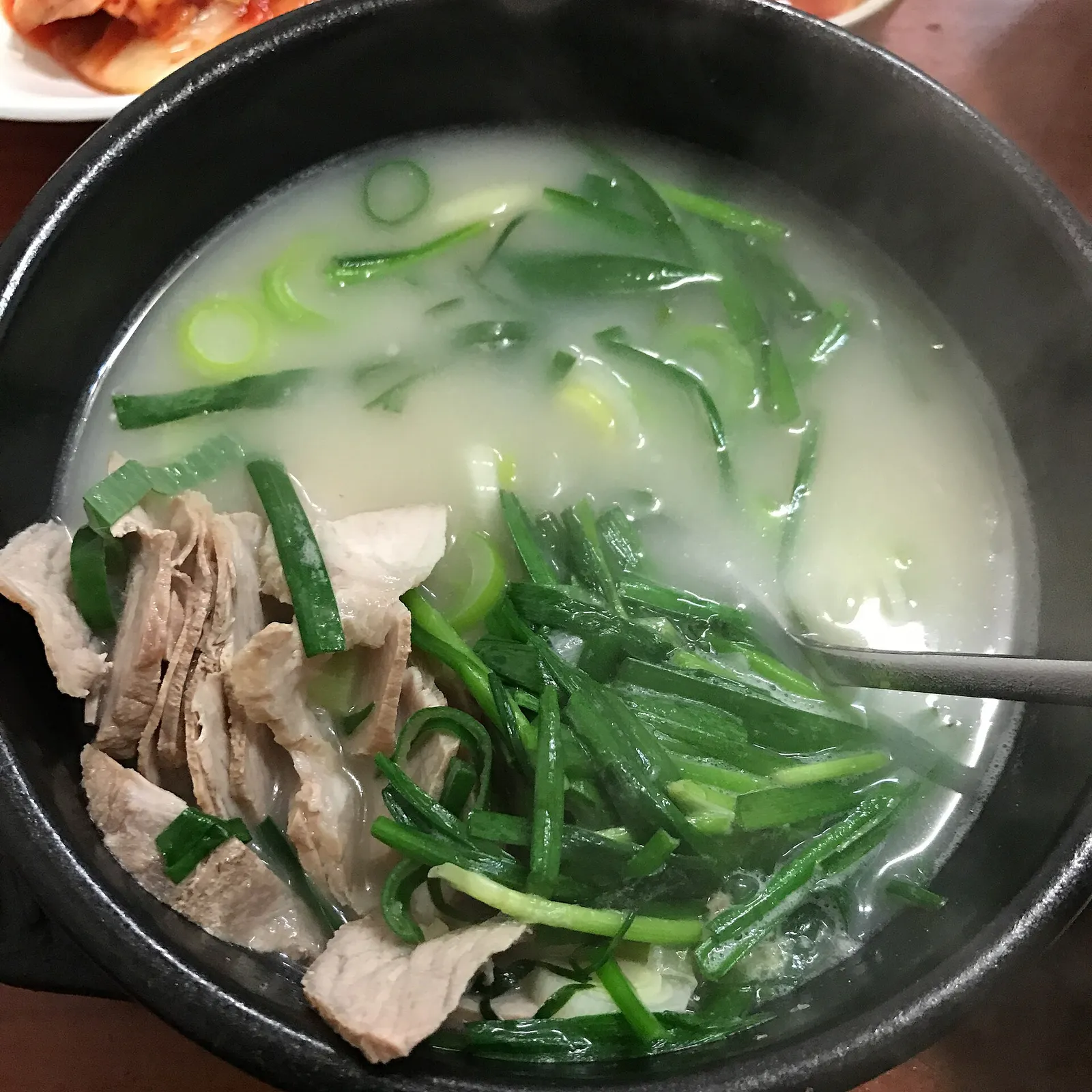
Dwaeji gukbap (돼지국밥) is pork-bone broth poured over rice with sliced boiled pork. You season it yourself at the table with salted shrimp, chives and a spoonful of red chilli paste, which is why the bowl arrives looking plain. Expect ₩9,000 to ₩12,000.
The city has over seven hundred shops specialising in it, and Seomyeon has an entire street of them. Menus list variations: ttaro keeps the rice separate, sundae ttaro adds blood sausage, and modeum mixes pork with offal.
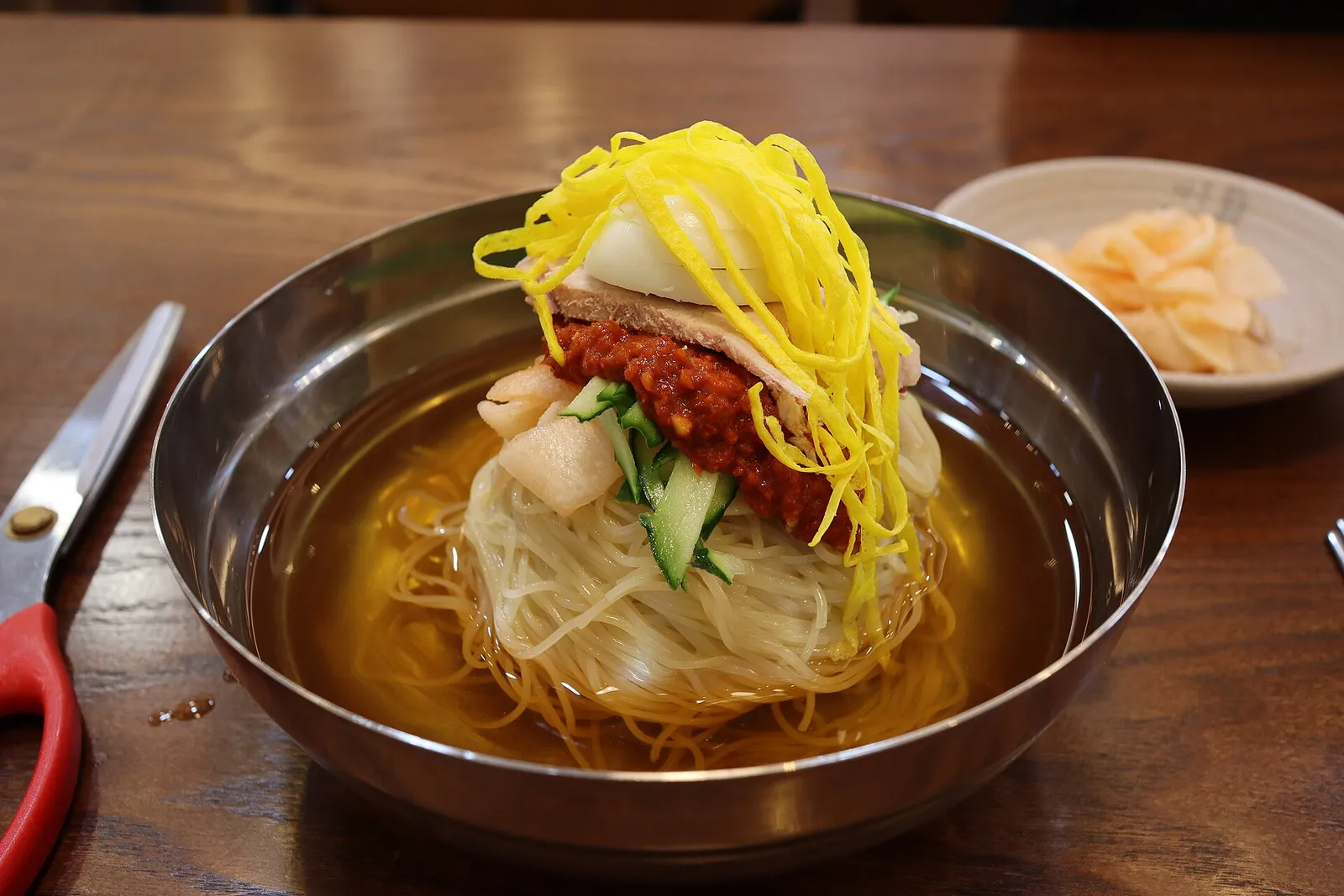
Milmyeon (밀면) is the one you cannot get properly outside Busan. North Korean refugees who settled here could not find the buckwheat for naengmyeon, so they made cold noodles from wheat flour and sweet potato starch instead. The result is chewier and slightly sweeter. It comes either in chilled broth (mul) or dressed in spicy sauce (bibim), and costs about ₩6,000 to ₩8,000.
Jagalchi and how the market system works
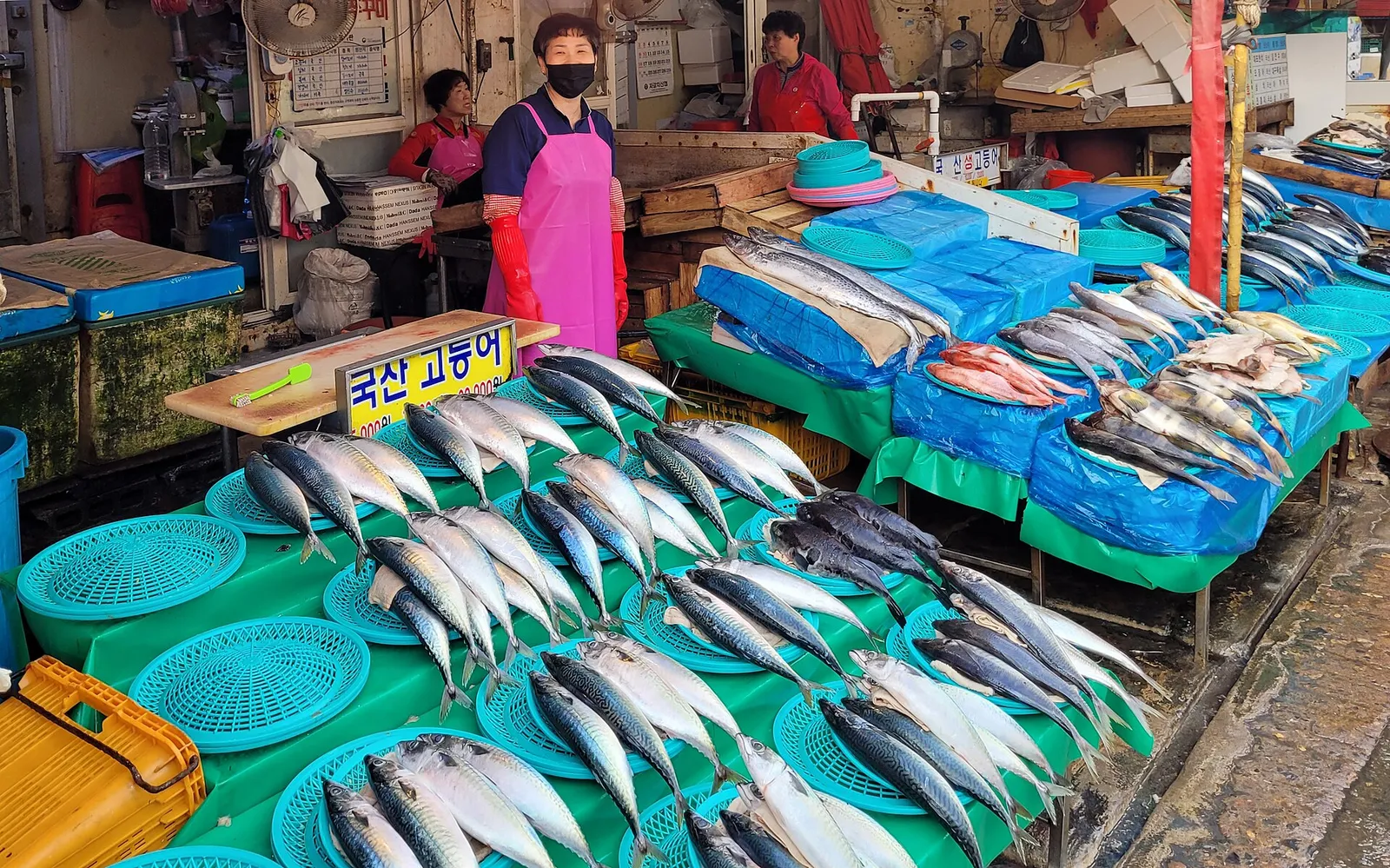
Jagalchi (자갈치시장) is Korea’s largest fish market, open 05:00 to 22:00 and closed the first and third Tuesday of each month. It is a two-minute walk from Jagalchi Station on Busan Line 1.
The system confuses first-timers, so here it is plainly. You buy live fish from a vendor on the ground floor. You then carry it upstairs to a chojangjip, a restaurant whose job is to slice your fish and serve it with side dishes, lettuce wraps and sauces. You pay the vendor for the fish and the restaurant a separate per-person table charge.
That table charge is the part to settle before you sit down, because it is not posted and varies. Widely reported figures are around ₩5,000 a head, with roughly ₩10,000 more if you want the bones turned into maeuntang, a spicy stew. Treat those as estimates and ask first.
If that sounds like too much negotiation, the restaurants on the upper floors sell fixed-price sets instead. An assorted raw fish platter runs roughly ₩60,000 for a small to ₩120,000 for the largest, and hoedeopbap, raw fish over rice with vegetables, is about ₩15,000.
Street food at Gukje Market and BIFF Square
BIFF Square is a 428 m pedestrian street in Nampo-dong, named in 1996 after the film festival. It is where ssiat hotteok (씨앗호떡) was invented: a sugar-filled griddle pancake, deep fried, then split open and packed with sunflower and pumpkin seeds, peanuts and walnuts. About ₩2,000 each, and the best thing on this list for anyone avoiding meat.
The adjoining Gukje Market (국제시장) grew out of the post-war trade in surplus goods and now has a dense food alley. Look for bibim dangmyeon, cold sweet-potato glass noodles tossed in red sauce, which is genuinely unique to Busan and hard to find anywhere else in the country.
Gukje Market closes the first and third Sunday of each month.
The rest of the local canon
- Busan eomuk (부산 어묵) — fish cake with a much higher fish content than the generic supermarket kind. Sold on skewers with hot broth at markets, and in bakery-style shops by the piece. Samjin Eomuk on Yeongdo has been making it since 1953.
- Jogae gui (조개구이) — assorted shellfish grilled at your table, concentrated at Gwangalli and Millak-dong. Reported at roughly ₩35,000 to ₩39,000 for a two-person set, though this comes from restaurant listings rather than an official source.
- Kkomjangeo (꼼장어) — charcoal-grilled hagfish, a post-war street food and a classic thing to eat under a tent with soju.
- Nakgopsae (낙곱새) — octopus, pork intestine and shrimp stir-fried together in a fiery sauce. A Busan invention and not for the cautious.
Where to eat by area
Seomyeon has the highest density of anything: the pork soup street, grilled meat, and the alley between Seomyeon Crossing and Judies Taehwa. It is also the easiest area to reach from anywhere in the city.
Nampo-dong is where the markets are, so it wins for lunch and street food but quietens down at night.
Gwangalli and Millak-dong are for shellfish and raw fish with a bridge view, and for drinking afterwards.
Haeundae Traditional Market is a five-minute walk from the station and stays open until 22:00, which makes it the convenient option if you are based at the beach.
Dietary notes, honestly
Busan is a difficult city for restricted diets and it is better to know that in advance.
- Dwaeji gukbap is impossible to adapt. Pork broth, pork meat and shrimp paste, with no workaround.
- Milmyeon is not vegetarian either. The broth is meat-based and it is usually topped with pork.
- Ssiat hotteok is the reliable option: fried in vegetable oil, filled with sugar and seeds.
- Grilled shellfish and raw fish work for anyone avoiding pork specifically, though the venues are shared-grill and alcohol-heavy.
- Halal certified restaurants are far scarcer than in Seoul. If that matters, our Itaewon food guide covers the country’s main cluster.
Practical notes
- Markets shut on rotating days. Jagalchi on the first and third Tuesday, Gukje on the first and third Sunday. Check before making the trip.
- Carry some cash. Cards work at most stalls now, but not all of them.
- No tipping, anywhere, including at markets.
- Point and count. Market vendors rarely speak much English, but numbers and a calculator app get you through.
- Go early for seafood. Jagalchi opens at 05:00 and the selection is best in the morning.
Wrapping up
Eat one bowl of dwaeji gukbap, one bowl of milmyeon and one seed hotteok and you will have covered what Busan does that Seoul cannot. Add a market seafood lunch if you have the appetite and the nerve to negotiate.
More in this series: the Busan overview, where to stay and what to see.