 Now, Yeogi
Things to Do in Euljiro: Sewoon Sangga, the Printing Alley, and What Is Disappearing (2026)
What there is to see in Euljiro, set out from official sources: Sewoon Sangga, Korea's first mixed-use tower from 1968, and its elevated deck now slated for removal; the ironworks alley the city's own heritage page says is being demolished; and the printing, lighting and tool alleys that are still working.
Places in this post
- Address
- 159 Cheonggyecheon-ro, Jung-gu, Seoul
- Menu
- Admission Free
- Tip
- Korea's first mixed-use residential and commercial building, opened in 1968. It was designed by the architect Kim Swoo-geun.
- Address
- About 350m along Euljiro 17-gil and 15-gil, Ipjeong-dong, Jung-gu, Seoul
- Menu
- Official status Seoul Future Heritage 2016-044
- Tip
- The city's own page says demolition is under way for redevelopment. Check before you go.
What you look at in Euljiro is not a sight. It is a workplace. You walk through alleys where presses are turning and forklifts are carrying paper.
And a good part of it is being demolished right now. That is what this post wants to tell you first.
Sewoon Sangga
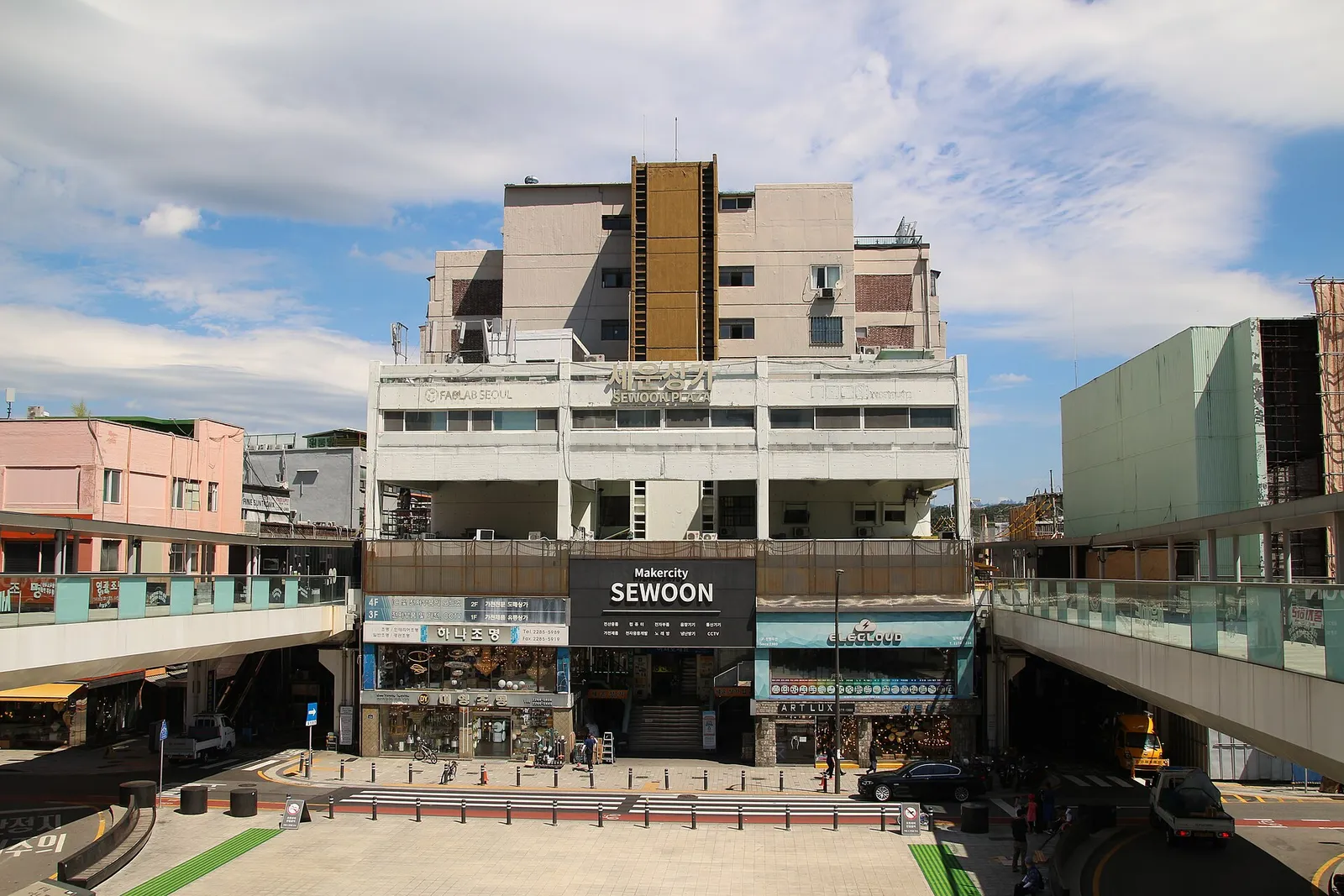
Korea’s first mixed-use residential and commercial building, opened in 1968. The architect was Kim Swoo-geun.
This is how the Seoul Tourism Organization introduces it.
Sewoon Sangga, which opened in 1968, was the country’s first mixed-use residential and commercial building and the mecca of the electrical and electronics industry through the 1970s and 1980s, a place that has lived through both a brilliant heyday and the dark years of decline.
The history of the site is unusual too. In 1945 the Japanese cleared it as a firebreak and left it empty against the risk of air raids. Shacks went up after the war, and in 1966 it became the first inner-city redevelopment site in the country; two years later Sewoon Sangga stood there.
The shops inside still sell electrical and electronic components, lighting, audio equipment and CCTV.
The elevated deck is coming down
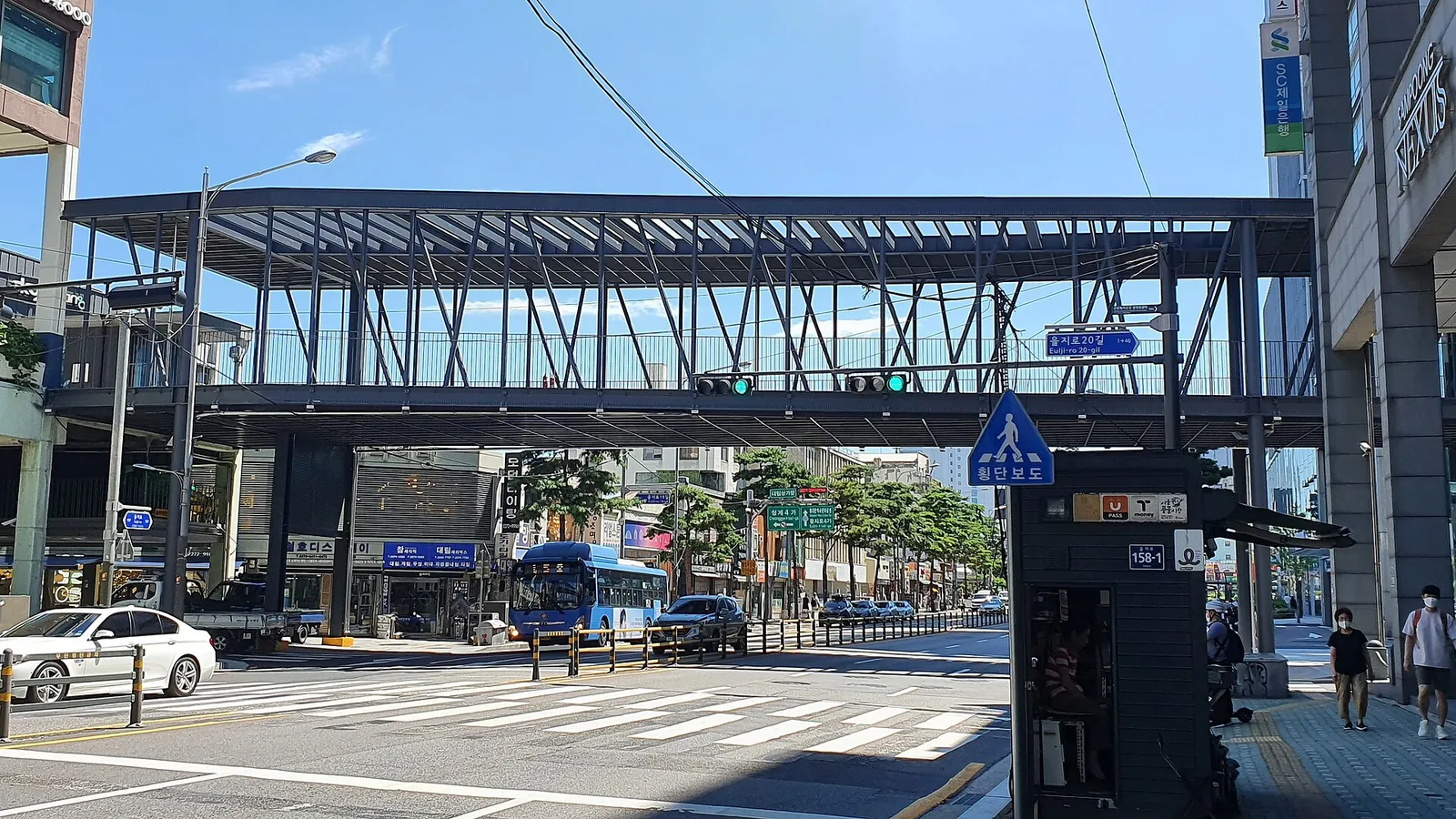
This part matters. If you have read online that you should go and walk the elevated deck at Sewoon Sangga, that information may be out of date.
- On 26 December 2024 the city’s urban regeneration committee resolved that the Dasi Sewoon regeneration project be concluded. That is a formal end.
- On 26 March 2026 a Seoul city fact briefing stated flatly that the current policy is to “demolish the old and dangerous concrete arcade blocks” and create a green axis of about 136,000 square metres.
Here is the city’s own description of the deck.
The elevated walkway around Sewoon Sangga is installed along a section of roughly 1km, running from Sewoon Sangga to Cheonggye and Daerim Sangga, Sampoong Sangga and the PJ Hotel, and on to Inhyeon and Jinyang Sangga … and includes the decommissioning of the roughly 250m of steel-framed walkway installed on either side of Sampoong Sangga and the PJ Hotel.
The 250m section has been approved for removal, and the rest goes in stages as the arcade blocks become parkland. In other words, the walkway will not survive.
The 5,670 square metre park at Sampoong Sangga had its implementation plan gazetted on 17 July 2025, and the target for breaking ground is the first half of 2026.
How much of the deck you can actually walk today could not be confirmed. Check the signs on site before you go.
The alley the city describes as being demolished
It is not often you see wording like this on an official heritage page.
The Ipjeong-dong ironworks alley is designated Seoul Future Heritage 2016-044. It runs about 350m along Euljiro 17-gil and 15-gil in Ipjeong-dong, Jung-gu, and took shape in the 1960s.
This is what the page says.
In 2021 the Sewoon 3-2 zone in which the Ipjeong-dong ironworks alley sits completed its management and disposal authorisation … at present demolition is under way across the area for redevelopment
It is designated heritage, and it is being demolished. As the food post also notes, Seoul Future Heritage designation carries no duty of preservation. The city itself states that it “does not establish a regulatory mechanism for uniform preservation”.
The Inhyeon underground shopping arcade is likewise recorded as “temporarily closed for the public-space works at Sewoon Sangga”.
The alleys that are still working
Talking only about demolition would give the wrong impression. A lot of these alleys are still at work.
The route the city put together for its 2025 Seoul Future Heritage public walk is a good reference.
Euljiro golbaengi street - Euljiro nogari street - Ipjeong-dong ironworks alley - Euljiro lighting street - Cheonggye tool market - Sewoon Sangga - the machinery and metalwork alley - Inhyeon Market - Chungmuro printing alley
Held to their axes, they go like this.
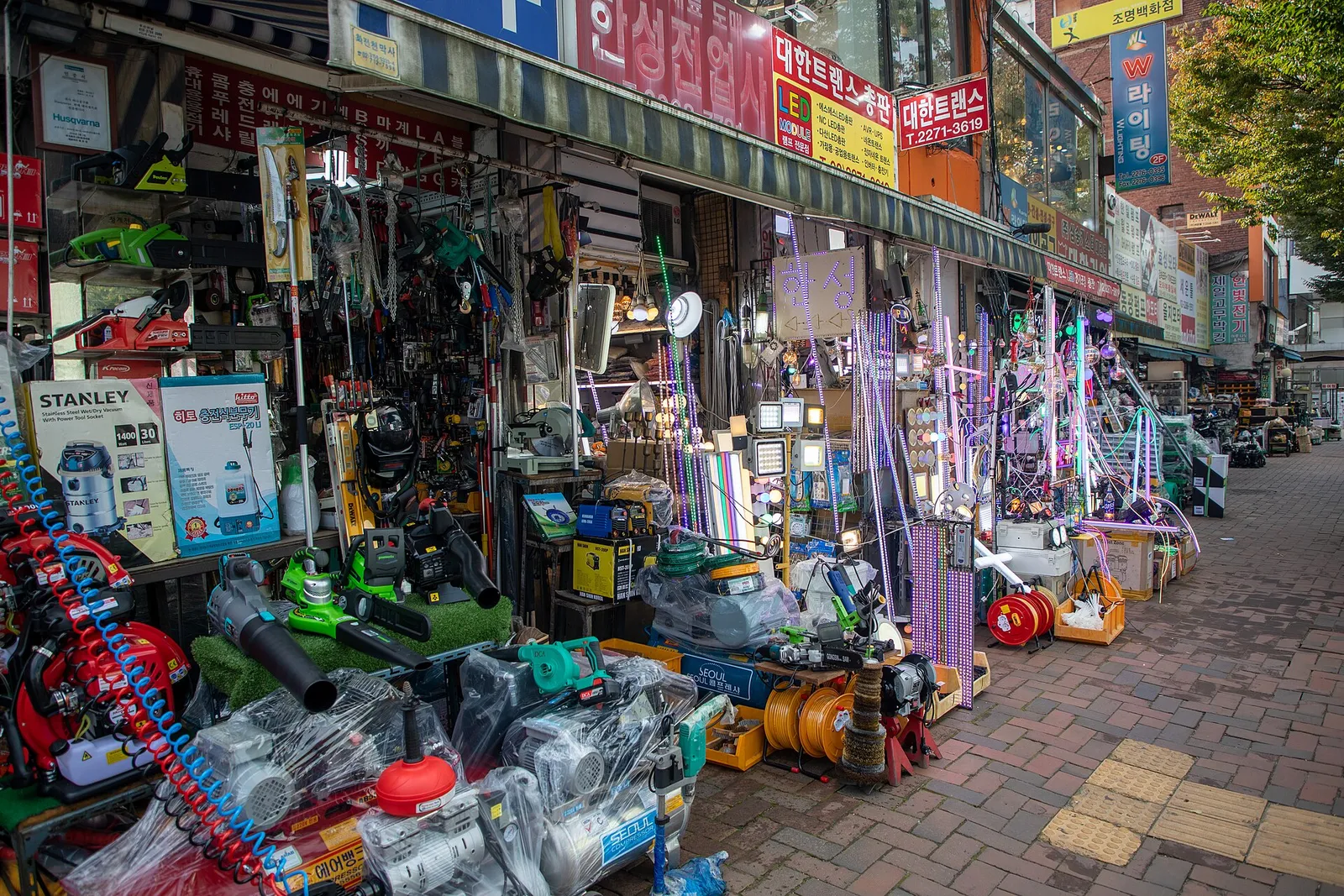
- The lighting street - on the main Euljiro road. A whole block selling nothing but lighting, from chandeliers to LEDs
- The tool market - on the Cheonggyecheon side. Drills, cutters and hose out on the pavement
- The printing alley - between Euljiro and Chungmuro. They will take an order for a single box of business cards
- The machinery and metalwork alley - where the lathes and mills are running
You will have no reason to go into the shops. The trade is wholesale and made-to-order. Looking as you walk is how this neighbourhood is enjoyed.
When you take photographs
These are people’s places of work. It is better to ask before photographing someone at work, or their machine, head-on. The alleys are narrow and forklifts and handcarts come through constantly, so standing in the middle of one is dangerous.
Bangsan Market
It has “market” in the name, but it is classified as something else.
In the city’s traditional market records (as of 28 August 2026), Bangsan Market is listed not as a registered market but as a “shopping street”. The Bangsan General Market right next to it is a registered market.
The distinction has a practical effect. This is the city’s explanation.
Within the categories of traditional market, those other than “registered” and “recognised”, such as shopping streets, … do not qualify for the additional income deduction rate that applies to traditional markets
Bangsan Market appears in Jung-gu’s official material as a “printing and packaging” market. It is widely known online as a market for baking and confectionery supplies, but no official basis for that could be found.
Is “Hipjiro” an official term
Half so. This is what the city wrote in a press release in August 2026.
Euljiro … its distinctive industrial landscape of densely packed print shops, ironworks and workshops joined by cafes, craft studios and cultural spaces, has acquired the nickname “Hipjiro”
It is a term that turns up in official Seoul city press releases, but the city itself calls it a nickname. It is not an administrative name.
That press release covered an on-site inspection of night tourism, and the route inspected was “the print shop and ironworks alleys, the Euljiro golbaengi alley, and the nogari outdoor-table street”. Which is to say those three are what the city regards as Euljiro’s tourism assets.
Which exit to take
| Destination | Station and exit |
|---|---|
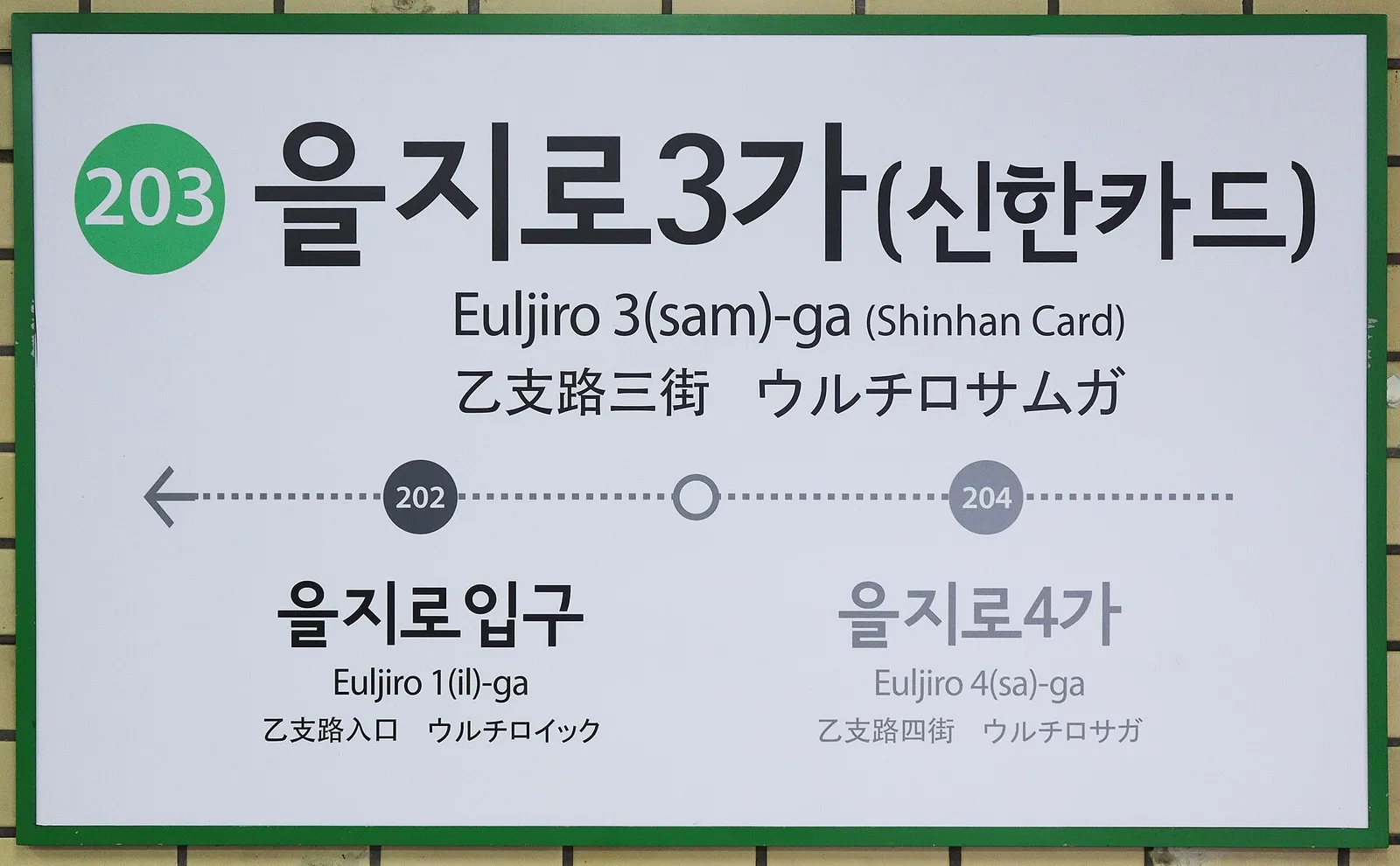
| Sewoon Sangga and the Cheonggye tool market | Line 2 Line 3 Euljiro 3-ga Station |
| The golbaengi alley | Line 2 Line 3 Euljiro 3-ga Station, exit 12 |
| The nogari alley | Line 2 Line 3 Euljiro 3-ga Station, 3-5 minutes on foot |
| The lighting street and Bangsan Market | Line 2 Line 5 Euljiro 4-ga Station |
| The printing alley | Line 3 Line 4 towards Chungmuro Station |
| The downtown office blocks | Line 2 Euljiro 1-ga Station |
Euljiro 3-ga Station is an interchange where Line 2 and Line 3 meet, and Euljiro 4-ga Station is Line 2 and Line 5.
What could not be verified
How much of the elevated deck is currently open could not be confirmed. The demolition policy and the approved removal of the 250m section are confirmed in official documents, but how far you can walk today is a separate question.
How much of the Ipjeong-dong ironworks alley is still standing could not be confirmed either. The city’s document says only that demolition is under way.
Whether Bangsan Market sells baking and confectionery supplies has no official basis that could be found.
Not every exit number could be verified. Only the numbers written in the table above are officially confirmed.
Wrapping up
- Sewoon Sangga is Korea’s first mixed-use residential and commercial building, from 1968, designed by Kim Swoo-geun.
- The Dasi Sewoon project formally ended in December 2024, and current policy is to demolish the arcade blocks and create a green axis.
- The elevated deck will not survive. Removal of 250m of it is already approved.
- The city writes that demolition is under way in the Ipjeong-dong ironworks alley.
- The lighting, tool, printing and metalwork alleys are still working. Look as you walk.
- Bangsan Market is a shopping street, not a registered market.
In one line: Euljiro is a neighbourhood with a lot you will not see unless you see it now. But please understand as well that what is going is not a tourist attraction. It is people’s places of work.
More in this series: the Euljiro overview, Euljiro food and where to stay in Euljiro.