 Now, Yeogi
Where to Stay in Euljiro: The District That Holds a Quarter of Seoul's Rooms (2026)
Jung-gu holds 25% of all the hotel rooms in Seoul. Yet the middle of Euljiro has hardly any. The difference between a registered tourist hotel and a residence, the trap in the name of the 6015 airport bus stop, and the conditions for using the City Airport Terminal at Seoul Station.
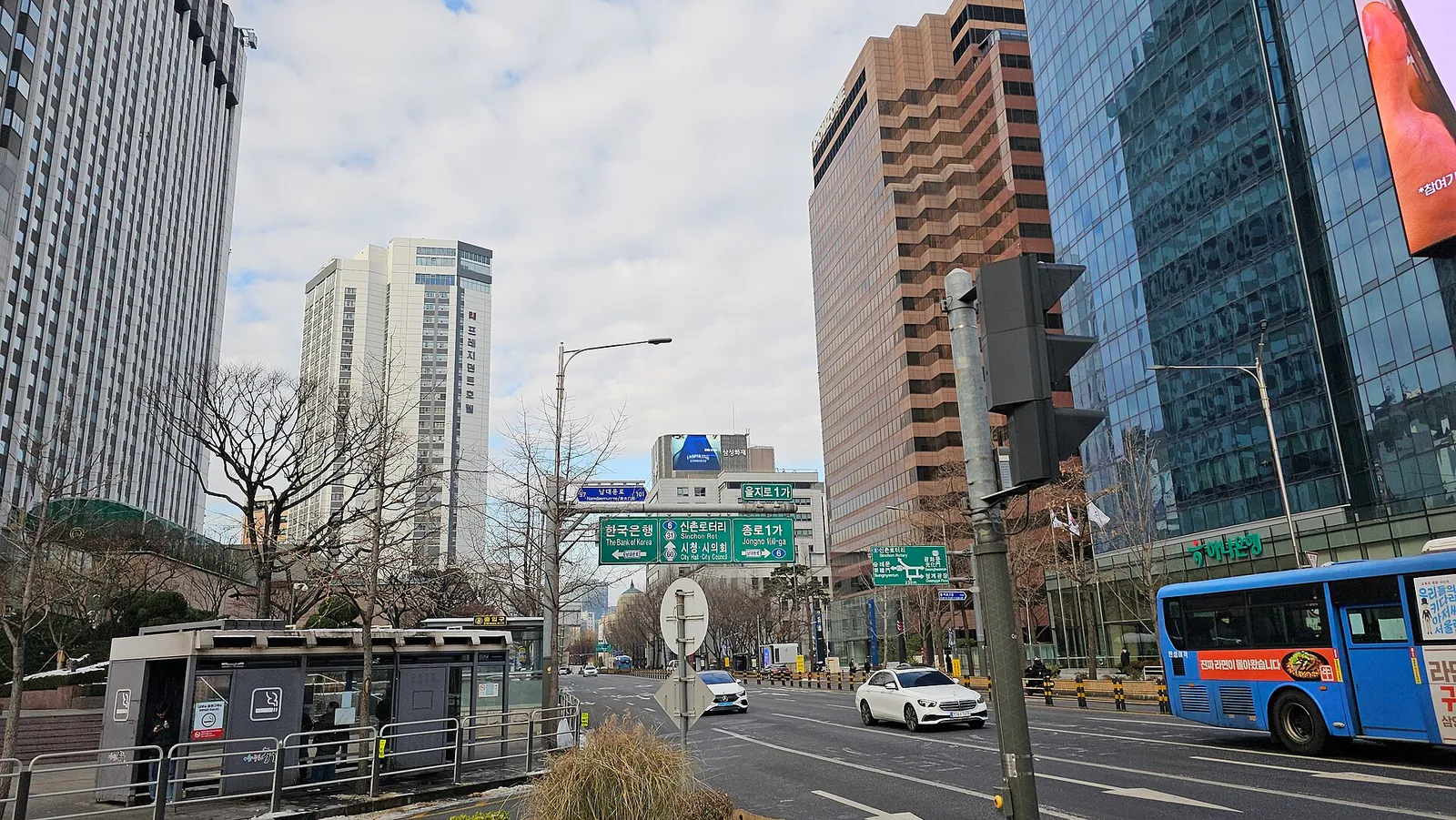
Places in this post
- Address
- 60 Euljiro (basement), Jung-gu, Seoul
- Hours
- Towards the airport, first bus 04:26, last bus 19:42
- Menu
- Airport limousine 6015 Exit 5, in front of Hana Bank - adult 17,000 won
- Tip
- It adjoins Myeongdong, and this stretch has the most hotels.
- Address
- 145 Euljiro (basement), Jung-gu, Seoul
- Hours
- Towards the airport, first bus 04:28, last bus 19:45
- Menu
- Airport limousine 6015 Exit 12, in front of Kookmin Bank
- Tip
- The stop is called Euljiro 2-ga but is actually at exit 12 of Euljiro 3-ga Station. Wait where the name says and you will miss it.
In the Seongsu-dong post the problem was that there was nowhere to sleep. Euljiro is the exact opposite.
Counting through the Ministry of the Interior and Safety licensing data gives 485 lodging businesses in Jung-gu with 28,340 rooms. That is 25.0% of every hotel room in Seoul, first among the 25 districts.
A quarter of Seoul’s rooms
| Rank | District | Rooms | Share |
|---|---|---|---|
| 1 | Jung-gu | 28,340 | 25.0% |
| 2 | Gangnam-gu | 11,742 | 10.3% |
| 3 | Jongno-gu | 10,258 | 9.0% |
| 4 | Yeongdeungpo-gu | 8,009 | 7.1% |
| 5 | Mapo-gu | 5,520 | 4.9% |
| … | |||
| 20 | Seongdong-gu | 1,397 | 1.2% |
Jung-gu alone has 2.4 times as many rooms as Gangnam-gu and 20 times as many as Seongdong-gu.
The district office reached the same conclusion. This is from a press release in August 2026.
Of all the tourist accommodation facilities in Seoul (756 of them), about 26% are in Jung-gu, the most of any of the 25 districts.
Two sources counting on different bases arrive at the same answer.
The mix of business types is the reverse too
In Seongsu-dong 62% of the rooms were in old-style inns. Jung-gu looks like this.
| Business type | Rooms | Share |
|---|---|---|
| Registered tourist hotel | 17,966 | 63.4% |
| Lodging business (residence) | 4,238 | 15.0% |
| General hotel | 3,412 | 12.0% |
| Yeogwan | 2,290 | 8.1% |
| Yeoinsuk | 153 | 0.5% |
Registered tourist hotels are 63% of it, and the old-style inns only 8%.
And yet the middle of Euljiro has no rooms
This is the most unexpected thing in the post.
Add up the twelve neighbourhoods around Euljiro and you get 83 businesses with 5,541 rooms, but 71% of them are bunched at the two ends. There are 1,345 rooms in Euljiro 1-ga and 2-ga and Janggyo-dong, and 2,585 in Euljiro 5-ga and 6-ga.
Euljiro 3-ga itself has just 12 businesses with 150 rooms. There are businesses but no rooms. The average is 12.5 rooms and half of them have one or two. Which is to say small lodgings tucked inside the printing and lighting alleys.
So “staying in Euljiro” means, in practice, staying towards Myeongdong (Euljiro 1-ga) or towards Dongdaemun (Euljiro 5-ga and 6-ga).
Check, even when the sign says hotel
The most numerous type of business in Jung-gu is the “residence”-type serviced lodging, with 127 of them. The two largest places in the Euljiro area, 731 rooms between them, are in this category.
Having “hotel” in the name does not mean the place has been through tourist hotel grading. It has a kitchen and is required to have a front desk and a lobby, but it sits under a different scheme. For a few nights there is no problem at all.
In Seongsu-dong this was a minor exception. In Euljiro it is common.
There is almost no urban homestay here
Jung-gu has 205 registered foreign-tourist urban homestays, but most are around Namsan and Hoehyeon, and only 3 are in Euljiro.
The unlicensed-lodging problem the Seongsu-dong post dealt with at length barely arises here. With hotels everywhere, there is little reason to book a private home. The principle is the same all the same. Running a lodging business without registering it carries up to 2 years in prison or a fine of up to 20 million won (about $15,000), and if it is on the Seoul Stay list, it is legal.
There are no hanok in Jung-gu at all. Of the 133 hanok on Seoul Stay, 100 are in Jongno-gu. For a hanok, go to the Jongno accommodation post.
Getting to the airport is this neighbourhood’s real advantage
The airport limousine Bus 6015 runs straight through Euljiro. The first nine stops on the route are all in Jung-gu, and three of them are in Euljiro.
| Stop | Where you actually board | First bus | Last bus |
|---|---|---|---|
| Royal Hotel (Euljiro 1-ga) | Euljiro 1-ga Station exit 5, in front of Hana Bank | 04:26 | 19:42 |
| Euljiro 2-ga (Fine Avenue) | Euljiro 3-ga Station exit 12, in front of Kookmin Bank | 04:28 | 19:45 |
| Kukdo Hotel (Euljiro 4-ga) | Euljiro 4-ga Station exit 10 | 04:30 | 19:50 |
The fare is 17,000 won for an adult (about $12.75) and 12,000 won for a child, first come first served, no booking. There are 80 departures a day, weekdays and weekends alike, every 10 to 12 minutes during the day.
There are two traps
One: the stop name does not match where the stop is. It is written “Euljiro 2-ga (Fine Avenue)”, but you actually board at exit 12 of Euljiro 3-ga Station. Go by the name and wait at Euljiro 2-ga and you will miss it.
Two: the last bus is early. 19:42 at Euljiro 1-ga, 19:50 at Euljiro 4-ga. For an evening flight, work out the subway or the airport railway rather than the limousine.
Coming in from the airport
From Incheon Airport, first bus 05:19 and last 22:59 at T2, first 05:39 and last 23:19 at T1.
The official guidance includes this.
At T1 boarding is first come first served, and cash, transport cards and tickets are all accepted When boarding at T2 a ticket is required (from the ticket office or a self-service machine)
At T1 you just get on; at T2 you have to buy a ticket. The official guidance also states that the bus may stop for 5 to 10 minutes at Namdaemun Market, just before Euljiro.
The City Airport Terminal at Seoul Station
Seoul Station is 9 to 15 minutes from Euljiro by subway. Two floors below it is the City Airport Terminal, where you can check in, drop your bags and clear immigration in advance.
The conditions are demanding, though. Only passengers holding a ticket for the direct express train may use it, only eight Korean carriers are handled, and routes to the United States, Guam and Saipan are excluded. Opening hours are 05:20 to 19:00.
Plenty of people turn up not knowing that and cannot use it.
Is it noisy at night
It depends on the block. The printing and ironworks alleys are quiet at night; the nogari alley and the golbaengi alley are loud until late.
The city said as much directly in a press release in July 2026.
centred on Jongno 3-ga and Euljiro and elsewhere … conflict between traders and residents over noise, rubbish and obstructed footways
One legal point is worth noting too. Jung-gu’s restriction on outdoor trading after 23:00 applies only in general residential zones. Euljiro is not covered. That is to say the outdoor tables are not legally required to end at 23:00.
There is no noise measurement point in Euljiro. Myeongdong has one, and it exceeded the night-time standard in all four quarters of 2025, but those are Myeongdong’s figures and cannot be transferred to Euljiro.
Where to book
- You want to sleep quietly - the Euljiro 1-ga end. It is an office district, quiet at night, and it has the most hotels
- You want the outdoor tables - the Euljiro 3-ga end. But there are very few rooms there
- You are in and out of the airport - any of the three 6015 stops. Seoul Station is close as well
- You want a hanok or a guesthouse - not Euljiro. Go to Jongno
What could not be verified
There is no official source for the average room rate in Jung-gu. That is why no figures appear in this post.
The walking time inside Seoul Station and the length of the underground arcade have no official figures that could be found.
The 194 tourist accommodation businesses cited by Jung-gu and the 485 lodging businesses counted here rest on different laws. The first is under the Tourism Promotion Act, the second under the Public Health Control Act. The two must not be mixed.
Wrapping up
- Jung-gu holds 25% of all the hotel rooms in Seoul, 28,340 of them. First in the city.
- 63% are registered tourist hotels and 8% are old-style inns. The exact reverse of Seongsu-dong.
- Euljiro 3-ga has only 12 businesses and 150 rooms. “Euljiro accommodation” means Myeongdong or Dongdaemun in practice.
- The “residence”-type serviced lodging is the most numerous business type. Check, even when the name says hotel.
- The airport bus is route 6015, with three stops in Euljiro. The last one is early, at 19:50.
- The stop called “Euljiro 2-ga” is actually at exit 12 of Euljiro 3-ga Station.
- The City Airport Terminal at Seoul Station is only for direct-express passengers on eight Korean carriers.
More in this series: the Euljiro overview, things to do in Euljiro and Euljiro food.