 Now, Yeogi
Eating in Euljiro: The Nogari Alley and Restaurants 70 Years Old (2026)
What to eat in Euljiro, set out from official sources: the nogari alley designated as Seoul Future Heritage, the regulatory reason no government restaurant list includes a beer hall, the current published prices at the good-price businesses within walking distance, and which places have already closed.
Places in this post
- Address
- Around 19 Euljiro 13-gil, Jung-gu, Seoul (95 Euljiro 3-ga)
- Hours
- Full to the outdoor tables in the evening
- Menu
- Official status Seoul Future Heritage 2015-029
- Tip
- 3-5 minutes on foot from Euljiro 3-ga Station. Sit down and draught beer and nogari arrive by the head count, without your ordering.
- Address
- Around Euljiro 3-ga, Jung-gu, Seoul
- Menu
- Official status Restaurant street designated by Jung-gu
- Tip
- Exit 12 of Euljiro 3-ga Station. Whelks are eaten under shredded spring onion, with a rolled omelette alongside.
- Address
- Around Ojang-dong, Jung-gu, Seoul
- Menu
- Official status Restaurant street designated by Jung-gu
- Tip
- 400m straight on from exit 6 of Dongdaemun History and Culture Park Station. It began in 1952, once had six restaurants and now has three.
Two eating neighbourhoods overlap in Euljiro: restaurants more than 70 years old, and outdoor street tables set out on the road.
Only one of the two appears on the government lists. Let me start with why.
The nogari alley
The city designated it Seoul Future Heritage in 2015, certificate number 2015-029. This is the original text of the designation.
The Euljiro nogari alley took shape from the 1980s, and the number of customers coming to it grew explosively in the wake of the IMF financial crisis.
In the nogari alley, where some ten beer halls sit together, the crowds in the evening are such that an empty seat is hard to find even at the outdoor tables. When customers sit down, draught beer and nogari come out by the head count without anything being ordered.
That last sentence matters. You sit down and the drink and the snack arrive before you order. That is how this alley works, and it can take a first-timer by surprise.
Nogari is a juvenile pollack. That is the Standard Korean Dictionary definition; it is dried, grilled and served with beer.
The alley is around 19 Euljiro 13-gil in Jung-gu, 3 to 5 minutes on foot from Line 2 Euljiro 3-ga Station.
The “some ten beer halls” in the designation text is a count from the 2015 survey. No official figure for the number today could be found.
The tables on the road are permitted
This is not a practice that gets quietly overlooked. There are two official documents.
- The Jung-gu street environment division’s road-occupancy permit plan for the Euljiro nogari alley and others (2021)
- The Seoul city pedestrian environment division’s notice of street-stall inspection results and requested measures for the Euljiro nogari alley (2024)
The district office manages it through road-occupancy permits and the city inspects it. The body of both documents is closed, so the permitted area and conditions could not be confirmed, but it is clearly something the administration keeps an eye on.
Which means there may be days with outdoor tables and days without.
Why no beer hall appears on the government lists
This is the interesting part.
The nogari alley is not among the seven restaurant streets designated by Jung-gu. The golbaengi alley is. It is not among the ten designated shopping streets either.
The reason is in the rules. This is the exclusion clause on the Jung-gu page for the “model restaurant” designation.
Businesses excluded from applying: businesses dealing mainly in alcohol, such as beer halls and soju bars, and businesses handling objectionable foodstuffs
A business led by alcohol is not eligible to apply in the first place. It is not about the food being poor. The scheme rules them out.
The city takes a different view, though. This is how it described Euljiro in a press release in August 2026.
Euljiro … its distinctive industrial landscape of densely packed print shops, ironworks and workshops joined by cafes, craft studios and cultural spaces, has acquired the nickname “Hipjiro” and is drawing attention as one of Seoul’s leading cultural and tourist destinations.
In particular, with a food trade and a culture of outdoor street tables forming around the golbaengi alley and the nogari alley, it has emerged as an inner-city night-tourism destination popular with younger people and foreign visitors.
“Hipjiro” is a word the city uses in official press releases. But this is a mention as the object of policy, not a designation.
The Seoul Future Heritage restaurants
On this side the official lists are thorough. These are the restaurants within walking distance of Euljiro among the 99 Seoul Future Heritage entries in Jung-gu.
| Restaurant | What they serve | Nearest station |
|---|---|---|
| Andongjang | Oyster jjamppong, menbosha | Euljiro 3-ga, 1-2 minutes on foot |
| Sunheungok | Braised oxtail, oxtail soup | Around Euljiro 3-ga |
| Wooraeok | Pyongyang naengmyeon, bulgogi | Euljiro 4-ga, 4-7 minutes on foot |
| Munhwaok | Seolleongtang | Euljiro 4-ga, exit 4 |
| Ojangdong Hamheung Naengmyeon | Hamhung naengmyeon | Euljiro 4-ga |
| Ojangdong Heungnamjip | Hamhung naengmyeon | Ojang-dong |
| Pyeongnaeok | Chogyetang, Pyongyang naengmyeon | Mareunnae-ro |
Andongjang is the oldest Chinese restaurant in Seoul. It opened in 1948 and is in its third generation; the “Andong” of the name comes from a place name in Shandong, China.
The note on Wooraeok is a good one.
The restaurant is said to have been renamed Wooraeok because the family “came back again” after fleeing during the Korean War.
Sunheungok serves only two things, braised oxtail and oxtail soup. It opened in 1949.
Munhwaok is one of the rare cases where an official city document includes directions.
Come out of exit 4 at Euljiro 4-ga and walk a little way and you will see a sign reading “Munhwaok” in red lettering on a yellow ground.
Oraegage
There is also the Oraegage certification, which the city extended to food in 2024. Twelve places in Jung-gu were selected, and the Euljiro ones among them include Ojangdong Hamheung Naengmyeon, Buminok and La Cantina.
Know the difference between the two naengmyeon
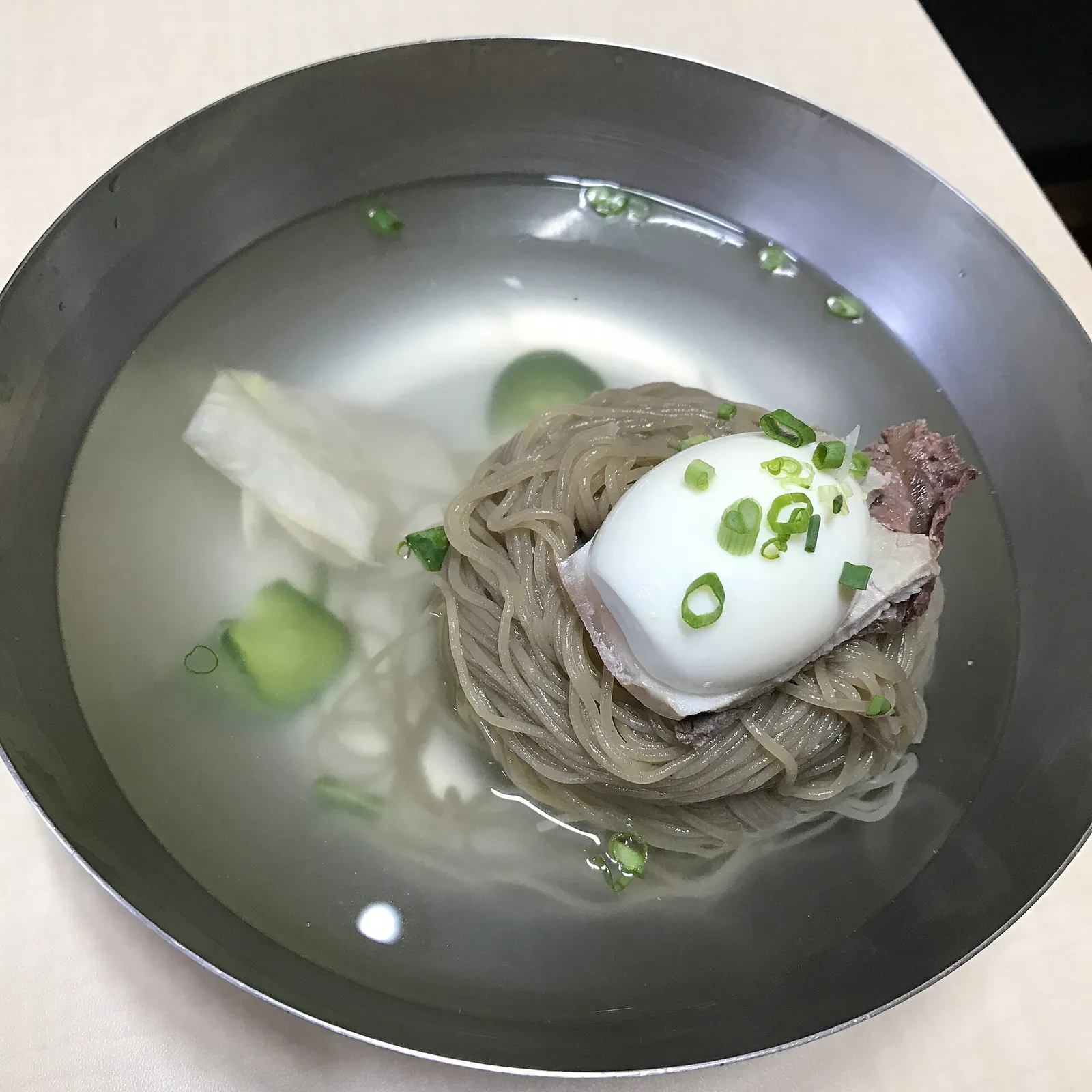
Confuse these two in Euljiro and you will end up eating something other than what you meant to.
Pyongyang naengmyeon is buckwheat noodles in a clear meat broth. The description at Wooraeok puts it exactly.
Into a broth made by simmering whole cuts of Korean beef cow rump and leg for four or five hours, buckwheat noodles and nothing else at all are placed
Many people find it bland. That is what it is supposed to taste like.
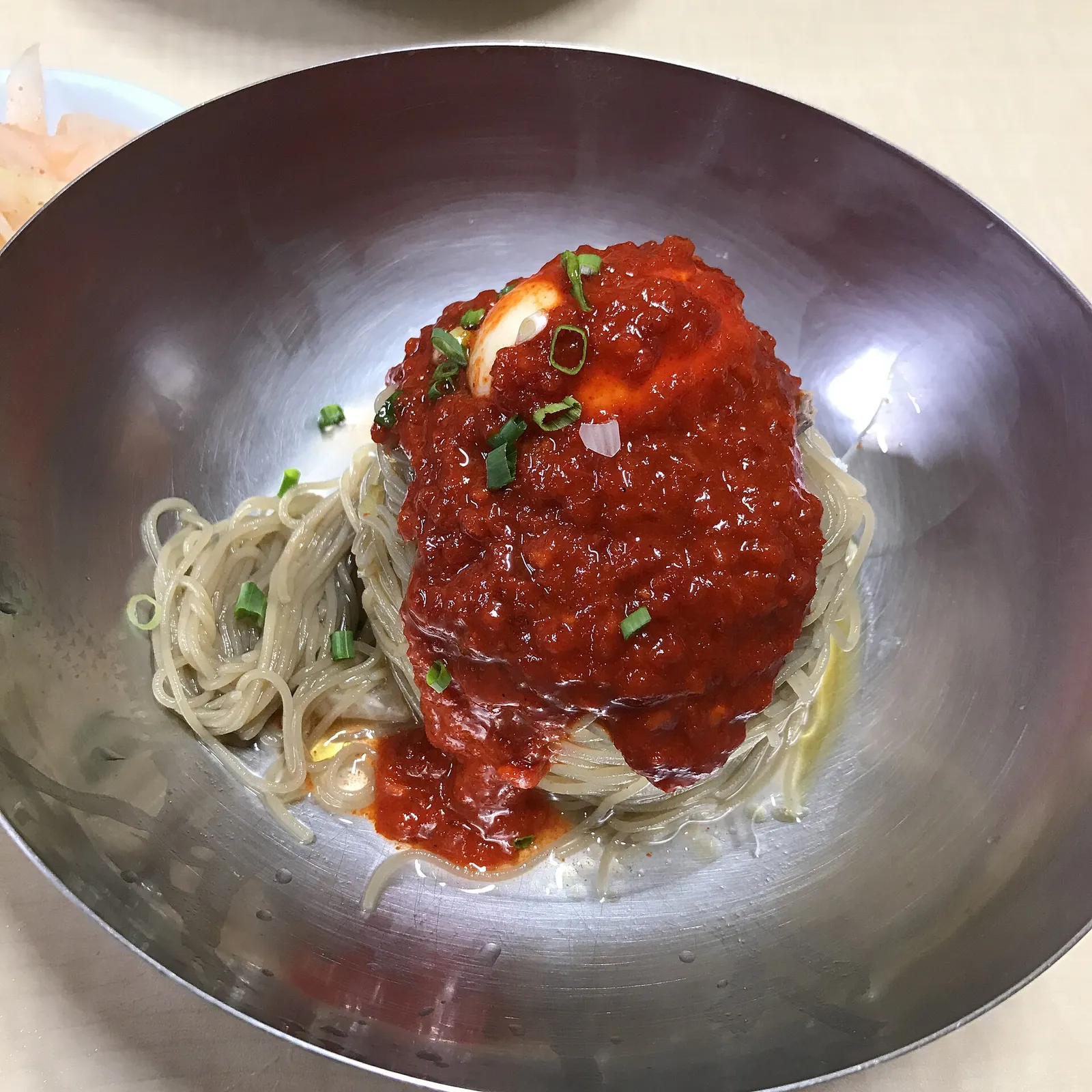
Hamhung naengmyeon is a different thing. The noodles are chewy, drawn from potato and sweet potato starch, and you mix them with a red sauce; many places top them with raw skate. Ojang-dong is where that is done.
This is Jung-gu’s official account.
Starting with Heungnamjip, which opened in 1952, the number grew to as many as six restaurants in the 1970s, but at present Heungnamjip, Ojang Naengmyeon and Sinchang Myeonok are the ones receiving customers.
Six down to three is a decline the district office itself records.
What it costs
These are the published prices in the Ministry of the Interior and Safety’s official “good price” database, as retrieved on 22 September 2026, for businesses within walking distance of Euljiro.
| Business | Published price |
|---|---|
| Kongdabang | Americano 1,800 won, cafe latte 2,900 won |
| New York Snack | Vegetable gimbap 3,500 won, kalguksu 7,000 won |
| Imo Bunsik | Gimbap 4,000 won, ramyeon 4,500 won |
| Donggyeong Udonjip | Udon 5,000 won, curry rice 6,500 won |
| Geomok Sikdang | Doenjang-jjigae 7,000 won, sundubu-jjigae 7,000 won |
| Iwon Son Kalguksu | Kalguksu 7,000 won, dumplings 6,000 won |
| Yeongjassi Udon Gimbap | Kimchi-jjigae 7,000 won, curry rice bowl 8,000 won |
| Gwanghui Sikdang | Doenjang-jjigae 7,000 won, galbitang 9,000 won |
| Hau Malatang | Beef malatang 9,000 won |
| San-gwa Deul Geurigo Bada | Assorted hot-stone bibimbap 10,000 won |
Prices are in Korean won throughout the table. As a rough guide, 1,000 won is about $0.75.
An americano at 1,800 won (about $1.35), in the middle of central Seoul.
It is a floor, not an average
An important caveat. The condition for the “good price” designation is an item priced below the average for the surrounding trading area. By definition, only places cheaper than their neighbours get on it.
So it is right to say you can eat for this much in Euljiro, and wrong to say this is what Euljiro costs on average. Pyongyang naengmyeon at an old restaurant does not cost this.
No comparison with past prices was possible. The database has no function for retrieving prices as of an earlier date.
Some places are already gone
This may be the most important part of the post.
Euljiro is in the middle of redevelopment, and there are places still named on official lists that are no longer trading. Only what can be confirmed in city documents is set down here.
Sangol Makguksu, Euljiro main branch - this is written into the Seoul Future Heritage text itself.
Closed during 2018 when works dragged on during a refurbishment because of a cultural heritage survey and … the Euljiro main branch is making preparations to open again.
On the official city record it has been closed since 2018, and when it might reopen is unconfirmed.
A business described as the original of the nogari alley - there is a record from 2022 of a petition requesting a meeting with the mayor being handled through three separate city departments. It was a dispute over surrender of the building. The body of the document is closed so the outcome could not be confirmed, but it is not in a state where it can be written up as a place that will be there when you arrive.
Seoul Future Heritage does not protect a business
This is easy to misunderstand, and the city has stated it outright.
The Seoul Future Heritage conservation programme does not establish a regulatory mechanism for the uniform preservation of heritage.
Future heritage … is preserved voluntarily by the owner, which distinguishes it from cultural properties whose preservation is made mandatory by law.
What the designation actually amounts to is a certificate, and a plaque fixed to the building if the owner agrees. It has no power under the scheme to protect a tenant or to stop redevelopment.
So this post does not suggest that you go with a particular restaurant as your target. Go with an alley as your target, and go into whatever is open that day.
Things worth knowing
Every restaurant and bar is entirely non-smoking, since 1 January 2015, whatever the floor area. Outdoor tables are no exception.
There is no tipping. The price on the menu is the final amount, VAT included.
Refusing a card payment is illegal. That said, at a very old place the terminal may not accept a foreign-issued card. It is safer to carry a little cash.
Which exit to take
| Destination | Station and exit |
|---|---|
| The nogari alley | Line 2 Line 3 Euljiro 3-ga Station, 3-5 minutes on foot |
| The golbaengi alley | Line 2 Line 3 Euljiro 3-ga Station, exit 12 |
| Several long-established restaurants | Line 2 Line 5 Euljiro 4-ga Station |
| Munhwaok | Line 2 Line 5 Euljiro 4-ga Station, exit 4 |
| The Ojang-dong naengmyeon alley | 400m from exit 6 of Line 2 Line 4 Line 5 Dongdaemun History and Culture Park Station |
What could not be verified
The current number of businesses in the nogari alley could not be confirmed. The only official figure is the “some ten” from the 2015 designation.
No comparison with past “good price” figures was possible. The database has no retrieval by reference date.
Bangsan Market is widely known as a market for baking and confectionery supplies, but Jung-gu’s official material lists it as a “printing and packaging” market. No official basis for the baking supplies could be found, so it is not written here.
The specific area and conditions of the road-occupancy permits could not be confirmed either, as the document is closed.
Wrapping up
- The nogari alley is Seoul Future Heritage 2015-029. Sit down and the beer and nogari arrive without an order.
- The outdoor tables are subject to road-occupancy permits, and the city inspects them.
- No beer hall appears on the government restaurant lists because the scheme excludes alcohol-led businesses.
- Pyongyang naengmyeon is clear and mild; Hamhung naengmyeon is red and chewy. Ojang-dong is the Hamhung kind.
- On the “good price” list, an americano is 1,800 won and a stew 7,000 won. That is a floor, though.
- Some places on the official lists have closed. Aim at alleys, not shops.
More in this series: the Euljiro overview, things to do in Euljiro and where to stay in Euljiro.