 Now, Yeogi
Free Palace Entry in Hanbok: What Counts and What Gets Turned Away (2026)
Wearing hanbok gets you into Seoul's palaces free, but only certain garments qualify. Here are the two requirements, the styles that get refused at the gate, why Changdeokgung's Huwon is the single exclusion, and how hanbok lets you into Gyeongbokgung's night viewing without a booking.
Places in this post
- Address
- 161 Sajik-ro, Jongno-gu, Seoul
- Hours
- Night viewing 2 September – 2 October 2026, 19:00–21:30 (last entry 20:30), closed Mondays and Tuesdays
- Menu
- Standard admission ₩3,000 (free in hanbok)
- Tip
- Even when the online night-viewing tickets sell out, people in hanbok go in without a booking and with no cap on numbers. Your outfit is checked at Heungnyemun Gate.
- Address
- 99 Yulgok-ro, Jongno-gu, Seoul
- Menu
- Palace buildings ₩3,000 (free in hanbok) · Huwon, the Secret Garden ₩5,000 (hanbok does not make this free)
- Tip
- The hanbok exemption covers the palace buildings only. In Huwon the only free categories are children aged 6 and under, national merit recipients and registered disabled visitors.
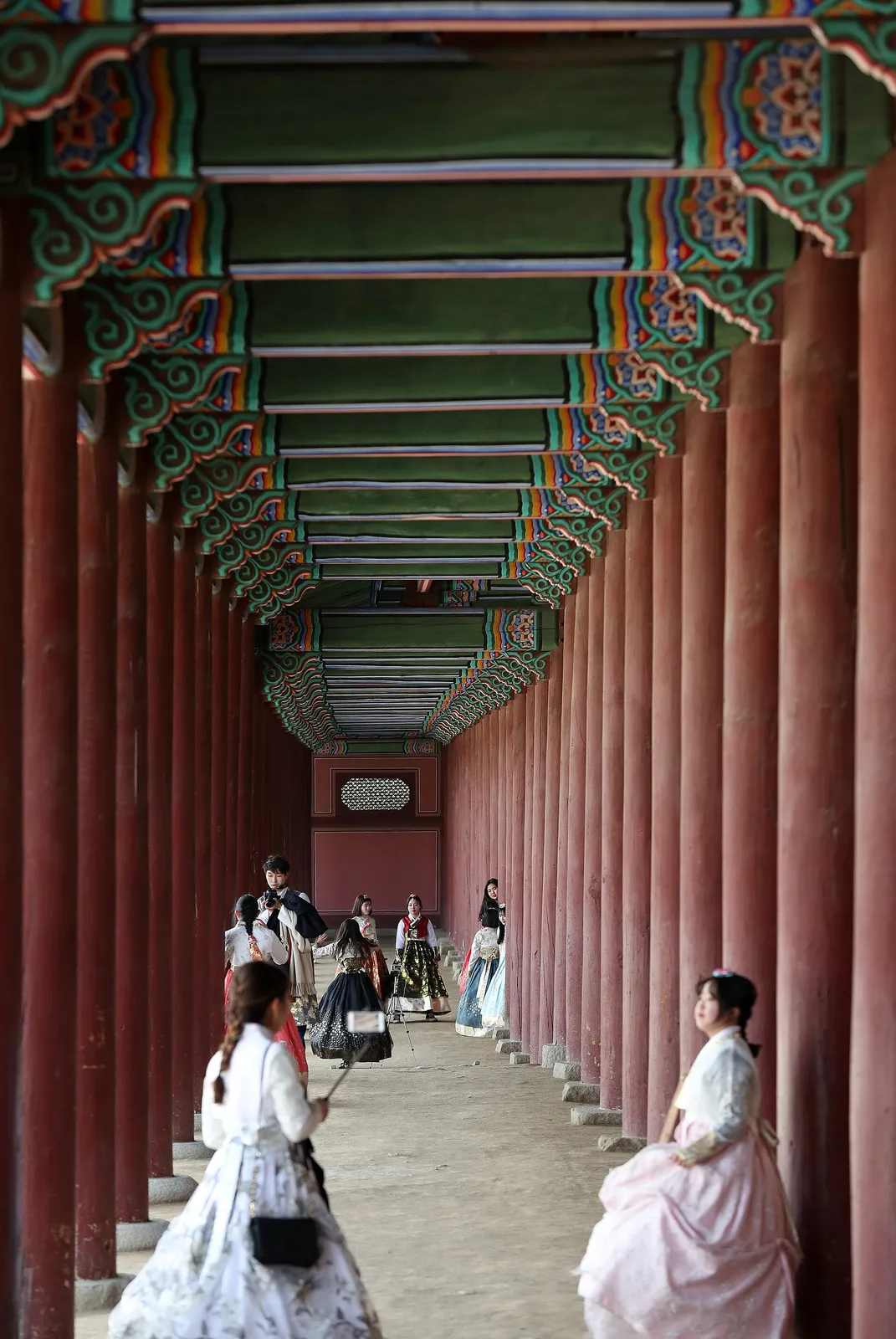
Wear hanbok, Korean traditional dress, and the palaces let you in free. Foreign visitors get exactly the same treatment.
What catches people out is that not every hanbok counts. The Royal Palaces and Tombs Center sets out what qualifies in a document called the hanbok free admission guideline, and some of the outfits rental shops hand out do not meet it. People really are turned away at the gate.
This post is drawn from that guideline itself.
There are only two requirements
Simpler than you would expect.
- A jeogori with a wrapping collar — the short jacket, as long as the front panels overlap and wrap across.
- Something on the bottom — a skirt or trousers.
You need both halves, and that is the whole test.
You do not need goreum
This is the detail most people worry about. The guideline’s own Q&A settles it.
Q Does a jeogori without goreum still count as hanbok? A Yes. A jeogori with a wrapping collar is recognised as a hanbok jeogori even without goreum.
Goreum are the long fabric ties you see knotted at the chest. Ties, a knot, buttons — none of it matters. The only question is whether the collar wraps across.
Modern everyday hanbok counts
The guideline states that both traditional hanbok and modern everyday hanbok are recognised as hanbok.
The same goes for trousers. A zip at the waist, or no daenim ties at the ankle, does not disqualify them: they count as long as they broadly follow the sapok baji cut, the wide-panelled traditional trousers. Skirts have no shape restriction at all.
There is no rule about fabric either. A summer ramie outfit counts if it otherwise follows the guideline, and nothing anywhere says polyester is a problem.
What does not count — this is the trap
These are the cases the guideline names outright.
- A modern hanbok jeogori cut like a T-shirt — the kind you pull on over your head. No wrapping collar, so it fails.
- A one-piece hanbok with no jeogori — the dress-style outfit with the top and bottom joined.
- A jeogori worn with jeans.
- A T-shirt worn with hanbok bottoms.
- A durumagi on its own. The durumagi is the long overcoat, and you need a proper top and bottom underneath it.
The first two are what rental shops most often put people in. They get recommended because they photograph well, and then they do not get you in free.
One conditional case: a waist skirt worn with a jeogori is accepted, but only if the jeogori reaches down to the waist.
Hair and shoes do not matter
The guideline says nothing at all about hairstyles, footwear or accessories. Trainers are fine. So is leaving your hair down.
There is one recommendation in the general section: hanbok suited to the dignity of the palace is encouraged, with excessive exposure discouraged.
There is no distinction by gender either. The jeogori rule is common to everyone, the bottom half is simply a skirt or trousers, and nothing says which one you are supposed to wear.
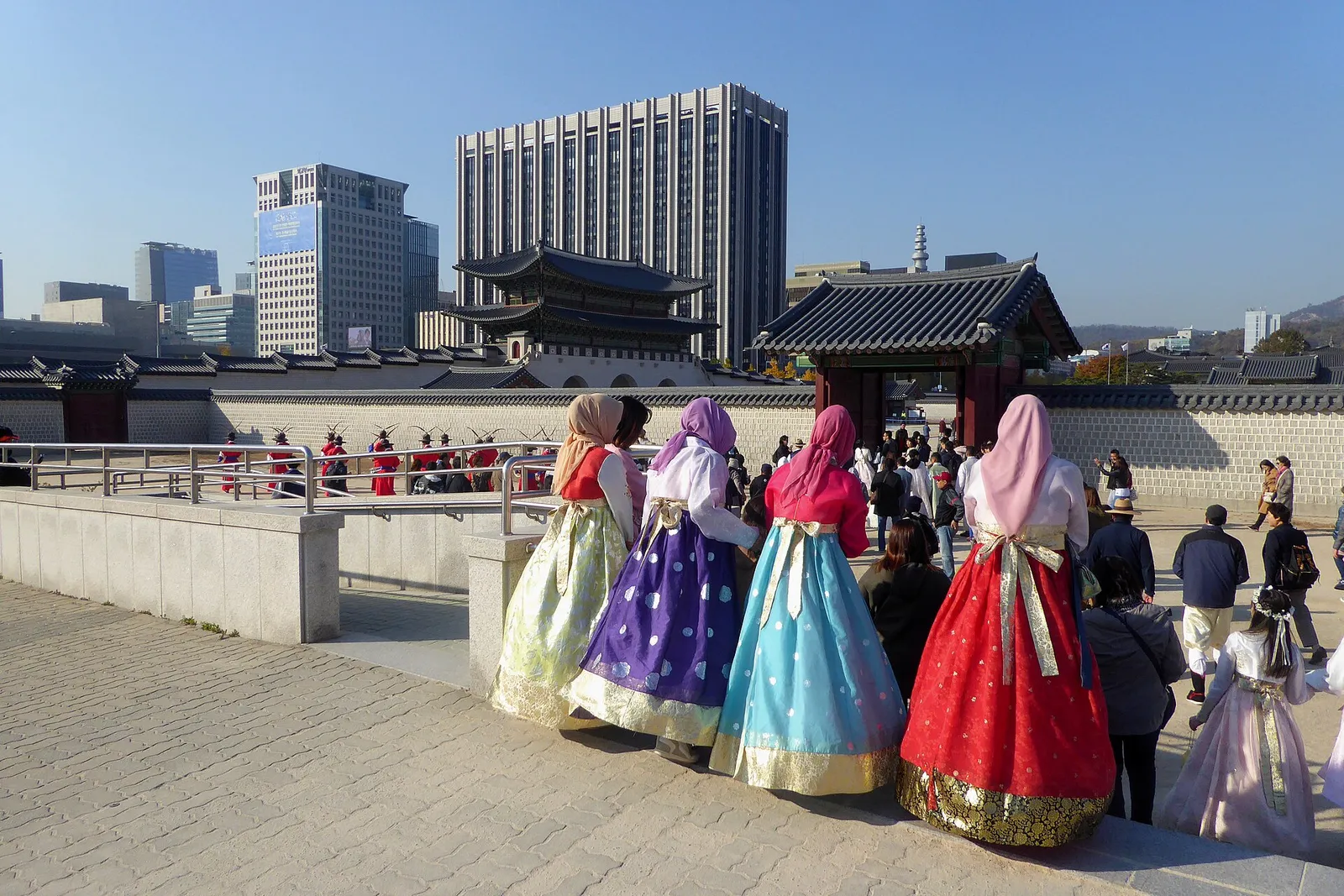
Foreign visitors are treated the same
The Q&A is explicit about this.
Q Is a foreign visitor wearing hanbok eligible for free admission? A Yes. The purpose of free admission for hanbok wearers is to popularise and internationalise hanbok, so visitors are recognised as eligible regardless of nationality.
Nothing distinguishes a rented outfit from your own, either. Borrowing it does not rule you out.
Where the free entry applies
The sites covered:
- Gyeongbokgung Palace
- Changdeokgung Palace (the palace buildings)
- Changgyeonggung Palace
- Deoksugung Palace
- Jongmyo Shrine
- the Royal Tombs of the Joseon Dynasty
Changdeokgung’s Huwon is the only exclusion
This is the single exception.
Huwon, the Secret Garden at Changdeokgung, is ticketed separately from the palace buildings at ₩5,000, and the only people who enter it free are children aged 6 and under, national merit recipients and registered disabled visitors. Hanbok wearers are not on that list.
So if you go to Changdeokgung in hanbok, the palace buildings are free but Huwon still has to be paid for.
What you actually save
These are the standard fares. Koreans and foreign visitors pay the same amount; only the age thresholds differ.
| Site | Admission |
|---|---|
| Gyeongbokgung | ₩3,000 |
| Changdeokgung (palace buildings) | ₩3,000 |
| Changdeokgung Huwon | ₩5,000 — hanbok does not make this free |
| Changgyeonggung | ₩1,000 |
| Deoksugung | ₩1,000 |
| Jongmyo | ₩1,000 |
Doing all four palaces plus Jongmyo comes to ₩9,000. A combined ticket brings that down to ₩6,000. In hanbok it is nothing at all.
Check this first
Foreign visitors aged 18 and under, or 65 and over, already get in free without hanbok. So do pregnant visitors with one companion, and registered disabled visitors with one companion. Admission is also free on Culture Day, the last Wednesday of every month, Huwon excepted.
Which means the people who actually gain from the hanbok rule are foreign visitors aged 19 to 64. And the ceiling on what you save is lower than it looks. Anyone planning to do all five sites would buy the ₩6,000 combined ticket anyway, so the most hanbok actually saves you is ₩6,000. For a single palace it is ₩1,000 to ₩3,000. If wearing the clothes is the point in itself that is a different matter, but on admission alone, that is the arithmetic.
Gyeongbokgung night viewing is the most useful part of this post
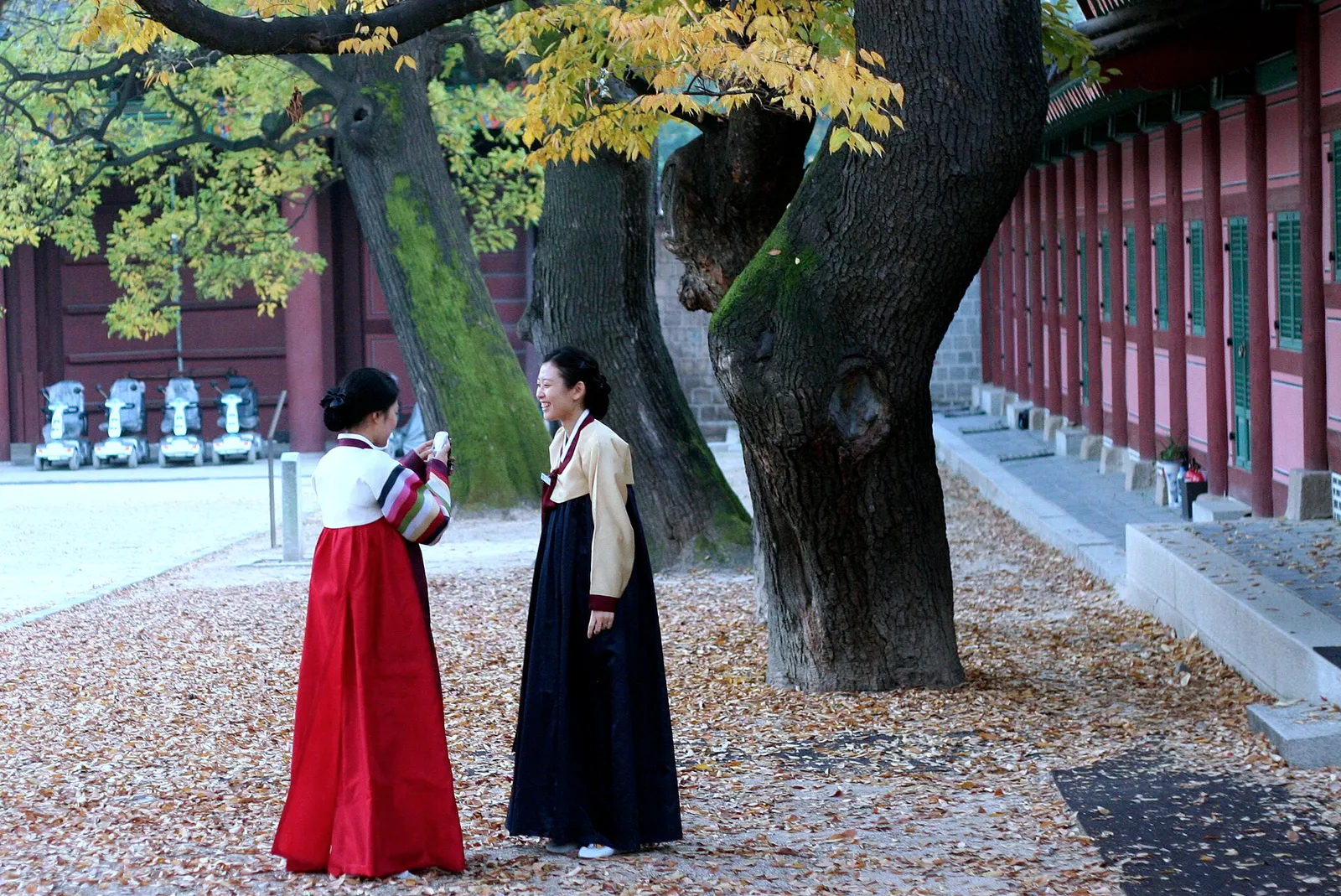
Tickets for the Gyeongbokgung night viewing go fast. There are 3,300 places a day: 3,000 online and 300 at the gate, the on-the-day ones reserved for foreign visitors. That 3,300 is the cap on paid admissions, so free entrants sit outside it.
But the official notice says this.
Free admission: no limit on numbers Those eligible for free admission include … Korean and foreign visitors wearing hanbok … Those eligible for free admission do not need to book in advance
In hanbok you walk in without a booking and with no cap on numbers. A sold-out night makes no difference.
The same notice also carries this line.
Visitors in hanbok are admitted after their outfit is checked against the hanbok free admission guideline. Hanbok that does not meet the rules will not be admitted.
They really do check, at Heungnyemun Gate. Turn up in a one-piece or a T-shirt-style top and you will not get in. That is why the first half of this post matters.
For the second half of 2026 the night viewing runs from 2 September to 2 October, and it does not operate on Mondays or Tuesdays. Hours are 19:00 to 21:30, with last entry at 20:30.
One more thing. The free-entry list at night is not the same as the daytime one. At the night viewing the only foreign visitors admitted free are children aged 6 and under, visitors aged 65 and over, and people in hanbok. The under-18 category that is free during the day does not apply after dark. So for a teenage traveller, hanbok is more useful at night than it is in the daytime.
Taking photographs
Photography inside the palaces is governed by the Regulations on Visiting Palaces and Royal Tombs. Most of it is nothing to worry about, but a few clauses can get you stopped if you do not know them.
Ordinary souvenir photography by visitors needs no permit. The regulations treat it as already permitted. Photographing yourselves in hanbok falls under this.
There are exceptions, though.
- Non-everyday costume such as character outfits, mascot suits and air suits, along with comparable props, requires a separate permit application. Hanbok is not in this category, but cosplay is another matter.
- Photography in particular areas can be restricted to prevent congestion. The regulations also provide that photography may be restricted at the Royal Tombs, Jongmyo and Chilgung given the special character of those places. All three are spaces of ancestral rites and burial. For reference, Chilgung is not on the hanbok free admission list given earlier.
- Drone photography is effectively off the table. It is permitted only for a public institution acting in the public interest, or where the director-general allows it, and even then a separate Ministry of National Defense aerial photography permit is needed.
Commercial shoots are a separate matter. Advertising, drama and variety filming all require permission.
What could not be verified
Stated plainly.
Nothing about rental shops could be confirmed from an official source. No page of the Royal Palaces and Tombs Center or the Korea Heritage Service carries any information on rental shops, rental prices or rental durations. Tourism agency sites were either blocked or had search functions that did not work.
That is why no rental prices appear in this post. Check the price at the shop itself.
Whether the hanbok exemption extends to other paid programmes could not be confirmed either. The Changdeokgung Moonlight Tour and the paid Royal Culture Festival programmes are different in kind, and the only notice that names hanbok wearers as free admission was the Gyeongbokgung night viewing one.
The guideline’s revision date and effective date are not shown on the page either.
In short
- Two requirements only — a jeogori with a wrapping collar, plus a bottom half. Goreum are not needed.
- Modern everyday hanbok counts, and there is no restriction on fabric.
- What fails — a T-shirt-style jeogori, a one-piece hanbok, a jeogori with jeans, hanbok bottoms with a T-shirt, a durumagi alone.
- Hair and shoes are irrelevant.
- Free at the four palaces, Jongmyo and the Royal Tombs, with Changdeokgung’s Huwon the one exclusion.
- Gyeongbokgung night viewing is free in hanbok with no booking. They check at the gate.
- Foreign visitors aged 18 and under, or 65 and over, are free without hanbok anyway.
When you rent, check one thing only. Does the jeogori have a collar that wraps across the front, and is the bottom half a separate garment? Both of those, and you are through.
Read next: things to do in Jongno and travelling in Korea over Chuseok.