 Now, Yeogi
Jeju's Aewol Coast Road: Cafés, the Handam Walk and a Stone Salt Field (2026)
The Aewol coast on Jeju's north-west shore: a 9 km drive starting 10 km from the airport, the 1.2 km Handam clifftop walk, why the cafés clustered here, and when to come to avoid the crowds.
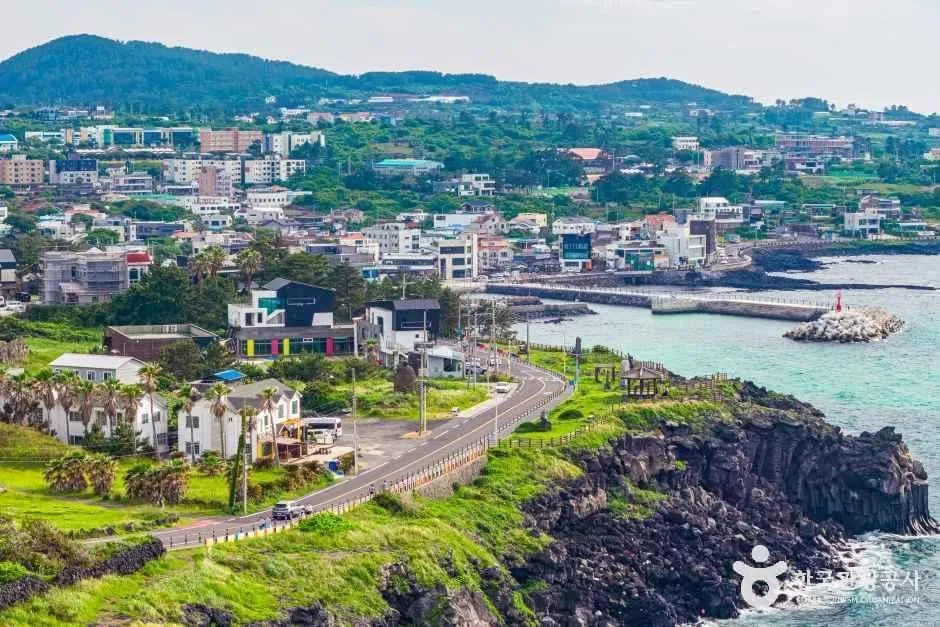
Places in this post
- Address
- Gueom-ri, Aewol-eup, Jeju City
- Hours
- Open at all times, year-round
- Menu
- Access Free
- Tip
- It starts about 10 km from the airport and runs roughly 9 km. There is a dedicated cycle lane and a footpath alongside, and the road forms part of Jeju Olle Route 16.
- Address
- Gwakji-ri, Aewol-eup, Jeju City
- Hours
- Open at all times, year-round
- Menu
- Access Free
- Tip
- 1.2 km from Aewol Harbour to Gwakji Gwamul Beach, also called the Gwakgeum Olle path. It faces west, so it is a sunset walk.
- Address
- 708 Aewolhaean-ro, Aewol-eup, Jeju City
- Hours
- Open at all times, year-round
- Menu
- Access Free
- Tip
- The only stone salt field in Korea. When the compartments hold water the surface reflects like a mirror.
Aewol is the stretch of coast on Jeju’s north-west shore that has become, over the last decade, the most café-dense place on the island. This guide does not recommend individual cafés. It explains what the road actually is, how to reach it, and when to go.
Times and prices are as of September 2026.
The coast road
It begins about 10 km from Jeju Airport and runs roughly 9 km along the north-west shoreline. Free, open at any hour.
It is not only a driving road. There is a dedicated cycle lane and a footpath alongside it, and this stretch forms part of Jeju Olle Route 16, so walkers and cyclists use it as much as cars do.
Several places along it are worth stopping for: Gueom Harbour, the Sineom-ri breakwater, Gonae Harbour, the Darak rest area and the rock formation known as the Big Stone Face. Driving it end to end without stopping misses the point.
Why the cafés are here
Geography. The shoreline curves and the road runs tight against the water, so a great many roadside buildings look straight out to sea. And it is close to the airport: twenty minutes from picking up a rental car.
The result is that cafés, restaurants and guesthouses have filled these nine kilometres. The road itself is the destination rather than any one business on it.
The honest corollary is that it is busy. Parking is difficult on weekend afternoons and the better-known places build queues. Come in the morning and it is a different place.
The Handam coastal trail
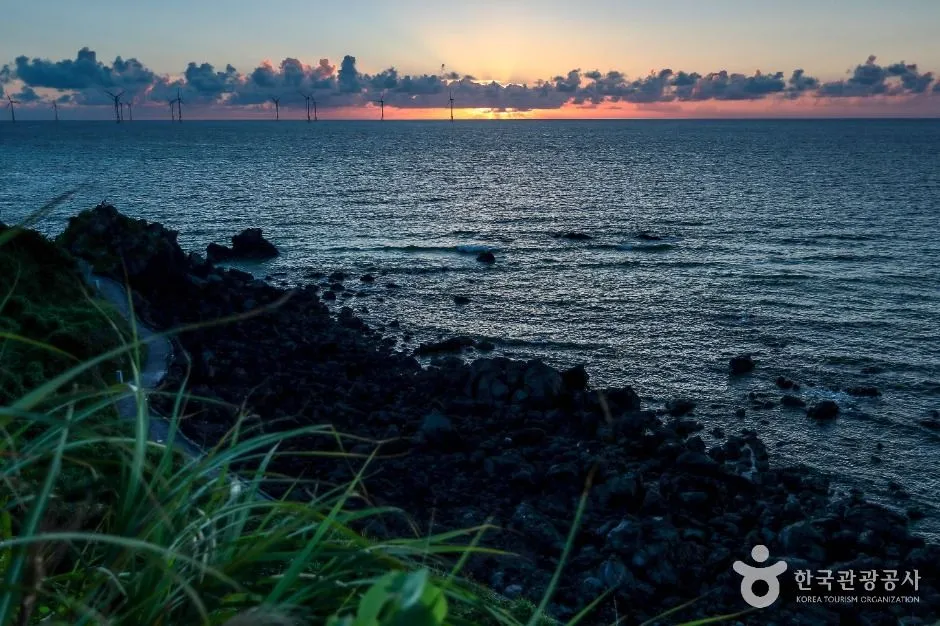
If you want to get out of the car and walk, this is the one. The Handam Coastal Trail (한담해안산책로) runs 1.2 km from Aewol Harbour to Gwakji Gwamul Beach, and is also known as the Gwakgeum Olle path. Free and always open.
The waves break beside you for most of it. The path threads between weathered lava formations along a shoreline of black rock, twisting rather than running straight. In 2009 Jeju City named it one of thirty-one “hidden scenic spots” on the island.
It faces west, so the sunset is the reason to time it. The walk takes well under an hour, so start it an hour before the sun goes down.
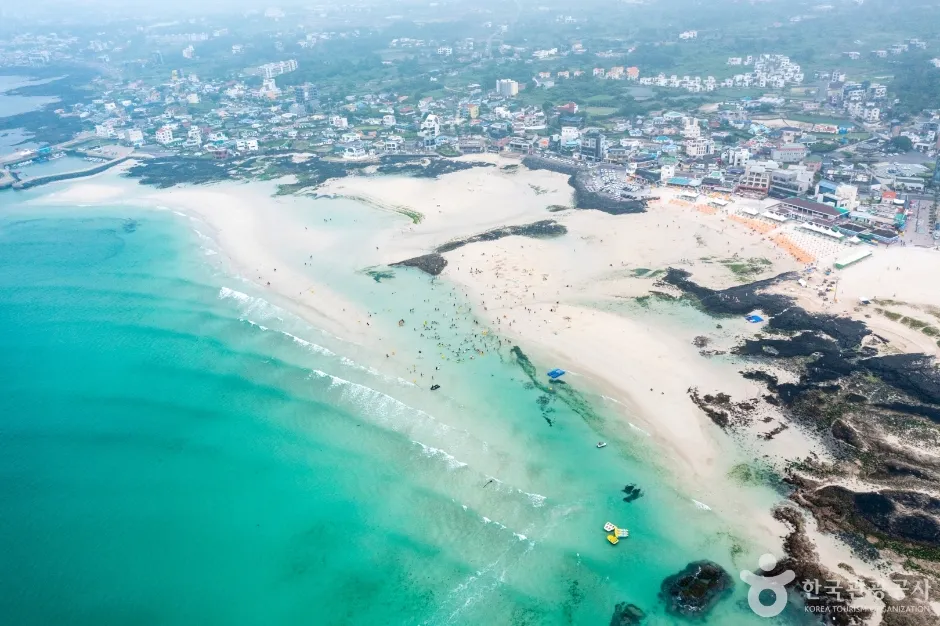
Gwakji Beach
The trail ends at Gwakji Beach (곽지해수욕장), free and open at all times.
It has one unusual feature. At the far end is Gwamul Nocheontang, an open-air bathing spot fed by spring water that, according to local tradition, soaks into the ground on Hallasan and surfaces here at the sea. It is divided into men’s and women’s sides and it is meant for rinsing the salt water off after swimming.
Gwakji-ri is an old village where prehistoric shell middens have been found. Local legend says a village once stood where the beach is now and was buried in sand overnight.
The stone salt field
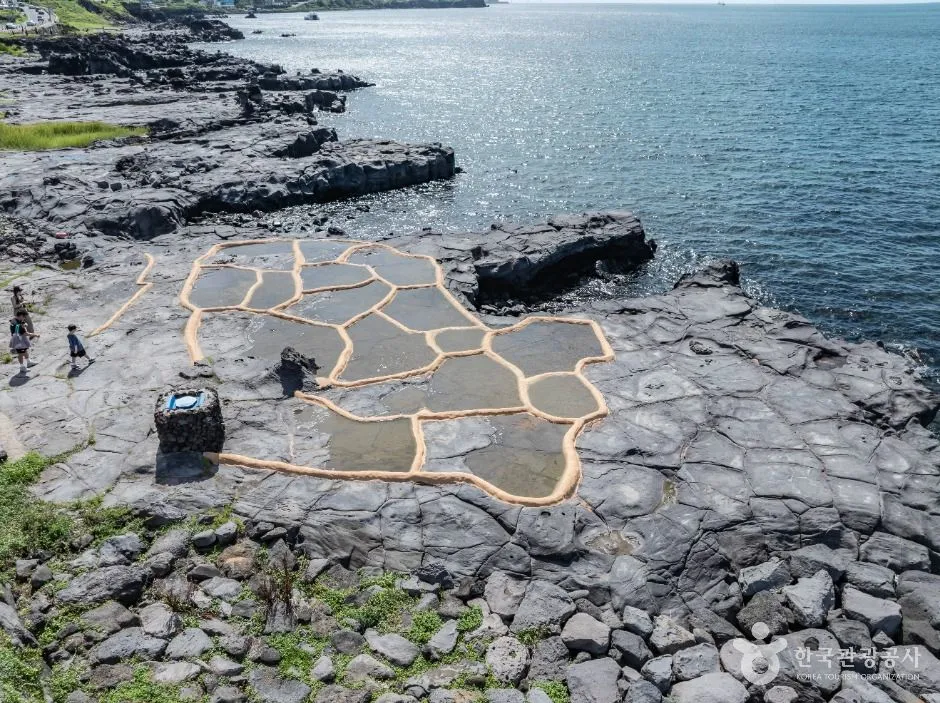
At 708 Aewolhaean-ro is Korea’s only stone salt field, known locally as sogeum billae. Free and always open.
Villagers built low earth walls across a broad shelf of cracked basalt, flooded the compartments with seawater and let the sun do the rest. At its height the salt field covered nearly 5,000 square metres and was a significant livelihood for Gueom-ri.
There is a detail here that says something about Jeju. The salt makers passed the salt field only to their eldest daughters. Jeju’s women have historically carried more of the island’s working life than on the mainland, and the inheritance custom reflects it.
It operated into the 1950s before cheap mainland salt ended it, and has since been restored as a heritage site. When the compartments hold water, the surface reflects like a mirror.
A half-day route
Leave the airport around 10:00 and stop first at the Gueom stone salt field. Follow the coast road slowly, pulling over at the harbours and rest areas, then walk the Handam trail to Gwakji Beach. Pick a café anywhere along the way. Time the return for sunset.
Twenty minutes further west is Hyeopjae Beach, which turns a half day into a full one.
Practical notes
- Go in the morning. Weekend afternoons mean difficult parking and queues.
- Check café prices before ordering. The sea view tends to be reflected in them.
- A bicycle works here, thanks to the dedicated lane.
- Sunset is the strength. This is the island’s west-facing coast.
- Buses reach Aewol, but stopping at will along the coast road really needs a car.
Wrapping up
Aewol is not a place you pick one café and drive to. It is nine kilometres of road to use slowly: start in the morning, stop at the salt field and the Handam path, drink your coffee wherever the view suits you, and stay until the sun goes down.
More in this series: the Jeju overview, what to see and what to eat.