 Now, Yeogi
Your First Jjimjilbang: What You Wear, Tattoos, and Sleeping Over (2026)
A first-timer's guide to the Korean bathhouse, checked against the law itself. Where you are naked and where you must be dressed is set by the Enforcement Rule, not by custom; there is no legal basis anywhere for a tattoo ban; and sleeping over is a stranger arrangement than most travellers expect.
A jjimjilbang is a Korean bathhouse with hot rooms attached: you bathe, then sit in a heated common area in an outfit the place issues you. Foreign visitors want to try it and dread trying it, because nobody tells them where you undress, what you put on, or whether tattoos will get you turned away. This post answers that from the law — from the Public Health Control Act and its Enforcement Rule.
The law has no word for “jjimjilbang”
The Act does not separate bathhouses, saunas and jjimjilbang. They are one legal business category, 목욕장업, the bathhouse business. The word “jjimjilbang” never appears in the statute; the Enforcement Rule’s term is 발한실, a sweating room.
What the law divides is not businesses but two services:
- (a) a facility where you can wash with water
- (b) a facility where you can sweat from the heat of heated elvan stone, ochre or jade, or from far infrared
A bathhouse is (a), a jjimjilbang is (b), and most jjimjilbang have both.
Where you undress and where you dress is set by law
This is the part visitors find hardest, and it is law, not house custom.
The bathing area — separated by sex, and naked
The Enforcement Rule provides that bathing rooms and changing rooms must not admit men and women together from the age of 4, given as 48 months. So the tubs and the changing room are separated by sex as a matter of law, and in there you take everything off. Swimwear is not the norm.
The same goes for staff: only men may work in the men’s side, only women in the women’s. That includes the seshin attendants, who for a fee scrub the dead skin off you on a table.
The sweating area — mixed sex, and you must be dressed
The provision itself:
Where a mixed-sex sweating room is to be operated, persons may be admitted to it or use it only after putting on the 발한복.
The 발한복 is the jjimjil outfit you have seen in photographs, usually a short-sleeved T-shirt and shorts.
Put plainly: a mixed-sex sweating area may be operated only on condition that people wear the outfit. The shop is not being generous; without it, it cannot legally run a mixed-sex area at all.
So the sequence is this. Strip completely, wash and bathe, then change into the issued outfit for the common area — two different spaces.
Will tattoos stop you getting in
The conclusion first. No provision of Korean law gives any basis for refusing entry because of a tattoo. The Enforcement Rule names only two categories the operator must turn away:
(a) persons recognised as having an infectious disease (c) persons recognised as unable to use the bathhouse properly because of intoxication or the like
Item (b) between them is a deleted provision: the “mentally ill persons” clause, removed in June 2022, nothing to do with tattoos. In the whole body of law, 문신 (tattoo) appears only among the acts prohibited to beauty-salon operators, unrelated to bathhouses.
So any tattoo ban is entirely the individual business’s own rule. Which is why it differs from place to place, and why the only reliable move is to phone ahead.
One precedent worth knowing
No decision of the National Human Rights Commission of Korea specifically about tattoos was found, but there is a precedent on refusal of bathhouse entry because of appearance.
In 2012 the Commission found that a Busan sauna refusing entry to a naturalised woman from Uzbekistan — because she looked foreign and might transmit HIV — was racial discrimination without reasonable cause, and recommended the owner not refuse bathhouse use on grounds such as race.
The National Human Rights Commission of Korea Act lists physical conditions such as appearance among the grounds of discrimination, and treats exclusion from commercial facilities as an equality violation.
One more thing — hair dye
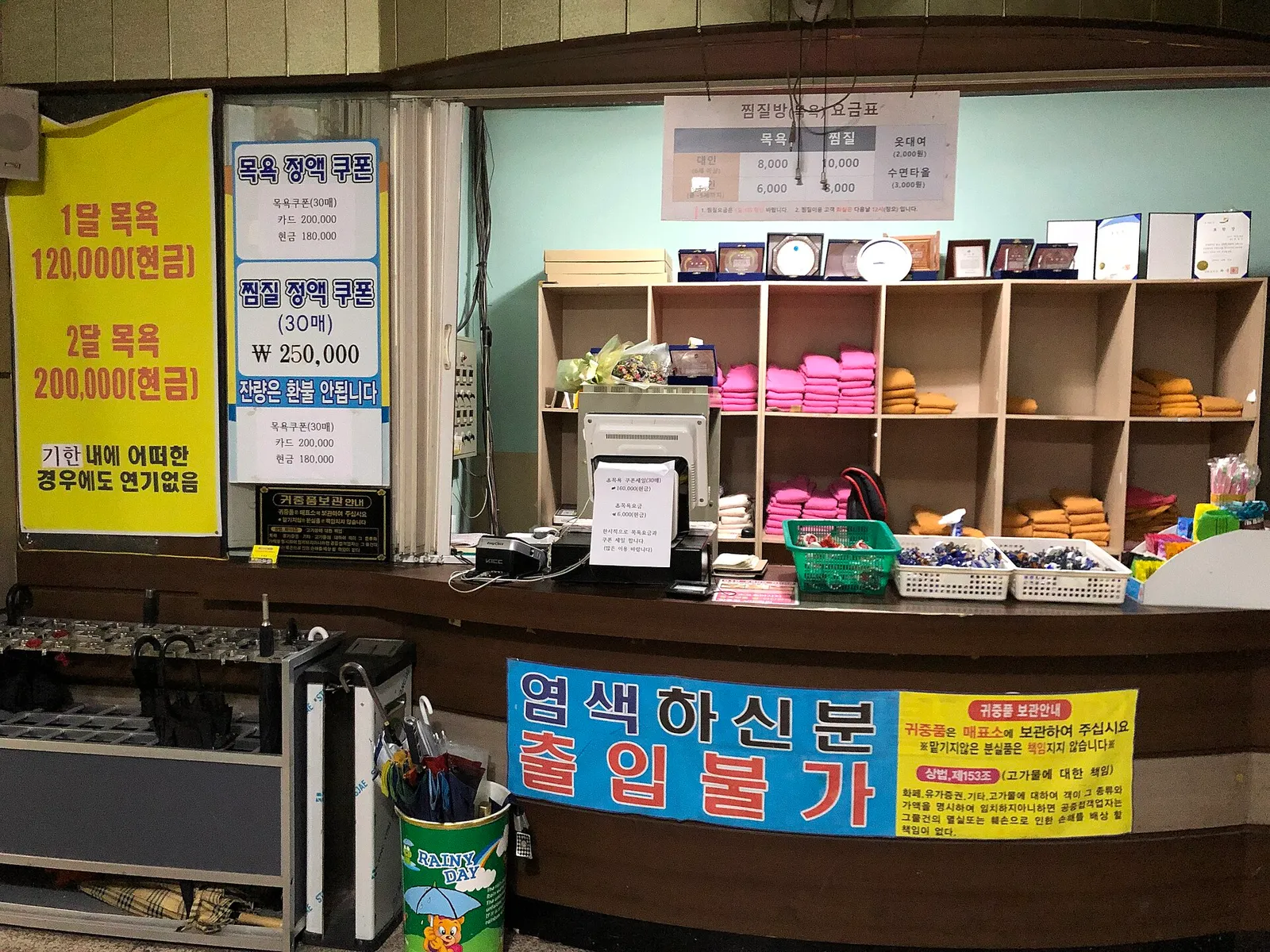
The counter photograph carries a large notice saying people who have just dyed their hair may not enter. Also a house rule, not law, and it catches people out.
How the pricing works
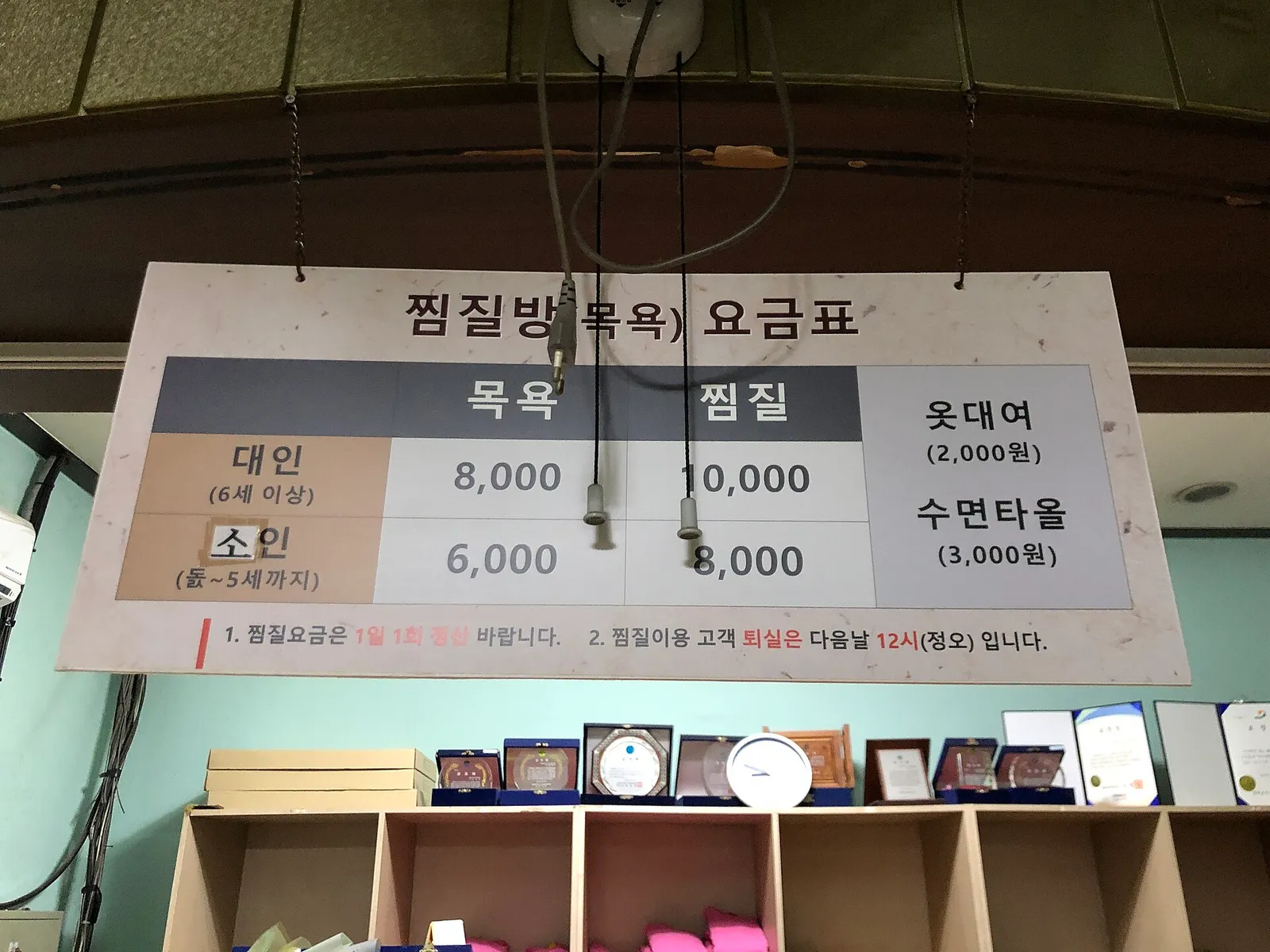
Posting the price list at the counter is a legal obligation.
Bathing and jjimjil are priced separately, with outfit rental and sleep towels itemised on their own. Seoul Tourism Organization listings show the variation: one venue charges sauna ₩13,000 (about $9.75) and jjimjilbang ₩15,000 (about $11.25), or ₩17,000 (about $12.75) at night; another charges ₩2,000 (about $1.50) for outfit rental on top of admission.
You cannot generalise that the outfit and towel are included. The law requires only that anything provided be freshly laundered.
And there is no government statistic for “jjimjilbang admission” at all. The official series is “bathing: one adult visit to a general public bath”, whose Seoul figure went from ₩6,538 (about $4.90) in August 2016 to ₩11,000 (about $8.25) in August 2026 — a public bath, not a jjimjilbang.
One venue’s official page also describes a post-payment system in which everything except admission is charged to the locker key and settled on the way out. One venue’s description, not a universal rule.
Can you sleep the night
Backpackers do it constantly, and legally it is stranger than they realise.
A jjimjilbang is not a lodging business. And the Enforcement Rule prohibits keeping bedding; what is permitted goes as far as large towels and pillows. What the law envisages is “temporary sleep or rest”. So it is a floor and a towel, not a room with a bed.
Yet the Seoul Tourism Organization’s own article writes that jjimjilbang are sometimes used as accommodation, while the Korea Tourism Organization’s English accommodation guide does not list them. The official sources disagree.
The Enforcement Rule does assume 24-hour businesses exist, since it sets a late-night curfew for young people at them, within a 22:00 to 05:00 range.
Not every jjimjilbang is 24 hours, though. One Seoul Tourism Organization listing shows hours of 07:00 to 22:00, and the price board above says jjimjil customers check out at noon the next day. Check first.
What you do inside
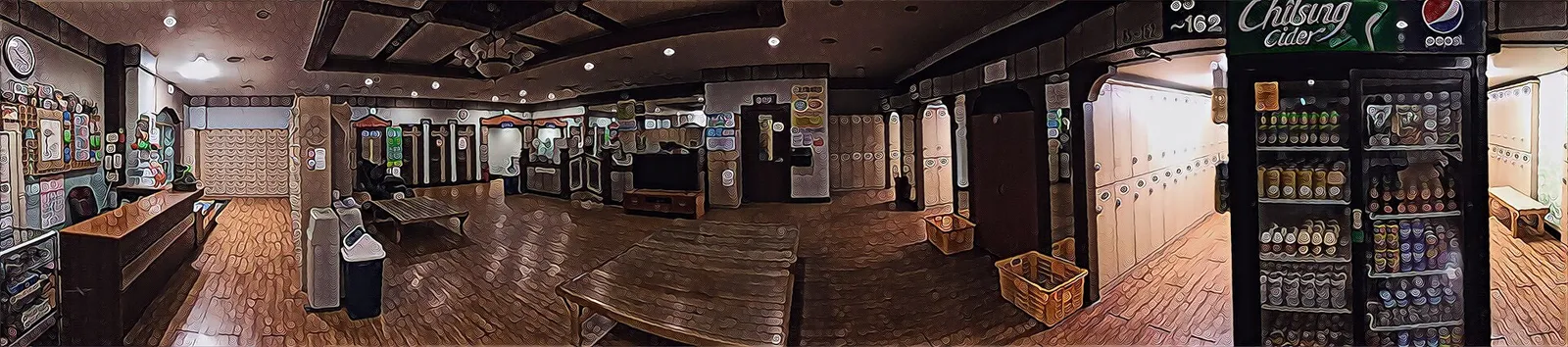
The facilities the law recognises are the bathing room, changing room, sweating room, convenience facilities (shop, restaurant, gym, hair salon) and a rest area including a sleeping room. The Korea Tourism Organization’s English page describes the standard experience as a towel rolled onto your head, boiled eggs, and sikhye.
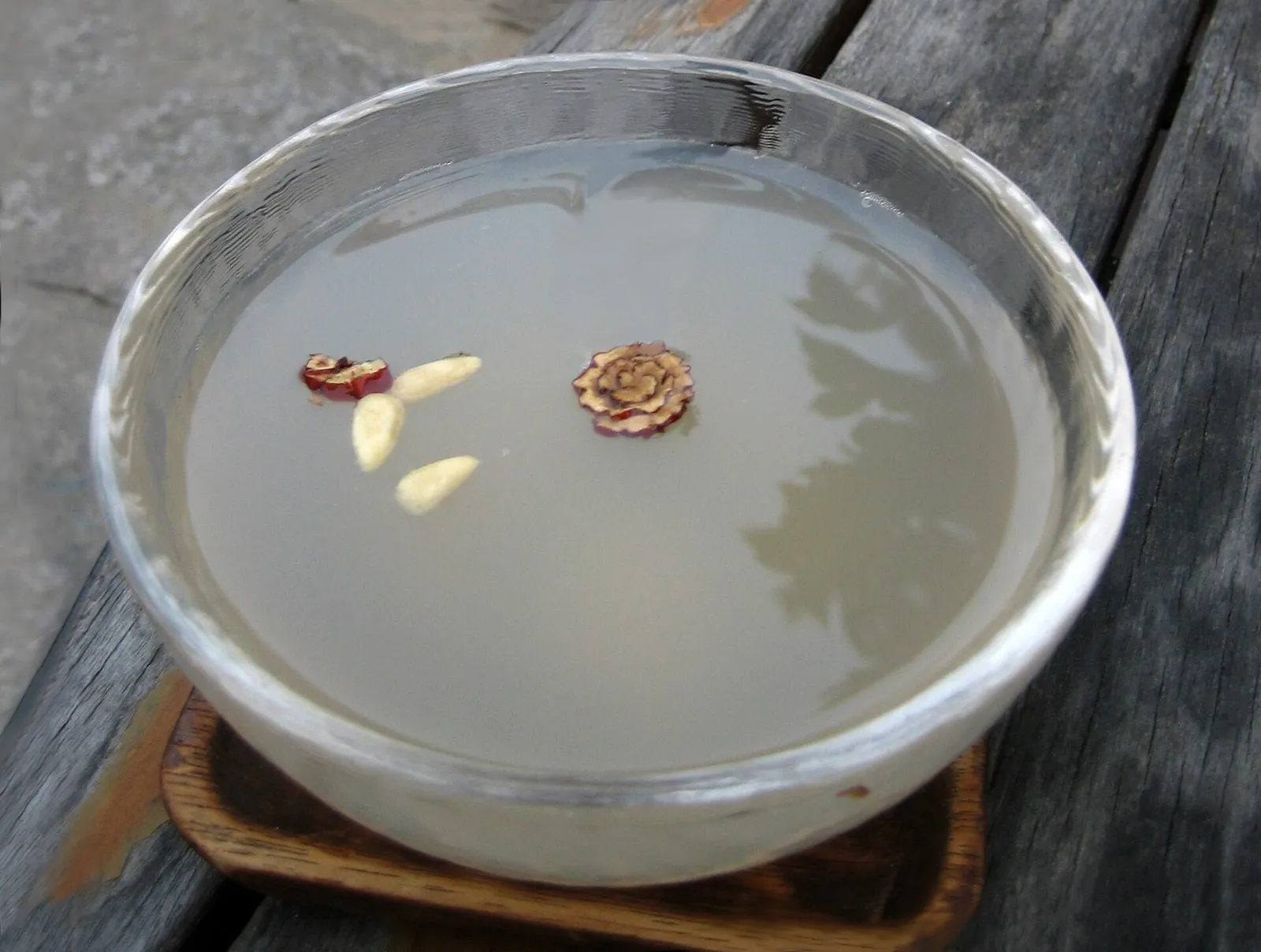
Sikhye is a sweet drink made from rice, served cold — the emblem of the whole institution.
One design feature: the Enforcement Rule forbids making sweating rooms and rest areas into closed rooms and requires the interior to be visible. That is why everything is so open.
Health and safety
Keeping a thermometer in the sweating room and posting a notice of bathing precautions are legal obligations. Of the groups the law lists, these matter most to a traveller:
- people with severe heart disease
- people with a systolic blood pressure of 180 or above
- people within two hours of drinking alcohol
There is, however, no legal upper limit on the temperature of a sweating room.
The Korea Consumer Agency reported bathhouse injury reports rising from 151 in 2021 to 574 in 2024, an average 56.1% a year over four years, of which 89.3% were slips and falls and 62.9% of the injured were aged 60 or over. Walk slowly.
As for the water: testing at least once a year; with filtration plus chlorine, weekly measurement of temperature and free residual chlorine; and a Legionella test once a year.
They are disappearing
Registered bathhouse businesses nationwide peaked at 10,098 in 2001 and stood at 5,668 in 2025, down roughly 44%. Seoul is worse: 2,163 in 1999 to 668 in 2025, down about 69%. And in Seoul only 189 of the 673 operating bathhouses — 28.1% — have sweating facilities.
So do not assume the bathhouse near your hotel has a jjimjilbang in it.
Practical summary
- The order — shoes in the shoe locker, outfit and towels at the counter, undress, wash and bathe, then change into the jjimjil outfit for the common area.
- No swimwear in the bathing area. Naked is the rule.
- The jjimjil outfit is compulsory in the mixed-sex area.
- With tattoos, phone ahead. No law bans them; some businesses do.
- After alcohol, wait two hours. It is named in the law.
- Check the posted price list for whether the outfit is included, and the closing time before planning to sleep there.
Wrapping up
A jjimjilbang needs almost no language: you are handed clothes, you undress, you wash, you dress, you sit down.
What confuses people is not the rules but where you take clothes off and where you put them on, and that is settled by law. Tubs: separated by sex, naked. Sweating area: mixed sex, outfit on. Remember that and the rest follows.
And if a tattoo has held you back, it is the shop stopping you, not the law. One phone call settles it.