 Now, Yeogi
Gwangjang Market Food: What Changed After the Overcharging Controversy (2026)
A guide to eating at Gwangjang Market: why the food alley is the only part open on a Sunday and stays open until 11pm, what bindaetteok and yukhoe and the gimbap are, and what the Seoul Metropolitan Government and Jongno District actually did after the 2023 overcharging controversy, taken from their own press releases.
Places in this post
- Address
- 88 Changgyeonggung-ro, Jongno-gu, Seoul
- Hours
- Hours differ by section (see above)
- Menu
- Food Alley Daily 09:00-23:00, open all year · General section Mon-Sat 09:00-18:00, closed Sundays · Vintage clothing arcade Mon-Sat 10:00-19:00, closed Sundays
- Tip
- 62 metres from exit 8 of Jongno 5-ga Station on Line 1. On a Sunday only the food alley is open.
Gwangjang Market is the traditional market foreign visitors come to most in Seoul. It is also the place that has been at the centre of Korea’s loudest overcharging row for the past three years.
This post does two things. It tells you what you eat there, and it sets out what the Seoul Metropolitan Government and Jongno District actually did after that row. The second part comes entirely from official press releases, not from news coverage.
Opening hours first
This is the thing visitors get wrong. The hours differ by section.
| Section | Hours | Closed |
|---|---|---|
| Food Alley | Daily 09:00–23:00 | Open all year |
| General section (clothing, fabric, dried goods) | Mon–Sat 09:00–18:00 | Sundays |
| Vintage clothing arcade | Mon–Sat 10:00–19:00 | Sundays |
Come on a Sunday and it is food only — no clothing, no fabric, no vintage shopping. The reverse holds too: if you are only here to eat, Sunday is fine, and the alley runs until 11pm.
These are market-level figures, though. The actual hours of individual stalls are not published in any official source.
Getting there, and the name
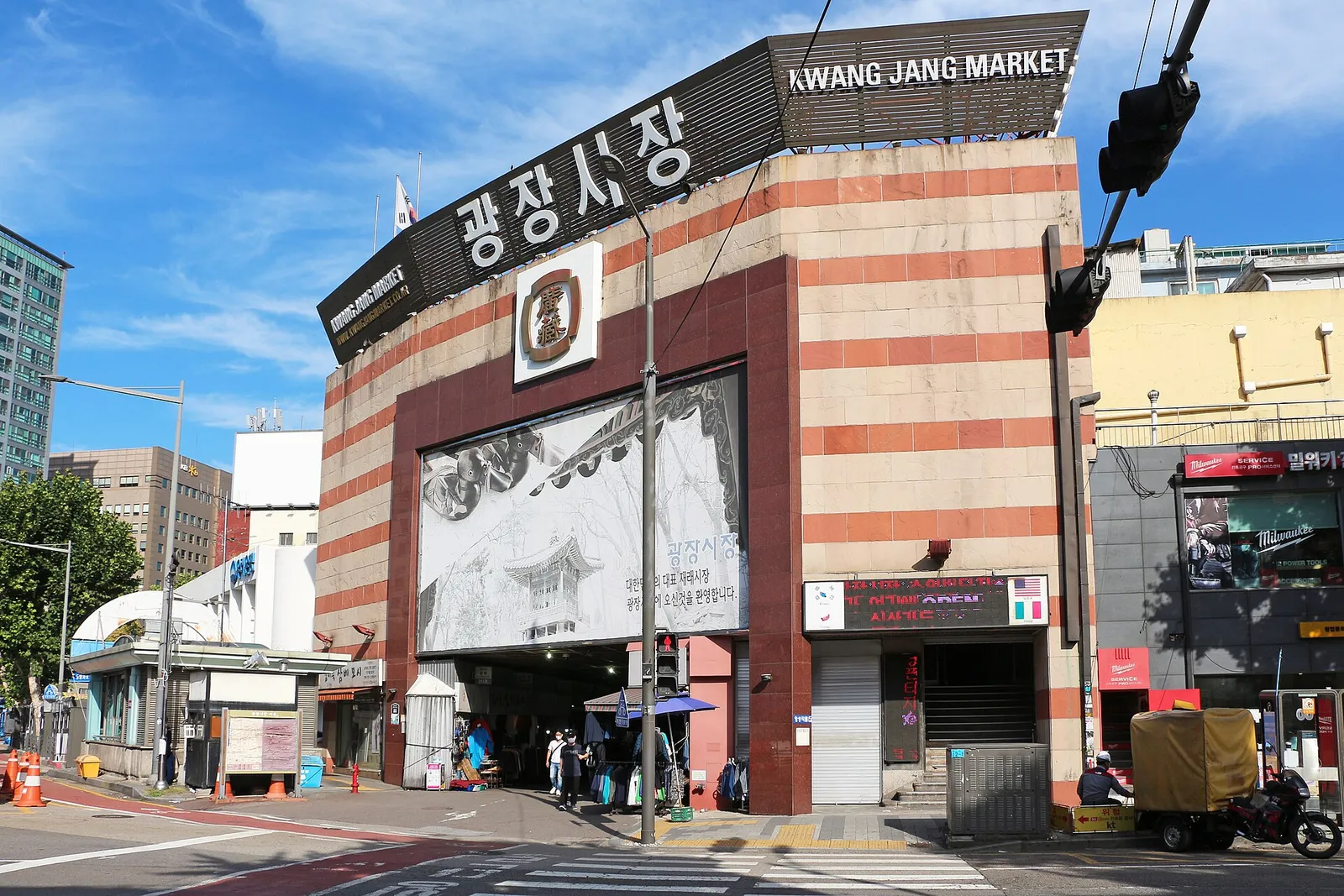
The address is 88 Changgyeonggung-ro in Jongno-gu, and Jongno District counts 685 shops.
- Line 1, Jongno 5-ga Station, exit 8 — 62 metres
- Lines 2 and 5, Euljiro 4-ga Station, exit 4 — about 100 metres
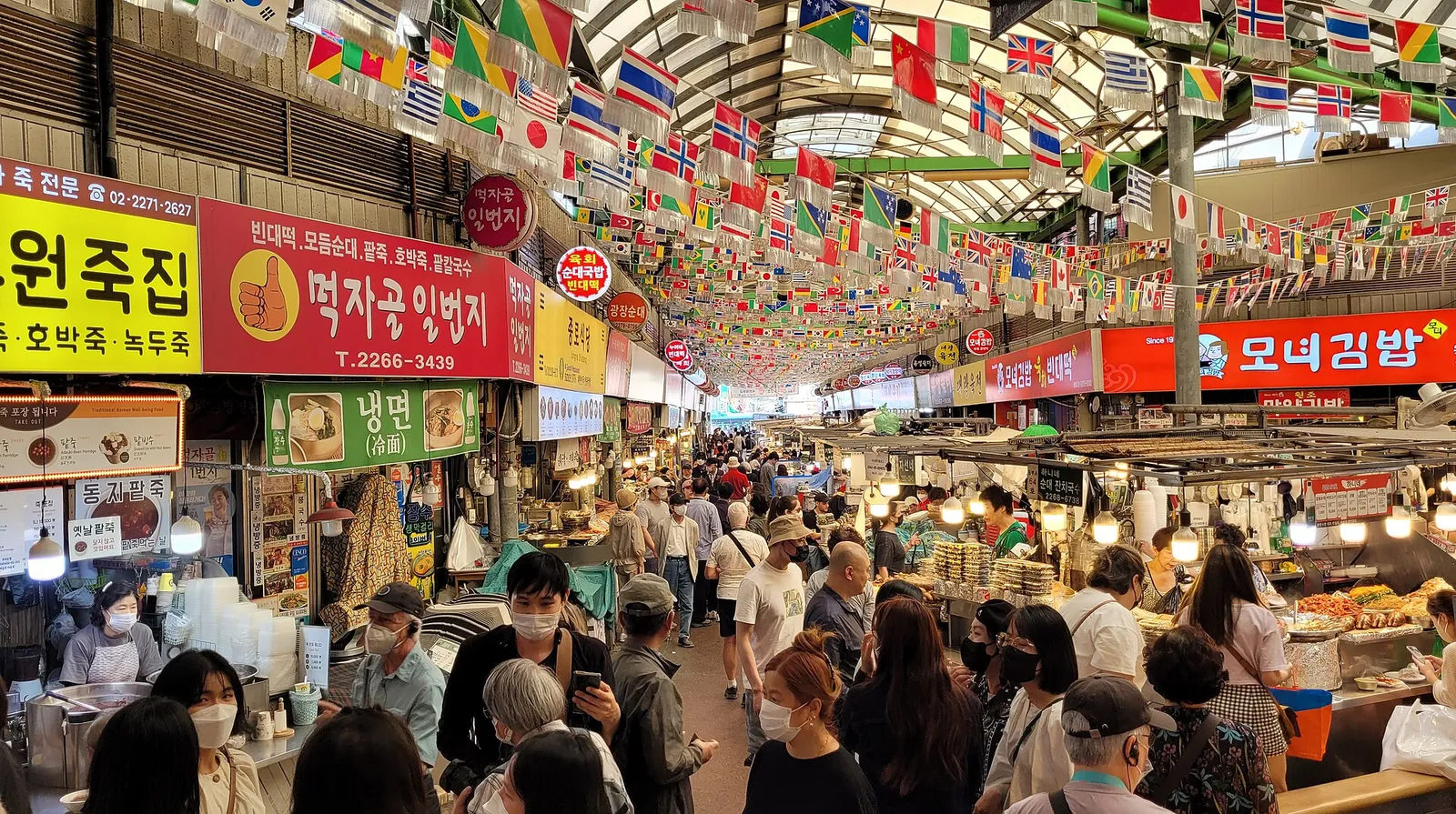
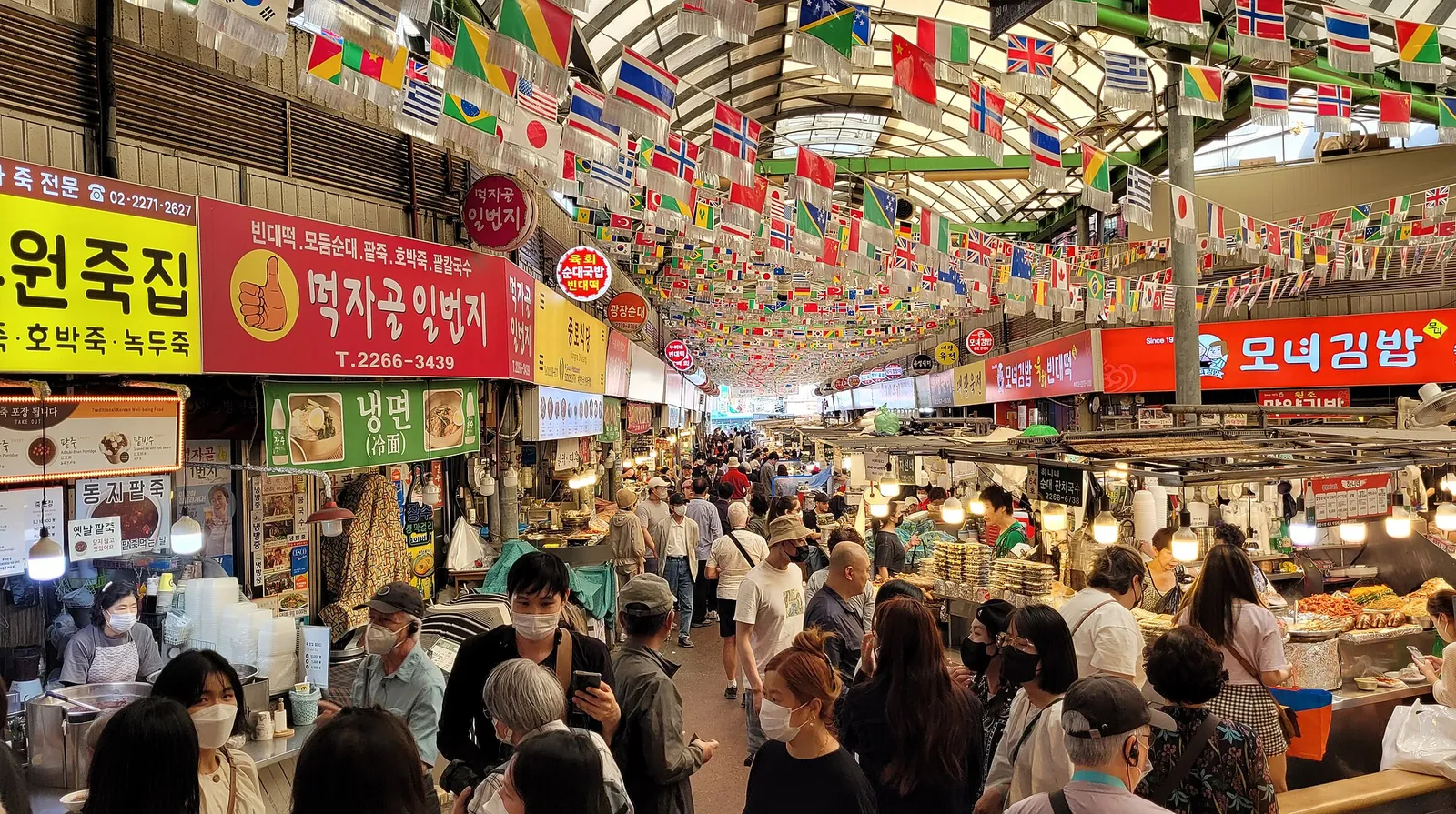
The name is spelled two ways. The government romanisation is Gwangjang, but as in the photograph above, the sign on the market building and the address of the official website both read KWANG JANG. If one spelling turns up nothing in your map app, try the other.
What to eat
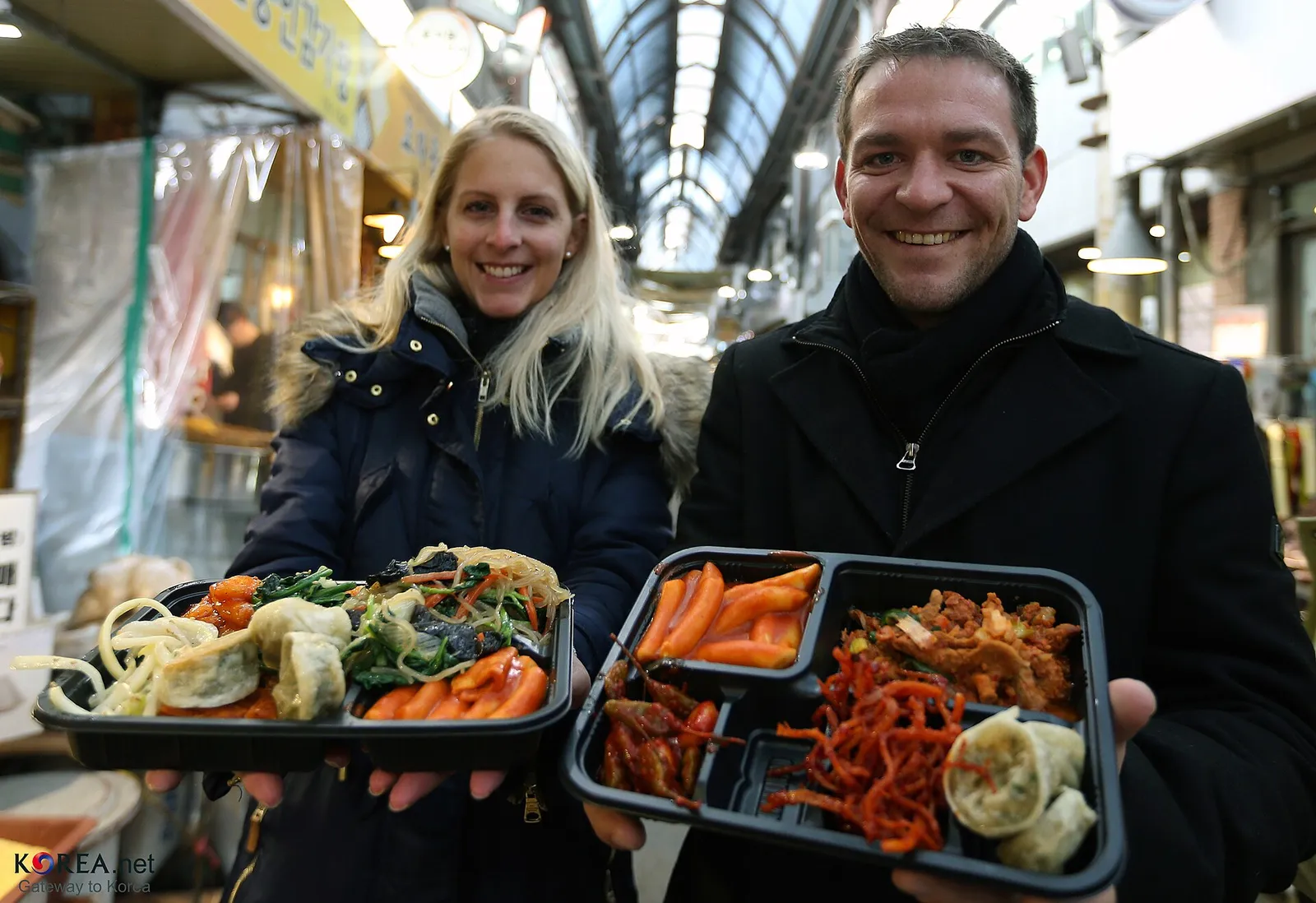
The Seoul Tourism Organization’s official page names these as the market’s signature foods: bindaetteok, modum-jeon, gimbap, sundae, head meat, yukhoe, donggeurangttaeng, nokdujeon and tteokbokki. The English version of the page adds fish cake.
Bindaetteok
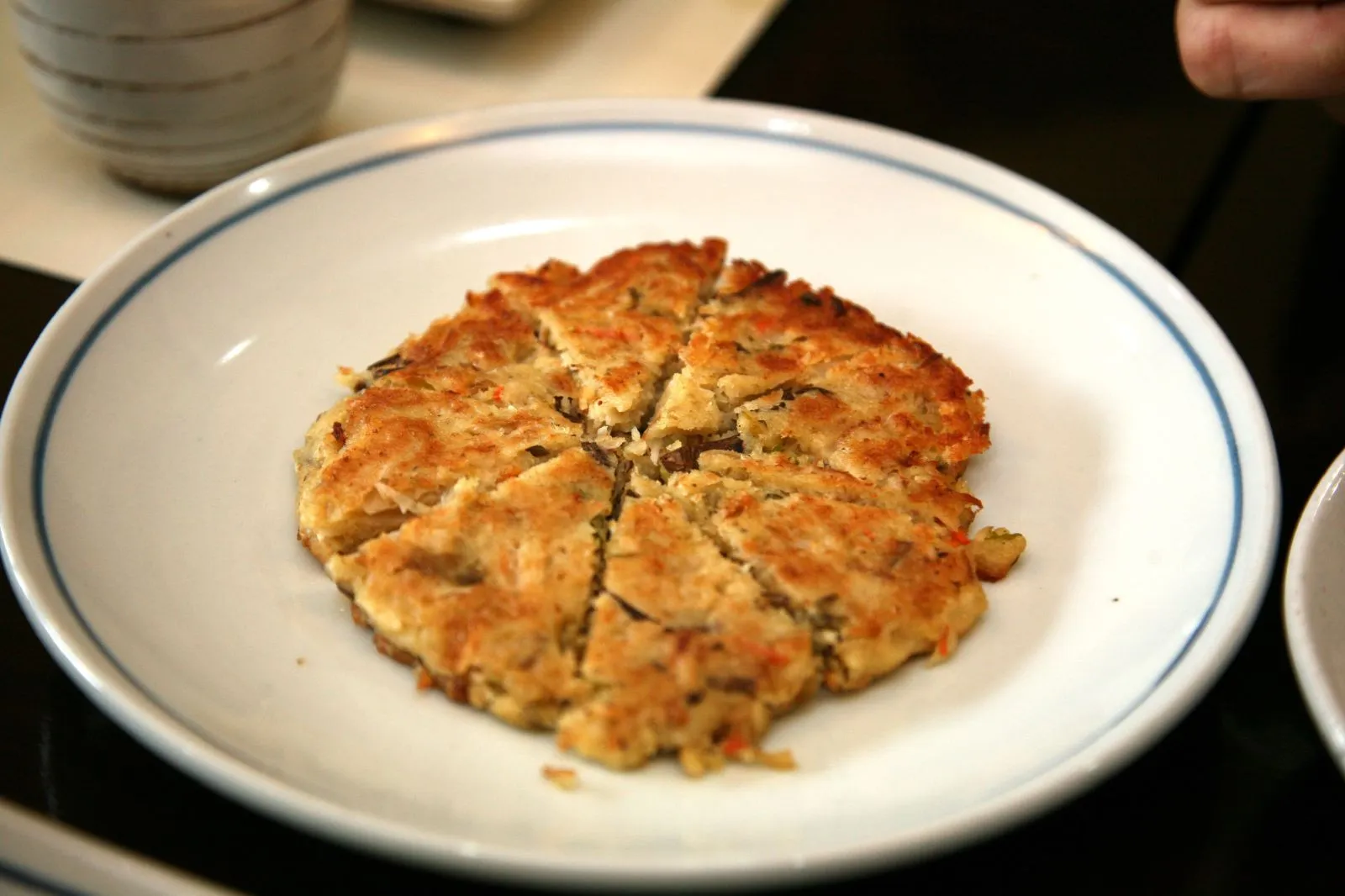
The market’s signature dish: a pancake of ground mung beans, fried until the edges crisp.
An article in the city’s own media outlet gives the origin this way. Refugees from Hwanghae during the Korean War began frying them in shortening that came out of US army bases, and sold them here. That article is a citizen-reporter piece rather than scholarship, so treat the story as a story.
Yukhoe
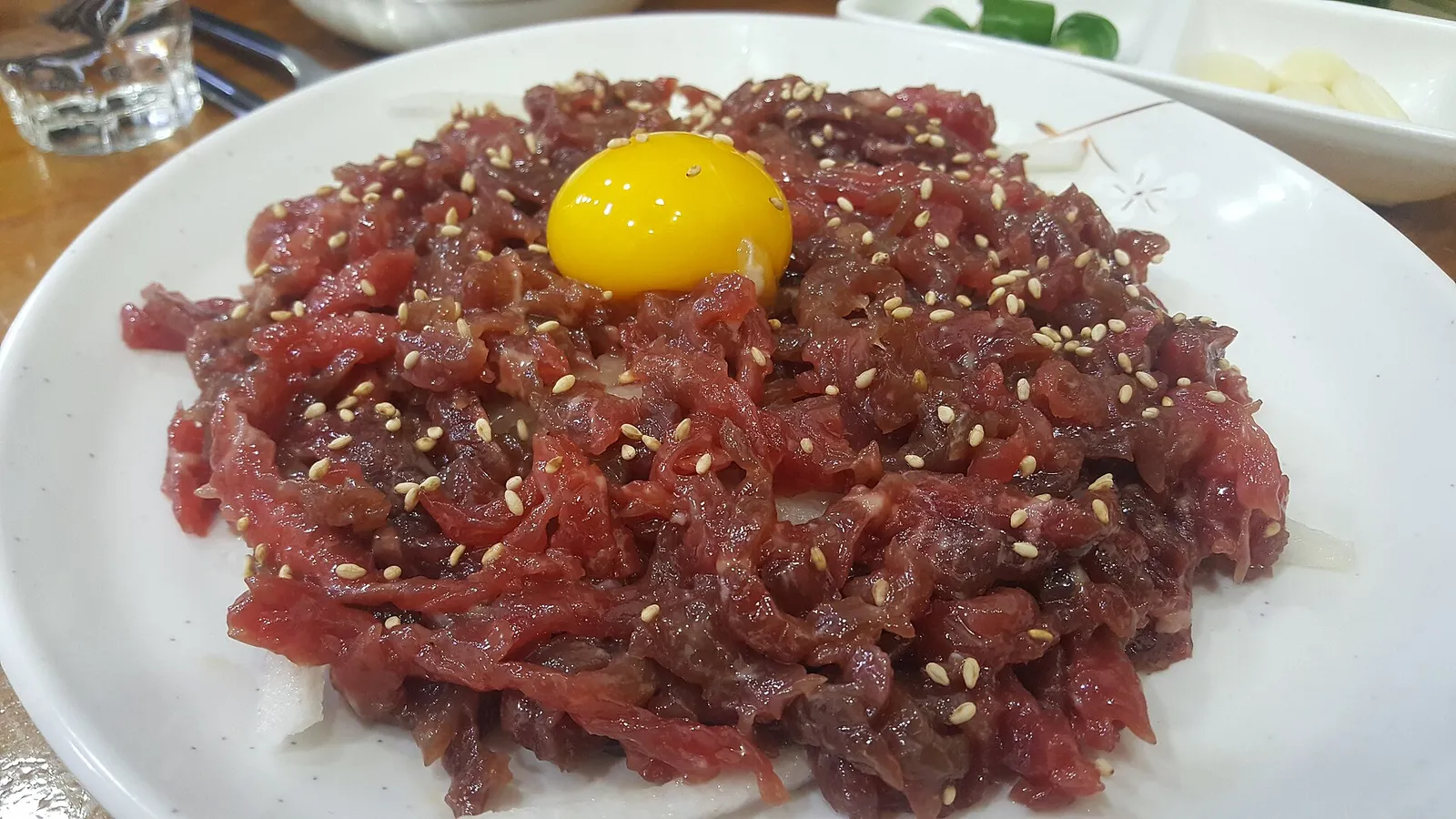
Seasoned raw beef, served with an egg yolk on top. There is a lane where the yukhoe stalls cluster, and an article in the city’s own media outlet describes it as the yukhoe alley with its long queues. It is not an administratively designated zone, though — it is simply what people call it. Same for the jeon lane.
Is it mayak gimbap or kkoma gimbap
Here the official sources disagree with each other.
Seoul’s own media outlet says the name was changed. In its words, public opinion held that mayak, meaning narcotics, should not be a friendly word for children, so the dish was renamed kkoma gimbap, meaning little gimbap.
Yet the Seoul Tourism Organization’s English page still writes “Mayak Gimbap”.
Both are official sites. The policy basis for the renaming, the date it took effect, and what the signs in the market actually say could not be verified. It very likely varies from stall to stall.
What actually happened after the overcharging row
The most useful part of the post. All of it comes from the original press releases of the Seoul Metropolitan Government and Jongno District.
December 2023 — the quantity-labelling rule
Seoul announced a set of measures to stamp out overcharging at Gwangjang Market, drawn up jointly by the city, Jongno District, the merchants’ association and the food-stall traders’ association.
- The quantity must be shown beside the price on the menu, to stop skimpy portions
- Sample models of the signature dishes are placed on display
- Any price increase must first go through a price-consultation body led by the merchants’ association
- Violators face suspension of business and other sanctions
The city’s own explainer article gave the example that made the rule necessary. At the time, one stall charged ₩19,000 for 200 g of yukhoe while another charged ₩28,000 for 300 g. On price alone the two cannot be compared; with the quantity written next to it, they can. That is a December 2023 illustration, not a current price — no current prices appear anywhere in this post, because none are published officially.
On the 19th of that month, the food-stall merchants held a pledge rally and adopted their own rules: one day’s suspension of trading for anyone who skips the training, a full survey of food prices, and graduated penalties according to the number of violations.
2024 — what is on the record in numbers
Jongno District published these figures:
- A multilingual QR menu system — 88 food stalls taking part, giving menus, photographs and prices in 20 languages
- A mystery-shopper monitoring team — 66 Korean and foreign members, 241 inspections, 89 items found to need correction, all fixed on the spot
- Card payment — a card payment agency service newly introduced at 77 stalls that cannot register as businesses
- A full stall survey — the rights holder, operating arrangement and trade name of all 192 street stalls in the market
2025–2026 — the stall real-name system
Jongno District grants road-occupancy permits under Article 61 of the Road Act, fixing the area and the term of each stall. It was announced in November 2025, and Seoul says it comes into force from June 2026.
The penalties are spelled out. Demerits are issued according to the number of violations, escalating through suspension of trading up to revocation of the road-occupancy permit. Lose the permit and the stall cannot trade in that spot.
May 2026 — the joint inspection
The most recent step. Seoul and Jongno District announced an intensive inspection through May and June, becoming a standing regime afterwards.
- Professional mystery shoppers, including foreigners, are sent in. Unfair treatment of foreign customers is a separate item on the inspection checklist.
- A joint price-labelling inspection, covering the 51 categories of retail business that are required to display selling prices. Serious breaches draw fines.
- A hygiene inspection, prompted by a recent controversy over reused ice, covering 159 food businesses and 109 food stalls. Using stock past its use-by date, or failing to display a price label, can mean suspension of business.
So is it fine now
Honestly: the enforcement framework is documented, but no figures have been published for how many businesses have actually been suspended. The results of the May–June 2026 inspection are not out either.
Here is the way to read it instead. Checking the price and the stated quantity is now the normal, expected thing to do, and a label that is missing or does not match is grounds for a complaint.
Practical notes
- Ask the price first. With the quantity-labelling rule in place, the menu should state the quantity. If it does not, ask before you order.
- Bring cash. The card payment agency service arrived in 2024 and covers 77 stalls. There is no basis for assuming every stall takes cards.
- Look for the multilingual QR code. It is at 88 food stalls. Scan it for the menu, photographs and prices.
- Weekends are packed. That is how Seoul’s own article describes it, and queues form on weekdays too.
- On Sundays, only the food alley is open.
- You can report a problem. The grounds are a charge that differs from the posted price, or no price list at all. Call Seoul on 02-120 or the tourist information line on 1330, and bring the receipt or a photograph, the time and the business name — complaints without evidence are not processed.
A little background
Seoul’s own media outlet describes it as Korea’s first permanent market, opened in 1905, which makes it more than 120 years old this year. The primary-source basis for that claim of “first” could not be verified.
It appears in Netflix’s Street Food: Asia. The series is from 2019, and Gwangjang is episode 6, “Seoul, South Korea”. Netflix’s own synopsis says the market’s stalls serve up old Korean favourites from soy-marinated crab to knife-cut noodles.
A Michelin listing could not be verified, because the Michelin site blocks access.
Wrapping up
Gwangjang Market is worth the trip. Nowhere else in Seoul has the density of its food alley.
But there is a reason for writing this post the way it is. The overcharging row really happened, and the authorities really did step in, and you are better off knowing that before you go. Checking the price and the quantity is not rude here; the system was built to make you do it.
Get that right and the rest is just eating.
Read next: Jongno 3-ga pocha street and what to eat in Jongno.