 Now, Yeogi
What to Eat in Gyeongju: Hwangnam Bread, Ssambap and Gyodong Beopju (2026)
Gyeongju's food explained: the 1939 red bean pastry and how to tell it from barley bread, what a ssambap set actually is, the six-ingredient Silla beef soup, and the 350-year-old rice wine sold in Gyochon.
Places in this post
- Address
- 783 Taejong-ro, Gyeongju
- Hours
- 08:00–22:00, open year-round
- Menu
- Box of 20 ₩28,000 · Box of 30 ₩42,000
- Tip
- Five minutes on foot from Daereungwon. This is the only shop trading under this name in Gyeongju, and it has been in the same family since 1939.
- Address
- 19-21 Gyochon An-gil, Gyeongju
- Hours
- 09:30–18:00, closed Sunday
- Menu
- 900 ml bottle ₩35,000 to ₩43,500 depending on the presentation
- Tip
- An unpasteurised rice wine brewed by the Choi family for about 350 years and designated a national intangible cultural property in 1986. Do not confuse it with the commercial Gyeongju Beopju sold in supermarkets.
Gyeongju’s food is less famous than its ruins, which is a pity, because the city has one of the more interesting local canons in Korea. Two of its specialities are protected by cultural designation and one of them is a pastry.
Prices below are from official or maker sources where a figure exists. Restaurant meal prices in Korea are rarely published, so where a number comes from listings rather than a menu, this guide says so.
Hwangnam bread
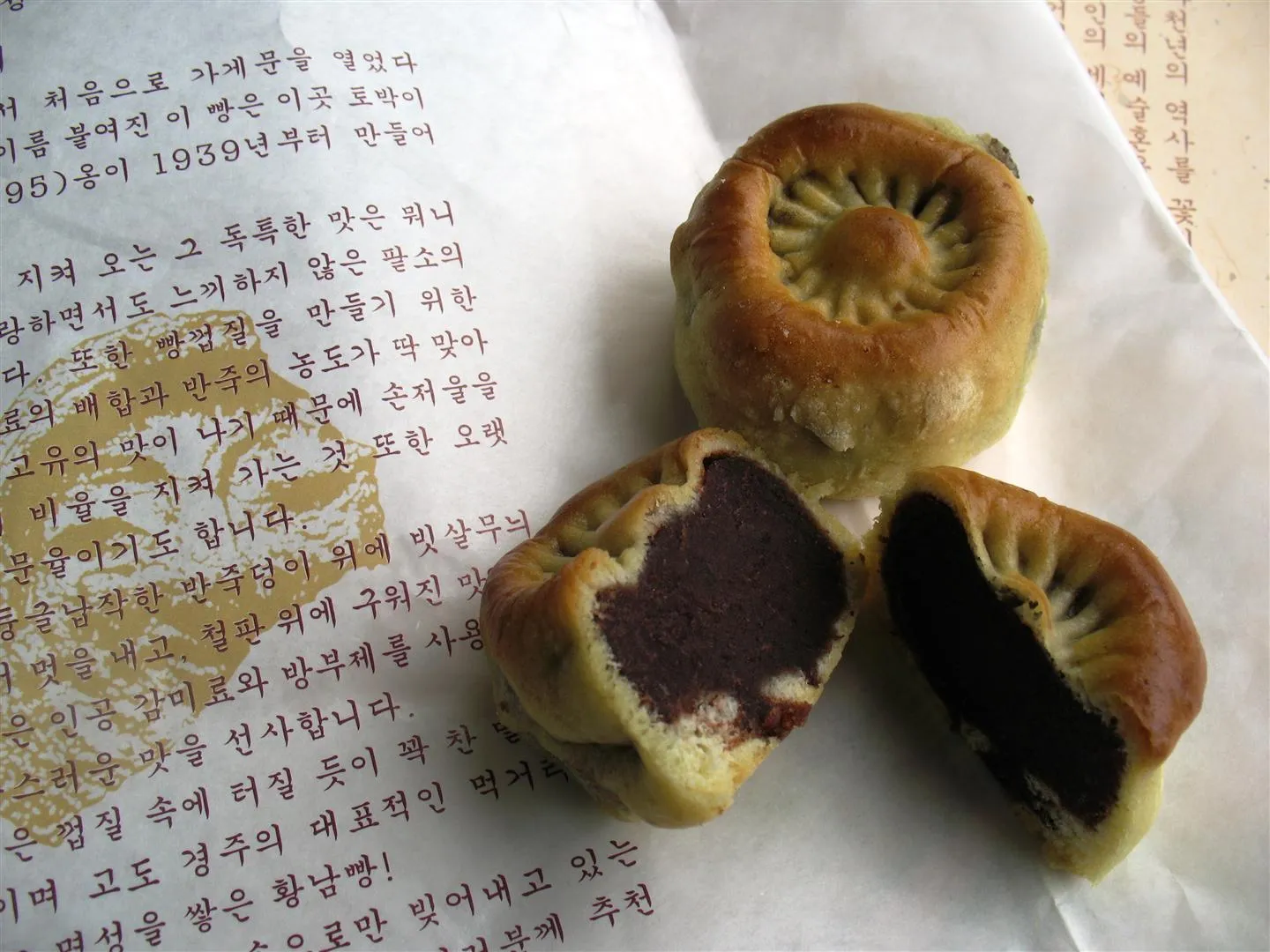
Hwangnambbang (황남빵) is a small round pastry with a very thin skin packed almost solid with red bean paste, stamped on top with a comb pattern borrowed from Silla design. It is closer to a confection than to bread.
It was created in 1939 by Choi Yeong-hwa, then twenty-one years old, in Hwangnam-dong, adapting his family’s red bean rice cake. The city designated it a traditional local food in 1994.
There is one shop in Gyeongju trading under the name, the original at 783 Taejong-ro, open 08:00 to 22:00 every day, about five minutes’ walk from Daereungwon. It is now run by the third and fourth generations of the same family. A box of twenty is ₩28,000 and a box of thirty is ₩42,000, so roughly ₩1,400 a piece.
You will also see other shops selling the same style of pastry. That is not counterfeiting. The founder’s business split among descendants and an apprentice who trained with him from the age of fourteen, and several operations now work from the same technique under different names.
Gyeongju bread and barley bread
These two get confused constantly, and they are not the same thing.
Gyeongju bread (경주빵) is the 1939 pastry sold under another name: unleavened dough, thin skin, domestic red bean. Ten pieces run about ₩12,000, with cinnamon and green tea versions a little more.
Chalbori bread (찰보리빵) is completely different. It is made from local glutinous barley with whole oats, and the texture is chewy and sponge-like rather than thin-skinned, with a lightly sweetened bean filling. The city lists eleven different makers. Twenty pieces run about ₩20,000.
If you only buy one, buy the Hwangnam bread. If you want something less sweet, buy the barley bread.
Two newer novelties have become local fixtures too: daereung bread, a cheese soufflé shaped like a tomb mound, and juryeonggu bread, shaped like the fourteen-sided Silla drinking die found at Wolji.
Ssambap
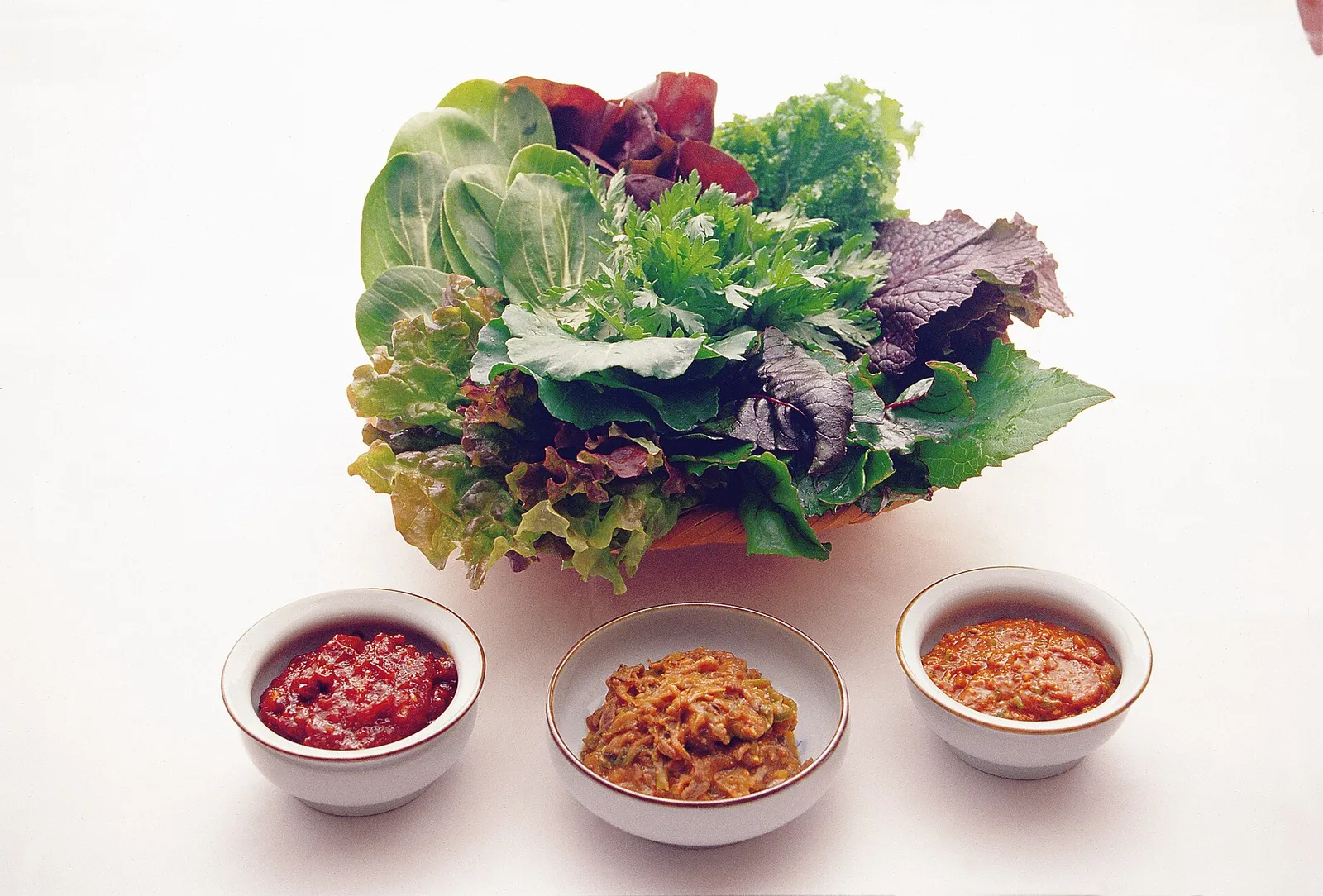
Ssambap (쌈밥) is the standard Gyeongju set meal, and it is the thing to eat if you want one proper sit-down lunch.
A set is built around grilled meat, usually Korean beef short rib patty, stir-fried pork, duck or freshwater snail in soybean paste, served with a tray of organic leaves for wrapping, a soybean stew, and somewhere between ten and twenty side dishes. You wrap the rice, meat and paste in a leaf and eat it in one go.
The city’s own restaurant listing names houses including Neulbom near Bulguksa, open 09:00 to 21:00 and closed Thursdays. Expect roughly ₩16,000 to ₩21,000 a head, though that band comes from restaurant listings rather than published menus.
The Silla soup
Gyeongju’s designated local dish is not what most visitors order, and it is worth knowing about.
Yukgaejang from the six villages (6부촌육개장) is a spicy beef soup built from six ingredients, one for each of the six villages that founded the Silla kingdom: Gyeongju beef brisket, tripe, intestine, dried bracken, a mountain green called gondalbi, and leek. It belongs to the city’s Byeolchaeban brand of revived Silla-era dishes, alongside a gondalbi bibimbap.
Two restaurants carry the official designation, one in Hwangnam-dong on Cheomseong-ro and one out near the KTX station.
Korean beef
The city describes itself as Korea’s largest beef-producing area and runs its own brand, Gyeongju Cheonnyeon Hanwoo. It took the country’s first HACCP certification for cattle rearing in 2007.
The format to look for is the self-service butcher restaurant, where you buy the cut at the counter and pay a small table charge to grill it yourself. There are branches in Bomun, Angang, Oedong and Yonghwang.
Gyodong Beopju
The one to bring home. Gyodong Beopju (교동법주) is an unpasteurised rice wine first brewed roughly 350 years ago by Choi Guk-seon, a court official who retired to Gyochon, and kept as the Choi family’s house liquor ever since.
It was designated a national intangible cultural property in 1986. The first holder of the tradition was Bae Yeong-sin; her son now holds it. It is made from glutinous rice only and it is not heat-treated, which is why it is sold locally rather than nationally.
Buy it at the brewery at 19-21 Gyochon An-gil in Gyochon Village, 09:30 to 18:00, closed Sunday. A 900 ml bottle runs between ₩35,000 and ₩43,500 depending on the packaging.
Do not confuse it with Gyeongju Beopju, a commercial rice wine launched in 1972 that you will find in supermarkets. Different product, different thing entirely.
Where to eat, by area
Hwangnidan-gil (황리단길) is the young street: cafés, desserts, small izakaya, craft shops. Coffee runs about ₩5,000 to ₩7,000 and snacks ₩3,000 to ₩8,000. It is where you go in the late afternoon, not for a serious meal.
Around Daereungwon is the bakery cluster. Hwangnam bread, the barley bread shops and the juryeonggu bread shop are all within a few minutes of each other, along with one of the two official Silla soup restaurants.
Gyochon Village has the brewery, Choi family formal dining and a traditional distillery, all in a small walkable block.
Bomun Lake Resort is resort dining: the Gyeongju beef branch, a brewpub and hotel restaurants. The most expensive zone and the least distinctive.
Practical notes
- Buy bread early. The main Hwangnam shop queues from mid-morning at weekends.
- Ssambap houses close midweek. Several take Thursday or Monday off.
- The bread travels; the wine does not. Gyodong Beopju is unpasteurised and wants refrigeration.
- Hwangnidan-gil is not a dinner district. Eat properly elsewhere and come here after.
- Vegetarians will find ssambap adaptable in principle, but the soybean stew and side dishes usually contain anchovy stock. Ask.
Wrapping up
Eat one ssambap set, buy one box of Hwangnam bread, and if you drink, take a bottle of Gyodong Beopju home. That is the whole Gyeongju food canon in a day, and two thirds of it is protected by the state.
More in this series: the Gyeongju overview, where to stay and what to see.